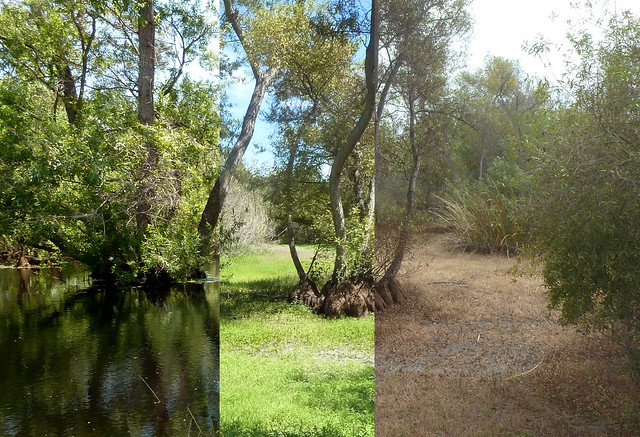
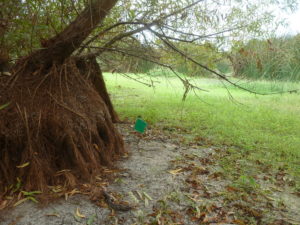
Spring: trees growing out of a pond. Summer: trees with a lot more branches growing out of dry ground with lots of grass.

Finally put together a before-and-after shot!

On the right: May in Madrona Marsh, after winter and spring rains filled up the low-lying areas of the preserve.

On the left: Late August in the same spot, after summer had dried up the pools. Despite the drought, and helped along by a couple of freak summer storms, the ground is still holding onto enough moisture that the floor of the vernal pool is covered with low greenery instead of dry grass.

I know, it’s always better to put “before” on the left, and I tried it with that layout, but it ended up looking better this way.

We’ve been joking about feral tomatoes for years, but recently I’ve started observing them in the wild.

Feral Tomato turning orange

So to speak.

Sometime last spring, a tomato must have been dropped in the planter next to the parking structure near work. One of the seeds sprouted, and that plant somehow survived all the remodeling and landscaping.

Feral Tomato by the parking lot

By June it was growing its own tomatoes. In fact, it was growing more tomatoes than the plants in our garden. Continue reading

Stormwater Pond Reflection

It rained pretty hard last night near home, and clearly it rained hard enough here that mud was flowing over the sidewalks, and the stormwater detention pond still had water at noon.

It’s funny how, four years into the worst drought in ages, we’ve had one of the wettest summers on record. Considering that LA usually gets no rain to speak of during the summer, that’s not saying much, but we’ve had several storms strong enough to cause floods and mudslides in the middle of a drought. We’re all hoping for a wet winter.

On a related note, yes, they’re still watering the lawn too much here. At least there’s a lot less of it than there used to be before the renovation, between the hollow and all the planters full of native and otherwise less-thirsty plants and wood chips behind where I was standing.

Also, ZPizza opened earlier this month, completing the trio of restaurants on the ground floor of the new hotel. More lunch options!

At the end of August I returned to the Madrona Marsh Preserve. It’s a fragment of the seasonal wetlands that used to dot the western edge of the Los Angeles basin, just inland from the coastal hills. These low-lying areas collect water during winter and spring rains, then slowly dry out over the summer, only to fill up and become wetlands again the next year.

On a hike in May I found extensive pools and lots of wading birds. Trees kept some parts shady. Scrub prevailed on the higher ground.

Returning at the end of summer, I found the area near the entrance looked about the same as it had before. As I got closer to the low-lying areas, the scrub seemed to have grown thicker. The pools were gone, but the ground where they’d been was clearly still wetter than the area around it. Plants were greener, and in some places it was still muddy.

There were also fields and fields of wild sunflowers. Most of the places that had been mud flats in spring were now covered with sunflowers. Some areas I’d walked to get closer to the pools were completely blocked. I saw dragonflies, and in a few places I found bushes that were absolutely covered with clumps of foam from some sort of bug.

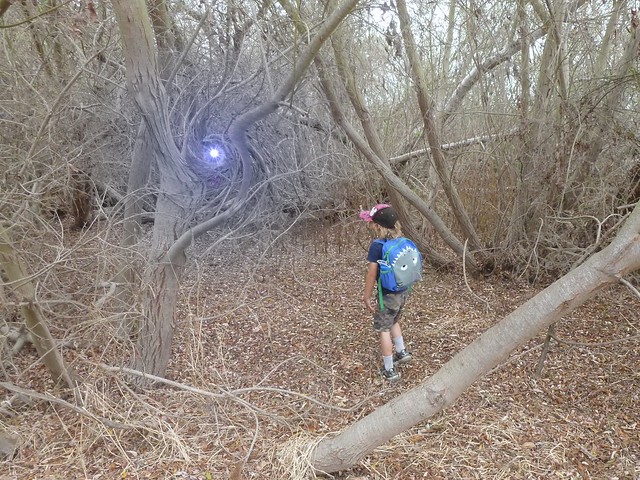
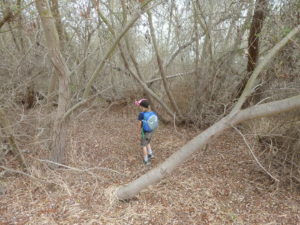
Once I reached the tree-covered area, I walked a trail that had been underwater the last time. It seemed to end abruptly until I realized that a tree limb had snapped and fallen to block the trail. It was still attached about ten feet up.

In the lowest, shadiest part of the preserve, I did find pools that were still wet, and still host to a few wading birds. I wonder if I return in, say, November, will they have dried out as well, or is there a last bastion that stays flooded all year (at least in years with normal rainfall)?

I didn’t recognize the spot at first, or I would have tried to frame it the same way, but I did manage to get shots of the same clump of trees flooded in spring and surrounded by dry land and low plants in summer. It was interesting to see the spreading roots without the water.

You can view the full Spring hike (23 photos) and the full Summer hike (8 photos) on Flickr.

A small cloud shows a spectrum, cut by a contrail that also cuts through part of a circular halo.

I noticed the halo around the sun as soon as I walked out the door for lunch on Thursday. The rainbow cloud? That appeared as I walked past a building. I saw it as soon as the southern sky came into view again.

The colors got more intense over the next few minutes, and I kept taking photos until my phone locked up. I stood there watching the colors intensify, then fade, while I pulled out the battery and waited for the phone to reboot.

A man who’d been sitting nearby, buried in his phone, looked up wondering what I was taking pictures of. He’d never seen anything like it before, and wondered what it was, and fortunately I was able to answer.

At the right angle, ice crystals in a cirrus cloud refract sunlight to produce a feathery rainbow effect. The circumhorizon arc runs parallel to the horizon, and while it can be long, it’s usually only seen in fragments like this. I’ve only seen a few of these myself, and it’s been years since I’ve seen one this intense. I took this photo through my polarized sunglasses, but the colors were bright even without them.

When my phone froze, he offered to send me one of his pictures just in case mine hadn’t actually saved. Fortunately they had, and I actually posted to Flickr several hours before his message made it through the cell network.

Within a few minutes, the cloud had drifted out of alignment, and the colors had faded completely.

An hour later, on the way back from lunch, I noticed a longer patch in a smoother cloud layer, but it was faint enough that I could only barely see it with my sunglasses on. Without them, it faded completely into the glare.

If I’d had my better camera with the zoom lens, I would have gotten some better shots of just the bright cloud. Then again, I wouldn’t have been carrying it with me to lunch, and the effect was gone in the time it would have taken to run back in and get it. So it’s probably just as well I stayed and watched instead.

Funny thing: I posted a cropped view on on Instagram featuring just the arc fragment and contrail. When I went back to look at the #rainbowcloud tag last night, I found no less than SIX other photos of what was clearly the same cloud at various points in its five-minute lifetime!

»All pages site-wide with this tag