Usually when I get an envelope labeled “Important information about your account” it turns out to be a set of balance transfer checks, sent hoping I’ll use them to put more money on my credit card. It’s about my account, sure, but neither important nor information.

This one takes the cake, though:

Important information about your account!  (Just kidding.)

It claims to be “Important information about your Verizon Internet service,” implying…but carefully not actually claiming that it’s from Verizon. It turns out to be an ad for Time Warner Cable. I suppose it is information, since it does tell you about TWC’s service, but it doesn’t actually say anything about Verizon’s service…and it certainly doesn’t say anything about my service plan, which it does claim to be about.

The fact that it’s addressed to “Current Resident” makes me wonder whether they would have sent me the same mailing even if I had their service.

There’s an old children’s joke that goes like this:

“Did you know the word gullible isn’t in the dictionary?”

Then when the other child goes to look it up, you laugh at them for believing you.

On the face of it, it’s a lesson in not believing everything you hear.

But when it comes down to it, the child who goes to look it up isn’t necessarily being gullible; he or she is doing research to confirm their expectations. Yes, gullible should be in there, but let’s make sure. Once you’ve seen a number of dictionaries that all have gullible in them, you can safely ignore the next person who claims that it’s missing, and insist that they put up their evidence.

That’s science.

The child who says, “Really?” and then goes around repeating it? He’s the one who needs a lesson in skepticism.

So the next time someone sends along a bizarre “fact,” especially one intended to spur you to action…dig a little deeper. Sometimes all it takes is two minutes of fact checking to save your credibility. You don’t want to get known as the guy who really did think gullible wasn’t in the dictionary…over and over and over again.

It's gloomy. The sky and sea are almost the same shade of gray. Looking along a steep cliffside toward a rock outcropping. It's high, maybe ten times as high as the low building perched on top of it, and grooves show dozens of layers stacked from the sea below to a bit below the top.

The Palos Verdes peninsula sits at the southwest corner of Los Angeles. Parts of it are built up in old, grid-style suburbs. Other parts are of the more modern, winding type. And still other parts remain open space, due in part to the unstable geology of the area. Parts of Portuguese Bend are sliding toward the ocean, requiring frequent repairs of the main road along the coast. Way back in 1929, a housing development began sliding into the ocean. Abandoned now, the area remaining above land is known as the sunken city.

Adjacent to those ruins is Point Fermin Park, an ordinary city park that sits atop the cliffs. The Point Fermin Lighthouse (previously featured here) looks over the sea, and a fenced walkway runs along the length of the cliffs.

Looking out here, you can see the layers of rock, and understand how parts of the point could just slide away. The warning signs on the fence don’t surprise me, but I have to wonder just who would want to climb out there.

Photo challenge (WordPress): Layers

Last night I had to do some late-night laundry, and when I went in to move clothes from the washer to the dryer, I noticed water on the floor. My first thought: Great, the washing machine’s busted. On opening it, though, it looked like it had at least drained fine. So I checked the closet for the water heater.

Bingo: A fine jet of water spraying out the side of one of the pipes.

So I got out some duct tape, figuring it could block the leak for a few hours, and notified the landlord so he could call a plumber.

It was dripping again by the time I finished writing the text. Maybe it would have worked if I’d been able to shut off the water to that pipe before putting the tape on, but my plumbing expertise is…rather limited. I didn’t want to mess things up any more than I had to.

But I did know that you don’t want water puddling on your floor, even if it’s a concrete laundry room floor, so I put a container down to catch the drips (now that it was only drips). It was full by the time I came back for the clothes.

Then I noticed the wall vent near the damaged pipe. There was a small hole in the screen to allow an overflow pipe to run outside, and it was a few inches below the bottom of the pipe that the hot water was trickling down.

Lightbulb moment: Cut a Pringles can in half and make a trough to channel the water out through the vent and into the planter outside.

Problem: I don’t think I’ve bought a can of Pringles in over a decade.

Solution: A paper towel roll lined with foil.

I actually ended up using several toilet paper rolls taped together end to end, but it worked: The spit-and-baling-wire contraption diverted the water outside, keeping it from flooding any worse until the plumber arrived.

Yeah, it’s best to fix something right. But sometimes you need to patch it now and fix it right later.

Trickling Out

Hotel bedsManeuvering around toys on the living room after four days by myself in a hotel got me thinking about clutter. Traveling forces you to pare down your belongings for the duration of the trip. What fits in the suitcase. What’s easy to pack up again (if you’re going to more than one place). But it’s really an illusion enabled by two things:

  1. At the end of the trip, you go back to your life. Anything you leave behind is merely deferred, not eliminated. Which is good, because even if you have extra stuff, you probably don’t want to be reduced all the way to a suitcase for real.
  2. The travel economy enables you to skip a lot of things that you’d otherwise need supplies (and time) for: cooking, cleaning, repairs, etc.

Yeah, it feels like you’re simplifying your living situation for a few days…but that’s because you’re paying for someone else to do all the maintenance work.

I started writing this on an airplane about to take off. In the time between my outbound flight and return trip, United took advantage of new FCC rules to draft a new policy allowing passengers to continue using (if I can remember the phrasing) “lightweight personal electronic devices set in non-transmit mode.”

I did have to stop as a matter of practicality during the takeoff itself, and being in a window seat I spent a lot of the next few minutes staring out the window.

Something I found interesting on the way up is how similar open space and water look at night from far enough up when you’re near a city, especially if the city just stops…especially at a natural boundary like a range of hills. In both cases you have a brightly lit region next to completely dark area. It’s only when you can identify patterns like docks, or roads through the empty space, or occasional lighted areas (though they could be boats) that you can really tell.

If you’re low enough, you can sometimes see the reflections of lights in the water. That made for an interesting illusion on the flight in. I’m not sure which bridge it was across the San Francisco bay, but it’s lit by regularly spaced white lights underneath the roadway. For some reason it looked like the lights were moving along the bridge as I flew past it, like the pulses in  a Mac progress bar.

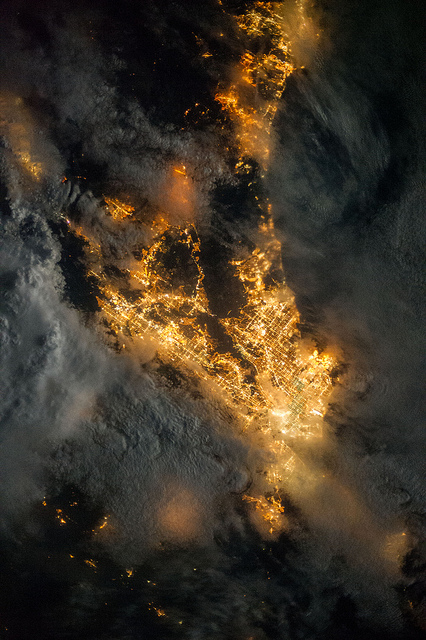
Something else that struck me: most areas along the California coast, seen at night, appear as darkness with islands of light. Greater Los Angeles is light with islands of darkness.

No wonder I can hardly see any stars these days.

»All pages site-wide with this tag