
The delayed PowerBook has shipped, and is scheduled to arrive on Tuesday!
Woo hoo!
The delayed PowerBook has shipped, and is scheduled to arrive on Tuesday!
Woo hoo!
A long-standing challenge for advocates of Free and Open Source Software (a.k.a. FOSS) has been explaining just what the term Free Software means, because in English,* the word “free” has several unrelated meanings. The classic explanation has been to compare “free speech” and “free beer.”
You see, when the average person hears the phrase “free software,” they generally assume it means the same kind of thing as “free beer.” But it’s really about the software being unencumbered – it’s about your ability to use, study, learn from, and improve the software. It’s not about the price tag.
The problem with the “free speech” label is that the phrase has its own very specific meaning and political overtones. As a result, people tend to focus on the ideas inherent in freedom of speech, dealing with software as a form of expression and focusing on issues like censorship. These are valid issues, but not the heart of what “free software” means.
Today I read a post on Groklaw describing it in terms of “free as in coffee” vs. “free as in liberty” – primarily because he didn’t like the association with beer – but I liked the use of liberty (edit: or just freedom if you want to keep the phrasing consistent) rather than speech, because it conveys the meaning without bringing in other issues.
(Ironically, the FSF page explaining the phrase links to a list of confusing words and phrases that are worth avoiding… that doesn’t include “free!” Update: These days it lists “for free,” “freely available” and “freeware”…but that still doesn’t solve the confusion of “free.”)
*In other languages, the meanings are more distinct. There’s no confusion between software libre and software gratis.
It looks like it wasn’t quite the perfect time I thought to order a PowerBook. I received confirmation today from TerraSoft that the delay is due to the changes in the PowerBook line (which were half the reason I chose now to order it). It seems they’re still waiting for a shipment from Apple!
Presumably they had some in stock when they updated their store, in which case this is probably a good thing: it means not only are the new PowerBooks selling faster than expected, but they’re selling well through a Linux shop!
That said, if I have to wait too long I may just cancel this order and drive down to the Apple store. Of course, then I’d have to deal with repartitioning and trying to set up dual booting myself, and not only is it more complicated than dual-booting a PC*, there’s a lot less information available.
Ah, well.
* In particular, I don’t know of any utilities like Partition Magic or Parted that will allow you to resize an active Mac OS filesystem, so I would have to wipe the disk and reinstall Mac OS along with installing Linux.
I just received spam advertising a book about fascism. It’s not your typical spam — it just looks like the introduction to a book, placed in email and sent — unsolicited of course — to random people around the net. It was fairly well written and not obfuscated, so it didn’t trigger much in the way of spam filters. (The great irony is that by misspelling and breaking up words to get past filters, spammers are making it easier for people to spot, making themselves look horribly unprofessional — would you really trust the product from someone selling “druuugs?” — and creating new, definite spam signs. When you see 10 drug names all misspelled with strange symbols, you know it’s either a spammer or a 14-year-old IRC junkie trying to be L337.)
They even made the effort to include a full plain-text equivalent alongside the HTML version, for the benefit of people who don’t trust or can’t read HTML mail.
And that brings me to the funny part, this statement from the plain-text version:
If your e-mail software does not support html, please click here.
Two problems: aside from violating W3C QA guidelines on link text, it makes no sense, because there’s nothing to click on!
They tried. They really tried. But they forgot to ask whether I actually wanted to be on their mailing list. (Oh, and the “click here” thing was funny.)
Last night’s mutual cyber-binge after only two days away from the keyboard was the kicker: If we’re going anywhere for two weeks, we’ll want to bring a computer along.
And so tonight I finally ordered a dual-boot PowerBook from TerraSoft. We’re splitting the cost as a combined wedding and belated/early birthday present to each other.
Sometime this weekend, we’ll have a new computer in the house!
I am now the proud owner of a Mozilla Coffee Mug!
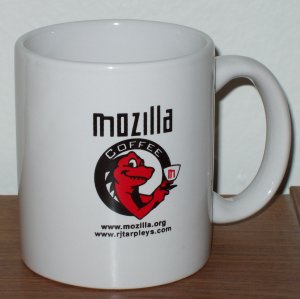
When I went to order a new batch of Mozilla Coffee, I saw that RJ Tarpley’s is now offering mugs with their logo. Something about it just screamed “Buy me! Buy me!” – something in the combination of “Mozilla” and the lizard’s expression as he holds up his coffee mug, all of it appearing on a coffee mug…
(Ironically, I’m posting this using Konqueror.)
Sometime early last year I decided I’d like to get a PowerBook. Ideally, one dual-booting Mac OS and Linux. I spent several months saying “I don’t really need a laptop,” but I really started to like the idea after a while, and Katie started to like the idea too, and this January I went so far as to contact TerraSoft Solutions about pricing. TerraSoft maintains their own PPC Linux distribution, Yellow Dog Linux, and their stock in trade is selling Macs preconfigured to dual-boot Mac OS and Linux.
I decided not to buy one then for two reasons: We had the wedding coming up, and I figured Apple was likely to upgrade the line by summer.
Well, the wedding is next weekend, and Apple has just announced upgrades to the PowerBook line.
It may be time to start looking at PowerBooks again.