Red Planet BluesSorry I don’t have a new article on Reading Les Misérables this week. I took a break to read Robert J. Sawyer’s latest novel, Red Planet Blues. It’s a detective noir story set on a future Martian colony where people have perfected the art of transferring human minds into robot bodies. It’s expensive, but it also makes modern fingerprint, DNA and other biometric forensics useless, forcing investigators to fall back on good old-fashioned sleuthing. The colony itself is essentially a gold rush town, only instead of gold, people have gone to Mars seeking fossils of long-extinct Martian life.

Sawyer read an excerpt from the novel during his author spotlight at Chicon 7 last summer. It sounded like great fun, and it lives up to its promise.

Unless I get totally swamped, I should be back to Victor Hugo next week…well…probably. There’s a new Julie Czerneda book out, and I’m really tempted to read that now that I know it’s out. I don’t want to lose too much momentum on Les Mis, though.

App icons for Kobo, Kindle, Play Books and ComiXology

While reading about Amazon’s purchase of GoodReads, I noticed a link to an article about e-book discovery that points out that a lot of people tend to explore multiple e-book stores. As someone who has done that, I’d like to comment on my experience.

Classic Kindle

I didn’t really start reading ebooks until I had a device I could use. I don’t like reading fiction on a desktop or laptop computer, and I don’t like reading it on a tiny phone. A couple of years back, Katie bought a Kindle 2, which is just about perfect for the base use case of reading a book from start to finish (though it’s a pain for much of anything else — I imagine the touch screen on the Paperwhite line is a huge improvement). My first serious eBook reading was on that dedicated device, which is linked to her account.

Tablet: Branching Out

Since I bought a general-purpose tablet last summer, I’ve branched out a bit. I picked up a few books on Google Play because they gave me some store credit when I bought the Nexus 7. At the time, a local independent bookstore that I like, Mysterious Galaxy, had a deal with Google where they could get a cut of what I spent.

I bought other books on the Kindle store, sometimes because of price or special deals, sometimes because of selection. Sometimes I’d even deliberately choose Amazon because the site where I learned about the book had an affiliate link, and I knew I’d be helping to support them. Mostly, I just like the Kindle reader app better.

At the start of the year, Google Play ended their deal with IndieBound. The new choice for independent bookstores seems to be Kobo. I’ve bought a few books from there after linking my account with Mysterious Galaxy, but I still don’t like the reader app much, and the service just seems…well…pushy. I’ve had to turn off a lot of “features” in the app. I don’t want or need recommendations in my status bar, thank you very much. And I sure as heck don’t need “accomplishments” to encourage me to read more. You know what encourages me to read more? Having time to read.

Fractured Library

The result is that between the two of us, we’ve got a small library of eBooks spread across two Kindle accounts, Google Play and Kobo…on two mutually exclusive devices. (And that’s not counting the reference books I’ve bought from O’Reilly and saved to Dropbox.)

OK, so it’s not a huge deal now, but as we buy more eBooks, it’s going to get harder to remember which book is on which account when trying to look something up or reread. We already have to discuss how to buy books that we’re both interested in reading.

I like having multiple sources to choose from. Selection, price, being able to support a third party, these are all things that you don’t necessarily get with a fully-siloed approach. But with the way eBooks are handled right now, it does add barriers to finding things.

I would prefer the way digital music purchases work: I can buy from anywhere, download a DRM-free file, and then put everything in one place. It doesn’t matter whether I bought the music from iTunes, Amazon, directly from the artist, or imported it from a CD. There’s no question of where to go when I want to listen to it. (Well, until they switch to an all-cloud-storage model, anyway. The cynical part of my brain wonders if this is the real goal behind that trend.)

On the plus side, since the libraries are searchable, and three of them are linked to the same device, it’s actually an improvement over the years we were living in a too-small apartment with 90% of our books in storage, and it was a question of finding which box they were in.

Audio Cassette

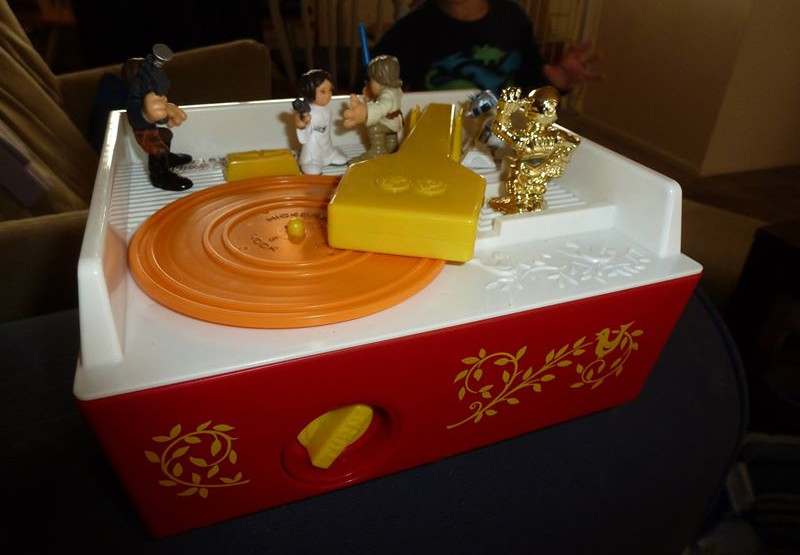
With all the Les Miserables reading and listening I’ve been doing lately, I decided to dig out an old mix tape of excerpts from Forbidden Broadway. It’s been years since I’ve actually listened to an audio cassette. Most of my music collection was on CDs to begin with, the iPod and my phone have long-since replaced the tapes I kept in the car, and playlists with shuffle have replaced mix tapes.

My two-year old, on seeing it, immediately asked, “What is this?” I tried to explain it was a way they used to record music before CDs, that it has a roll of tape inside, more like a measuring tape than sticky tape, that you have to be careful not to touch the edge (which he promptly did — hooray for leaders). Then I tried to demonstrate how the tape rolled from one side to the other, using the time-honored method of sticking a pencil in and turning it quickly.

And I couldn’t find a pencil.

More accurately, I couldn’t find a hexagonal wooden pencil. A mechanical pencil, sure. A bunch of pens. Some round wooden pencils. But nothing that would actually fit inside the capstan and turn it.

Demo of old technology defeated by…a lack of another old technology!

Defeated, I put the cassette in the tape deck on the stereo and played it. It sounded hollow and distant, with too much noise to actually listen to it. Some media age better than others. I’d bet the CDs I recorded it from (wherever they ended up) still play just fine. I wouldn’t be surprised to find my parents’ vinyl albums still play as well as they did twenty years ago, as long as they’re clean.

It makes me wonder what state the rest of my tapes, both audio and VHS, are in. I was planning to try to sell some of the pre-recorded VHS tapes if I could find someone who wants them, but now I wonder if I should play them first or just send them to e-waste.

I’ve been meaning to take a picture of this restaurant ever since I saw it from the IKEA parking lot across the street. I finally did, and also finally went there for lunch. It’s pretty good. They sell T-shirts that play even more on the name.

Anyway, the next time someone tells you “There’s No Pho King Way!” you can tell them that yes, there is, in Carson, California.

Yesterday I looked at the moon and Jupiter and thought, there’s going to be another conjunction tomorrow, isn’t there? Then I forgot, but fortunately I had to make a grocery run and looked up.

For this second shot, I zoomed out and let it overexpose the moon so I could get the bright star Aldebaran in the photo as well. It was a bit easier than the really good one in January, because the crescent moon isn’t as bright (less area shining at us), so it didn’t overwhelm the stars and planet quite so thoroughly.

As I post this, it’s been about half an hour, so if you’re in the western half of North America and the sky is clear, you can walk outside RIGHT NOW and see this!

Yesterday, my phone suddenly started downloading something called “Facebook build (somethingorother).” It didn’t show any progress, wouldn’t go away, and I worried that maybe it was a piece of malware or something buggy. A quick search turned up nothing. A later search found other people asking what this was. Late last night, there were articles about “Hey, why is Facebook updating itself!”

It turns out that yes, Facebook is now downloading its own updates on Android phones and tablets instead of just pushing them out through the relevant app stores (Google Play and Amazon, mainly). I’m sure they thought it was a great idea — web browsers like Firefox and Chrome have been doing this for several years on the desktop.

The problem is that it violates expectations of what the app will do, and where your software is coming from.

Imagine your car’s manufacturer issues a recall. Now imagine three scenarios:

Scenario 1: You receive a notice of the recall, asking you to make an appointment to bring the car in for maintenance. (For those of you who don’t drive, this is how it normally works.)

Scenario 2: You receive a notice offering to send a technician out to do the repairs at your home or workplace. (This would be awesome, but impractical.)

Scenario 3: You’re sitting in the living room when you hear a noise from the garage. You go out to investigate and find someone messing with your car.

That’s what this feels like.

It’s one thing to offer software through third-party channels. The fact that it’s possible is one of the reasons I prefer Android to iOS. In that case, notifying me of updates, maybe even simplifying the download would be very convenient — if I know ahead of time that it’s going to happen. And if they’re not switching channels on me. A download coming from some new location, but claiming to be a familiar piece of software, and a notice telling you to install it? That’s how trojans work.

In short, it’s a violation of trust…and if there’s one thing we’ve learned about Facebook over the last few years, it’s that the social network has enough problems with trust.