OK, it’s not quite as confusing as having, say, a First Street and a First Avenue in the same city, but sometimes you have to wonder what went through the mind of the city planner who approved certain street names.
OK, it’s not quite as confusing as having, say, a First Street and a First Avenue in the same city, but sometimes you have to wonder what went through the mind of the city planner who approved certain street names.
Apparently the movie industry is trying to come up with an ad campaign to get people back into theaters. The LA Times doesn’t seem to take the idea terribly seriously, as they’ve suggested the slogan, “Movies: Just like DVDs, but Larger.” Meanwhile, theaters and studios are blaming each other for the decline in attendance:
Theater owners blamed Hollywood for making inferior (and overly long) movies, studios worried that theaters were turning the multiplex (with its barrage of pre-show commercials) into as much of an ordeal as an escape.
How do you figure out who’s right? Oh, wait, that’s easy: Both of them.
Make better movies, and more people will brave the long lines, high prices, 20 minutes of annoying big-screen commercials, 15 minutes of previews for movies that aren’t terribly interesting, people yakking on cell phones, people narrating the entire @%!# movie for their friends 30 seconds ahead of the action, etc.
Clean up the theater experience, and people will be willing to go for movies that look kinda interesting instead of really interesting.
It’s not just the big screen and immersive sound. Watching Serenity at home lacked the intensity of watching it in a theater full of fans (even the second time, when we knew what to expect). Neither canned laughter nor a studio audience can compare to dozens or hundreds of people laughing together in the same room. And it’s hard to match the collective “Oh, $#!7” that swept the theater in each showing of Return of the King when Shelob showed up again after Frodo thought he had escaped. The communal experience strikes a chord that you just can’t reach with a couple of people and a TV set.
People who talk through the entire movie aren’t just distracting you from the movie, they’re interfering with that communal experience. There’s only so much theater staff can do, short of kicking people out, but at least we know in the future they’ll get to inhabit a special level of Hell. 😈
DC has announced their comics for June, and I’m really looking forward to three books.
 First, they finally announced a release date for the re-launch of The Flash: The Fastest Man Alive. It was getting to the point where I was in more suspense over when they’d launch it than who was going to be wearing the mask. And at least we know that Wally and Bart are “not dead” (in the words of Infinite Crisis writer Geoff Johns), though that doesn’t necessarily imply we’ll see them anytime soon. Now I only have to worry about who’s going to be “the” Flash, and whether the new book will be any good.
 Almost as good was the surprise return of Michael Moorcock & Walter Simonson’s Elric: The Making of a Sorcerer. They got half-way through this mini-series in 2004, and issue #3 just never appeared. It looks like they’re finally going to finish it. Which reminds me, I should look for the final book in the Elric/Von Bek trilogy and see if it’s in paperback.
And then there was the real surprise: An issue of Solo by Sergio Aragonés and Mark Evanier. (Shouldn’t that be Duet?) Need I say more?
Also interesting: Astro City: Samaritan and Fables #50.
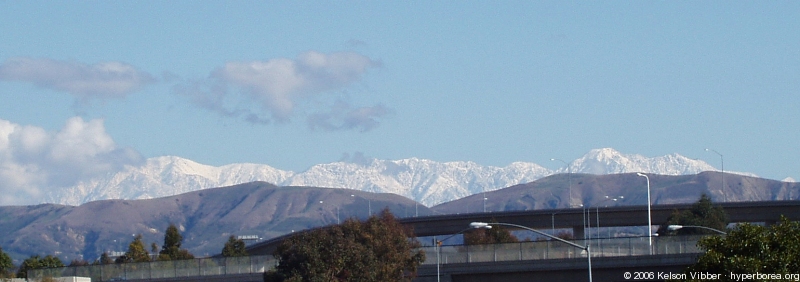
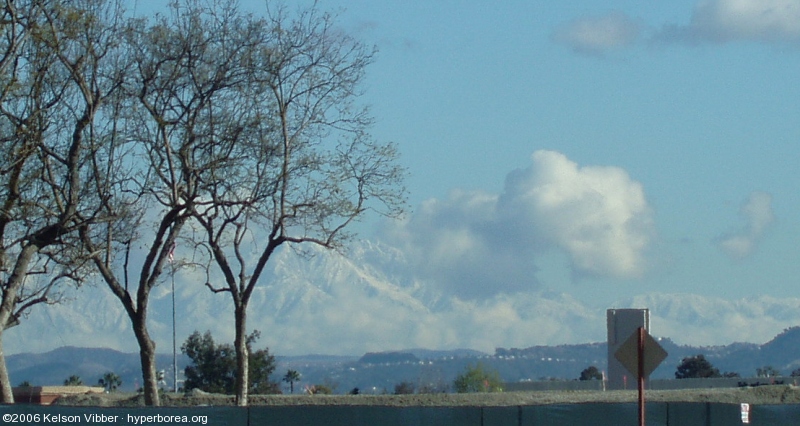
We don’t get snow here in the middle of Orange County (heck, this is the first time I’ve seen hail here in at least a decade), but we do get to see it from a distance. Mostly off in the San Gabriel Mountains to the north and northeast. While stopped at an intersection this morning, I caught a glimpse of the snow-covered range rising out of the clouds in the distance. Unfortunately this is the best shot I could manage on short notice:
Add this to the list of jobs I don’t want: Dancing Statue of Liberty mascot.

This poor guy was dancing around in front of a tax preparer’s office last weekend. Faces have been blurred to protect the innocent.
Update January 2009: Someone hit this post after searching for “dancing tax preparer.” Is it really that common?
Feel free to add to the list in the comments!
It’s been almost two weeks since hotel reservations for the San Diego Comic Con went on sale and sold out in a matter of hours.
The crunch is amazing. Last year, San Diego’s public transportation system dissolved under the combined assault of 100,000+ Comic Con attendees and a weekend of Padres games. Two years ago, the first year we stayed in town instead of just driving down for Saturday, we booked so late that we were stuck with the Super 8. Just for kicks, I checked the prices there. A room for this coming weekend would cost half what we paid per night on Comic Con weekend in 2004. And their prices during the con this year? I can’t tell, because they’re already sold out.
This morning, Travel Planners (the company handling reservations for the convention) sent out an email to people who had reserved hotel rooms through their service. After assuring me that my reservation was fine, they went on to ask:
In the meantime, we have a favor to ask of you. Please take a minute to reassess the number of rooms that you’ve booked and help your fellow attendees and exhibitors by canceling any rooms that you are not absolutely certain you’ll need.
Like you, we’re all thrilled that Comic Con is growing by leaps and bounds every year, but with each new show it gets more and more difficult to find enough hotel rooms to accommodate so many visitors. Accordingly, every hotel room becomes an integral part of the show’s success.
It’s not uncommon for people to grab multiple rooms just in case more people come, or to keep their options open (say, reserving both an expensive hotel downtown and a less expensive one further out, then cancelling one once they’ve made a decision). I’m astonished that it’s come to the agency pleading with people to let others have a chance at the rooms now, instead of waiting until just before the hotels start charging for cancellations.
On a related note, now’s as good a time to any to link to some recommendations for anyone planning to attend Comic Con: