The Station Fire burning through the Angeles National Forest north of Los Angeles is expected to reach the summit of Mt. Wilson sometime tonight. In all likelihood it will damage or destroy the communications towers and the observatory complex. The Mount Wilson Observatory is an active observatory, and is also of historical importance because of discoveries made there over its 105-year history. In particular: Edwin Hubble’s* observations with the 100-inch Hooker telescope (shown at right) indicated that universe is much larger than was previously thought, and that it was expanding — observations that revolutionized astronomy and led to the current Big Bang theory.

People listening to a talk, lots of pictures of the sun printed out on the wall.I’ve been to the observatory once, on a tour my family took on August 8, 1992. We’d just come back from a trip to Florida where we visited Disney World and Cape Canaveral during the summer I was 16. I really wish I could remember more about the trip…but I took pictures and labeled them (though not in much detail). With the observatory threatened, I thought I’d dig them out and scan them**. You can see all eight on my Mt. Wilson Observatory Tour 1992 photoset on Flickr.

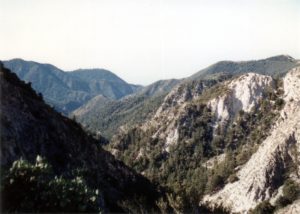
Forested mountain valley with a hazy white sky.The Observatory’s website is apparently hosted on the grounds, so the fact that its fire status page is still responding indicates it’s still there and has power. The latest update says that they’re setting up a backup info page, but it’s showing a 404 error right now.

*As in the Hubble Space Telescope.

**Scanning them was not a problem. Digging them out? That was a problem. I knew exactly which photo album they were in, and thought I knew where the album was. As it turned out, it wasn’t there. It was in an unopened box shoved at the very back of the long,narrow hall closet, such that I had to move 3 other boxes, several bags, and an unused CD rack just to see that it was labeled “photo albums” on top. Edit: And, oh yeah, the trail of ants along the wall, going after the long-forgotten bag of Halloween candy. The wall I kept brushing up against. How did I forget that part?

That’s the missing piece that makes the classic phrase more than a simple tautology. It’s not just that it’s in the last place you look. It’s that it’s in the last place you want to look.

This was a fun panel with representatives from Eureka!, Caprica/Battlestar Galactica, and Fringe, moderated by Phil Plait of Bad Astronomy.
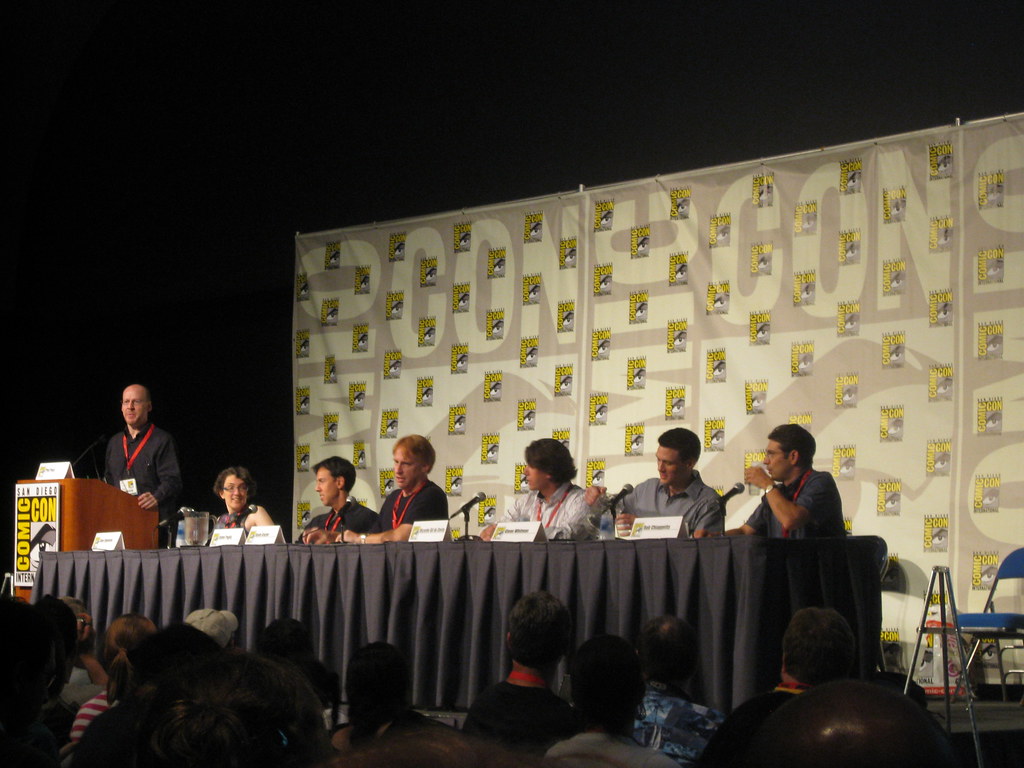
Some interesting moments:

After they talked about the ethics of interrogating a corpse, one of the guys from Fringe (I think Rob Chiappette) remarked that he wanted to see a Law & Order: Fringe show. I think I’d watch that!

One of the reps from Eureka revealed that they’d planned an episode that would take the Attack of the Killer Tomatoes concept and play it seriously, but it didn’t make it. Jamie Paglia said “It’s so good we didn’t do that episode.” Either Glenn Whitmann or Rob Chiappetta remarked immediately, “You’ll see it on Fringe!”

Phil Plait asked why there wasn’t more astronomy on Fringe, and Glenn Whitmann explained it was because it was a horror show, and it’s easier to creep people out with biology & neurology than astrophysics.

A fan asked the panelists whether they had ever done something dangerous on their show that made them worry about people trying the experiments at home (“Don’t try this at home, kids!”) For the most part they figured the level of technology, gadgetry and genius that their characters had made things impractical to imitate, though Rob Chiappetta added, “If you see Walter [Bishop] do something on screen, don’t do it!”

Another audience member mentioned that he worked in robotics, and was concerned about the way robots were portrayed as good or evil. If too many robots were portrayed evil, he might lose funding… Jane Espenson explained that “Killer robots are a lot more fun to watch.”

And of course Phil Plait plugged his book, Death from the Skies! “I love having a microphone!”

Photos will be on my Flickr account later tonight, once they trickle through the incredibly-slow hotel wifi. Update: They’re up! The trick was apparently waiting until 6am when no one else was using the wifi.

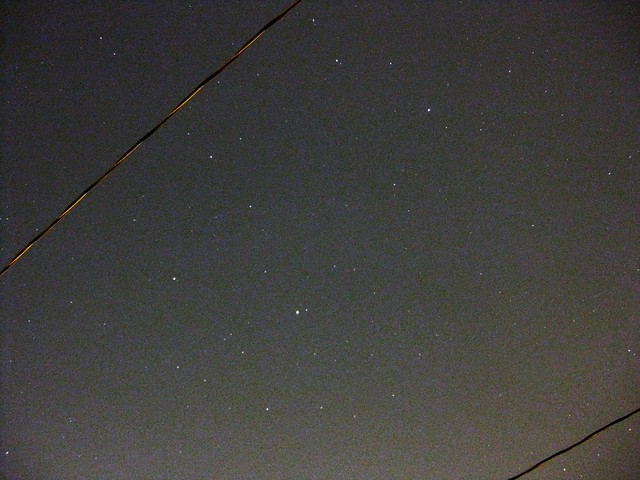
I figured I’d try spotting Comet Lulin from my back yard. I found Leo and Saturn easily enough, but just couldn’t see anything that looked like a comet. It should be a little to the right of Saturn, going by Sky & Telescope’s chart.

Too much light pollution, I guess. And unlike the Bad Astronomer, I didn’t have any binoculars to try a closer look.

On the plus side, I did spot a meteor out of the corner of my eye, off to the left of this field.

Figuring the camera might pick up something I missed, I took a few long exposure shots, running 15 seconds with the equivalent of ISO 1600. There’s a dot next to Saturn, but I’m not sure if it’s the comet or a star.

I’ll have to try again in San Simeon. Light should be much less of a problem, though clouds might be an issue.

Listening to “Into the West” (end credits song from Lord of the Rings: Return of the King). Lyric, “Across the sea a pale moon rises.”

It’s all about crossing the sea into the west to go to elf heaven. Presumably the speaker is standing at the Grey Havens, waiting for the ships to arrive and carry her off to the Undying Lands, looking across the sea…to the west.

So since when does the moon rise in the west?

Admittedly, it’s a fantasy setting, but Middle Earth is set up to be a mythical past for the real world, so I’m fairly certain the sun and moon still rise in the east…

I remember being bowled over when astronomers first detected planets around other stars. Now they’ve actually managed to get pictures!

Of course, they’re about as detailed as pictures of the stars at a science-fiction convention panel taken from the back of the room, or the band on stage from the upper-top-fifth-tier seating (see! that dot there is so-and-so!), but still…it’s a start.

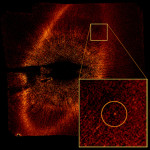
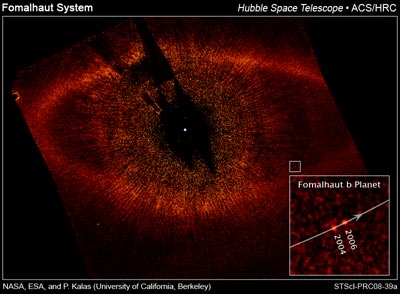
There’s one photo from Hubble of the planetary debris disc around Fomalhaut, with a little dot that apparently has been tracked in other images, consistent with being in orbit around the star. It’s estimated at being about the size of Jupiter and about four times as far out from its star as Neptune is from the sun.

Meanwhile: consider that we can see something the size of Jupiter even though it’s 25 light years away!

Then there’s one from the Gemini North telescope that has actually caught two planets in orbit around a star called HR 8799 — a photo of a planetary system!

Update: Hubblesite has more on Fomalhaut including this image showing Fomalhaut B’s location in 2004 and 2006:

ยปAll pages site-wide with this tag