
I woke up this morning to the music from Episode III playing on the clock radio. What’s odd is that I recognized it immediately despite the facts that I had not listened to the soundtrack, and the section I heard was all new music. None of the recurring themes from the other films was present, and yet it was unmistakably not only John Williams, but Star Wars. I let it run just to be sure, waiting for a familiar theme or the announcer’s voice (can you call someone on a classical station a DJ?), and sure enough they identified it as “the title theme from Star Wars: Revenge of the Sith.”
Tag: Science Fiction
If you’re not with me…
Regarding the furor over Revenge of the Sith/Post-9/11 parallels: Get over yourselves.
You know, I could see parallels in Star Wars: Episode II and post-9/11 America. Palpatine’s emergency powers = PATRIOT Act. Militarization in response to the separatist movement = attacking Afghanistan and rattling sabers at Iraq. And there are conspiracy theorists who think that Bush arranged for 9/11 to generate an excuse for a power grab—just as Palpatine/Sidious manufactured his crisis by having Dooku/Tyranus arrange for the clone army under the name of a dead Jedi, then wait for the appropriate time to start fomenting a rebellion. But you know what, Episode II was filmed before 9/11, so Lucas couldn’t possibly have intended all that as commentary on the War on Terror any more than JMS could have been commenting on the same subject with the Nightwatch arc on Babylon 5.
So now, with Episode III, sure, he could mean it as commentary. And he admits seeing parallels. Note: seeing, not writing. But he states that the story grew out of looking at historical democracies’ descent into dictatorship (Los Angeles Times this morning):
Lucas began researching how democracies can turn into dictatorships with full consent of the electorate.
In ancient Rome, “why did the senate, after killing Caesar, turn around and give the government to his nephew?” Lucas said. “Why did France, after they got rid of the king and that whole system, turn around and give it to Napoleon? It’s the same thing with Germany and Hitler.
“You sort of see these recurring themes where a democracy turns itself into a dictatorship, and it always seems to happen kind of in the same way, with the same kinds of issues, and threats from the outside, needing more control. A democratic body, a senate, not being able to function properly because everybody’s squabbling, there’s corruption.”
That’s the model he’s been basing the transformation on. The prologue in the original 1976 novelization of Star Wars refers to the Republic “rotting from within” and describes Palpatine’s rise to power:
Aided and abetted by restless, power-hungry individuals within the government, and the massive organs of commerce, the ambitious Senator Palpatine caused himself to be elected President of the Republic. He promised to reunite the disaffected among the people and to restore the remembered glory of the Republic.
Lucas originally described Palpatine as becoming a figurehead Emperor, with the Imperial governors behind the Empire’s “reign of terror” (note the French Revolution reference there), but had clearly changed his mind by the time he wrote Return of the Jedi. But the description of how Palpatine gets into power tracks exactly with what we’ve seen him do in the actual films. In fact, throughout the prequel trilogy he uses the same strategy in each film. He creates a crisis as Darth Sidious (the invasion of Naboo, or the Separatist movement), then offers to solve it as Palpatine—as long as people will give him the power to do so.
In other words, Palpatine’s tactics were set in stone back when Bill Clinton was President.
As far as dialogue… Please, if you think a variation on “If you’re not with us, you’re against us” is a deliberate attack on a statement Bush made, you really need to get out more. How many centuries has that phrase been around?
I’m reminded of Yoda’s words to Luke on Dagobah, when he asked what was in the cave. “Only what you take with you.”
Star Wars Prequels…Overdone CGI-fests? Nope!
Y’know, something I just can’t understand is the tendency, in rants about how the Star Wars prequels have not measured up to and/or sullied precious memories of the originals, to make sure there’s a dig about them being soulless computer-generated films, often citing the superiority of earlier effects with actual models and the presence of real actors.
Haven’t Pixar and DreamWorks demonstrated that it’s entirely possible to make a well-constructed, entertaining film entirely with CGI? Hasn’t Hollywood’s studio machine demonstrated that it’s entirely possible to make a shallow, soulless film entirely with real actors? Remember the original reviews of Jurassic Park that accused the milestone CGI dinosaurs of being more lifelike than the actors?
It ain’t the CGI, folks.
The effects are top-notch. The visual design, even when referencing other films, is impressive. Acting. Directing. Writing. This is where Episodes I and II have broken down. And if you’ve seen the right movies, you know the leads can act—when they’re given a chance.
No, it’s the dialog and the directing—both primarily Lucas’ work, and both tasks he let others take on or at least polish in earlier films. From what I hear Tom Stoppard has polished the dialog in Episode III. One can only hope that Lucas’ “practice” directing the last two has given him the experience needed to make the final film stand out.
Hitchhikers Review
I’ve been meaning to write a review of the movie version of The Hitchhiker’s Guide to the Galaxy, but Real Life says it so much better. In the rant, I mean, not the comic. I don’t think people who didn’t like the movie are stupid, but I do think that people who didn’t like the movie solely or primarily because it wasn’t identical to the book are being short-sighted, given that Douglas Adams himself changed the story every time he moved it to a new medium.
Some things worked, some didn’t, but overall I liked it.
No DWG Necessary!
Someone at MIT had way too much fun writing up the press release: The Time Traveler Convention – May 7, 2005. As they point out, you only need one.
Farce Cape
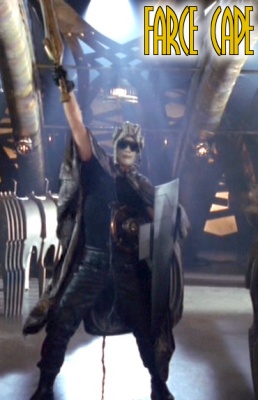
A caption I always wanted to write. From “Crackers Don’t Matter,” one of Farscape’s more comedic episodes.
Limited Resources
A while back I remarked that the Babylon 5 spinoff Crusade died in part because the Sci-Fi channel had already committed to Farscape.
I was thinking about VR.5 recently. Had it survived into a second or third season, Anthony Stewart Head might not have been available for Buffy the Vampire Slayer. Can you imagine anyone else as Giles? Of course, given the nature of the show (they killed off a regular about five episodes in, and pulled an “everything you know is wrong” moment near the end of the season), it’s entirely possible that Oliver wouldn’t have made it through season 2 anyway, and he still would have gotten the role as Giles.