Usability researchers like Jakob Nielsen have long contended that people read differently online than on paper: they tend to skim, follow links, and jump off quickly if they don’t find what they want. (Rather than being judgmental, Nielsen simply advises that you tailor your online writing to this.)

Now the Washington Post reports that people are observing a spillover effect, with online skimming habits interfering with concentration when it comes to more in-depth reading…even when reading print.

Sadly, the article mostly distinguishes between two modes of reading:

  • Online skimming of casual articles and social media on screens.
  • Serious reading of novels and in-depth content in print.

There’s nothing to distinguish, for instance, reading on a dedicated e-reader (without the siren call of Facebook or hyperlinks) from reading on your laptop. Nor is there anything to distinguish casually reading on your phone’s tiny screen from reading at your computer, or sitting on the couch and reading on a book-sized tablet.
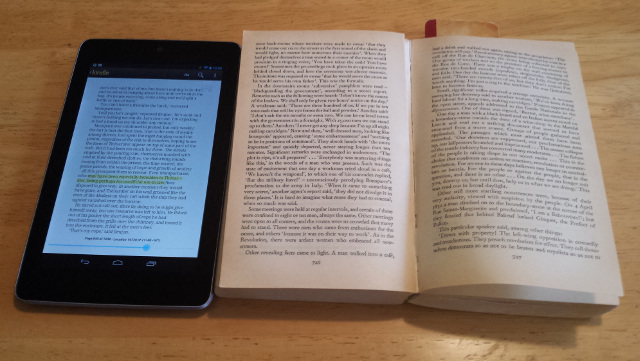
A tablet and a breaking paperback.

Personally, I’ve found display size to be the biggest factor in maintaining attention. I get tired of reading on my phone, and I tend to skim on a desktop or laptop, but a handheld tablet (I have a Nexus 7, which is close to the size of a paperback book) works out about right. I’d much rather read a long article on that tablet than on a computer, even with the browser window sized for optimal column width.

So yeah, it’s much easier to concentrate on something long in a book than on a desktop or cell phone…but an ebook reader or a tablet is a lot closer.

There are still tradeoffs: My Les Misérables re-read changed drastically when I switched from a paperback to my tabletnot because I couldn’t concentrate on long passages, but because my method of notetaking changed. My reading actually sped up, but my commentary slowed down. (It did ultimately take me longer than I expected to finish the book, but only because I had so many other books I wanted to read, and ended up taking breaks and reading them instead.)

The main problem I do have with a tablet isn’t continuing to read, but starting to read. Even without a wifi signal, it’s tempting to catch up on email, or saved articles in Pocket, and before I know it, I’m done with lunch and I haven’t even opened the book I’d planned on reading.

(Via Phi Beta Kappa)

I finally saw Frozen last week. Somehow I managed to avoid spoilers, detailed critiques (I’d file them away to read once I’d seen the movie), or even — believe it or not — hearing “Let it Go” before I had a chance to watch the scene and get the full context.

It was a lot of fun, very energetic, and I liked the music. For a lot of reasons, I couldn’t help but think of Tangled, and found myself tracking down both soundtracks.

Frozen Songs

I’m not sure which was a bigger surprise: That Kristen Bell can actually hold her own opposite Idina Menzel, or that one of the songwriters of Avenue Q won an Oscar for a Disney movie. Seriously: I’d forgotten the composers’ names, and I was trying to place the style while watching. Somewhere in the first half hour, something reminded me of Avenue Q, and I thought, “Nah, couldn’t be” and moved on. Now, I can’t unhear similarities.

After listening to the songs from both Tangled and Frozen a lot over the past week, I feel like Alan Menken’s score from Tangled is better overall, and more consistent, but the song list is very sparse and very reprise-heavy. Frozen is much more uneven, but the stand-outs are great, and much more catchy.

I’m going to be weird for a moment and say that the most perfect song in the movie is “Do You Want to Build a Snowman?” It captures Anna’s determination and optimism in the face of the sisters’ disintegrating relationship and their lonely circumstances, and there’s not a moment of awkwardness in the whole thing (except where it’s intentionally adorable).

“For the First time in Forever” and “Let it Go” are 90% fantastic. The former has a few clunker moments, and the latter IMO could have done with just one more pass-through on the lyrics. I love the way the performance in the movie starts out buttoned-up, then releases all that tension from the opening verse, and then turns into an anthem of self-discovery. And on second viewing, the links between the two songs add an interesting layer.

The other songs are serviceable, but nothing really stands out.

Tangled Music

Going back to Tangled, “When Will My Life Begin?” and “Mother Knows Best” are solid, and “I See the Light” is a beautiful mix of a madrigal sound on the verses with a more modern, sweeping chorus. The music is gorgeous, including the score (which is also fun to listen to for echoes of other Menken Disney scores), but the lyrics don’t have quite the same zing that the better lyrics in Frozen do (though they’re considerably better than the low points).

Still, I found myself compelled to learn the lyrics to “I See the Light,” partly to have something more complete running through my head, and partly for the lullaby value. (I do have a three-year-old, after all.)

Update: One Year Later….

A year later, a lot of the songs from both movies have grown on me. I’ve come to appreciate the lyrics in Tangled more, particularly the wordplay in “I’ve Got a Dream” (though the tune is basically “She’ll Be Coming ‘Round the Mountain”), the exaggeration in “Mother Knows Best” and the dissonance in “When Will My Life Begin.” And while I still think Tangled has a better score overall than Frozen, I can hear how well it’s constructed now. A lot of the tracks bring to mind the scenes immediately on hearing them, and everything is connected musically.

“I See the Light” did, in fact, become one of my go-to lullaby songs last year. After a while I started to regret it, when he began singing shrilly off-key fragments of songs in nonsense syllables at the top of his lungs all day, but thankfully he’s since cut down on frequency, learned to sing on-key and control his volume, learned more than just two lines of each song and started actually singing words. When he wants to. He still drops into the other mode of “singing” from time to time, but it’s not constant anymore.

WickedI’ve been catching up on last year’s movies. I finally saw Frozen last week, which prompted me to track down the soundtracks to both that movie and Tangled (more about that later), and listening to those prompted me to dig out the cast album for Wicked for the first time in, well, forever.

I was reminded of why I hadn’t listened to it much. Aside from a handful of songs (“Corner of the Sky” and “Colors of the Wind” come to mind immediately), something about Stephen Schwartz’s music just doesn’t stick in my head, and Wicked isn’t an exception. No matter that I like the story, that I like the characters, that I like Idina Menzel and Kristin Chenoweth…the songs just don’t stick. Not even “Defying Gravity,” except for the title refrain.

But remember how I mentioned I was catching up on last year’s movies? I had a disc out from Netflix of Oz: The Great and Powerful, and several episodes of Once Upon a Time on the DVR…the ones introducing the Wicked Witch as the villain for this half of the season. And it was weekend of Emerald City Comicon.

It seemed appropriate to continue catching up.

For the record, so far I much prefer Zelena (OUAT) to Theodora (Oz:TGAP) as far as characterization goes (she has some), though I haven’t seen enough to decide how she stacks up against Elphaba.

A few nights ago I watched the moon rise. This isn’t actually very common, just because hills and buildings mean that I rarely get a clear view of the horizon, but I had been working late and drove past LAX, which gave me a long flat stretch off to the east.

The weird thing is: it was gray.

I’m used to the moon looking white when it’s up high in the sky, yellow when it’s low, sometimes orange when it’s near the horizon, especially when there’s smoke or smog. A few months ago while the Colby Fire raged in the mountains to the northeast, I reached the top of a hill and had a fantastic view of a deep red moon through the smoke.

But gray? That was a surprise. It looked just like photos of the moon that are taken at the right exposure level to show you details instead of washing everything out. Squished a bit, of course, because it was so low.

As I kept driving, I passed more buildings and lost sight of it. A few minutes later, I caught another glimpse after it had climbed a little higher, and it looked slightly yellowish, just like I’d expect it to at that height.

I don’t know if it was something about how my eyes had adjusted, or if there was something in the haze above Los Angeles or even just nearby that counteracted the normal effect of scattering.

It did, however, remind me that the next full moon will feature a lunar eclipse, visible from our neck of the woods…the first since my son is old enough to (maybe) appreciate it. That should be fun.

It’s always annoying when someone figures out a way to exploit intentional behavior, especially when it’s a key part of the design.

Sucuri reports on a denial-of-service attack that used thousands of legit WordPress sites to distribute the attack by sending fake pingbacks “from” the target site to all of the reflectors. Those blogs would all contact the targeted site to confirm the pingback and retrieve a title and summary…all at once, overwhelming it and taking it offline.

The quick-and-dirty solution is to remove XML-RPC functionality, but that also breaks certain plugins (like Jetpack) and the ability to connect to your blog using the WordPress mobile apps.

A little background on why Pingbacks work this way:

Waaaay back in the early days of blogging, most bloggers would interact by way of comments. If you wrote a blog post, and I was inspired to write a response, I would then go over to your site and post a comment letting you know about my own post. Two systems were proposed in 2002 to automate this process: pingbacks and trackbacks.

  • Trackbacks sent a complete summary to the remote blog, including the title of your post, the link, and an excerpt (which you could manually craft, or let your software handle).
  • Pingbacks sent a notice — a “ping” — to the remote site with the URL of your post, and then the remote site would retrieve it and extract the title and a summary.

This was also around the time that blog comment spam and spammy blogs were getting to be a big problem. What would happen is a spamming site would send out trackbacks to as many sites as possible claiming that they’d responded to some post, thereby getting backlinks on a zillion blogs and increasing their page rank. Pingbacks had an advantage: Because you were calling back already, your server could check to see whether the other site really had linked to you. It took a long time, but eventually this escalated into spammy blogs creating a temporary post with real links to the pages they pinged, then replacing it with a spam page after a short amount of time.

The problem now is: How do you block abuse of an as-designed behavior? That’s happened before: Back in the early days of the internet, it was considered polite to run your mail server as an open relay and rude to lock it down, but after spammers started massively abusing them, an open relay became a sign of a sysadmin who didn’t know what he was doing.

The comments on the Sucuri article suggest that Akismet, as a collaborative comment-spam filter, might be able to mitigate this type of attack. Wordfence’s collaborative security filter seems like another system well-positioned to detect it. But if that approach fails, pingbacks might just go the way of open relays.

Update March 18: Akismet has released a new version of the anti-spam plugin that mitigates this problem in two ways:

  1. Spam checks on pingbacks are now done before the verification request is sent, so that once an attack is identified, Akismet will prevent blogs from participating.
  2. An X-Pingback-Forwarded-For header is added to the verification request identifying where the pingback actually came from, making WordPress+Akismet a less attractive choice as a reflector by removing the anonymity.

Item #2, IMO, belongs in WordPress itself, not in a plugin, but I imagine this was a way to roll out the feature more quickly, at least to those sites using Akismet.

Update April 8: The X-Pingback-Forwarded-For header has been added to WordPress 3.8.2 and the upcoming 3.9.

Since speculating idly on replacing roadside and median grass with more drought tolerant landscaping, I’ve started noticing spots around town that have done just that — some of them on my daily commute! An office building here, a mini mall there, an island, or the sidewalk strip in front of a single house. Not a sea change, but a beginning, or at least an experiment.

I’ve also spotted a few more houses that have taken out their lawns in favor of wood chips or rocks and a less-thirsty garden. Maybe it’s the variety, maybe it’s just that the people who’ve put in the effort to convert their lawns have actually, you know, put some effort into it, but they actually look better than a lot of the lawns out there. (As renters, we don’t really have the option of replacing the lawn, but we’re trying to be smarter about our patio and the strip we manage alongside a walkway.)

Spiky shrubs, lavender flowers, agave, and tufts of scrub grass are all common. Some of the roadside strips look like well organized chaparral. Birds of Paradise are common too, but I’m not sure how well they handle low-water conditions.

On the other hand, none of that helps if you keep watering like it’s grass, or use sprinklers that water the street and sidewalk as much as the soil around the plants. Just on my lunchtime walks I’ve found patches of grass where the dirt is always on the verge of becoming mud, and driveways that always seem to have puddles below them. Someone didn’t get the memo.

And then there are the strips of bare dirt that remind me why ground cover of one sort or another is necessary: erosion has left concrete plugs sticking up out of the ground around fence posts, or brick walls leaning out toward the street.

I suppose you could go the route I saw along one street: fill the island with concrete and paint it green. But that’s not only uglier than dirt (literally), it has the critical disadvantage that when it does rain, the water doesn’t even have a chance to sink in. And we desperately need to convert that rain to groundwater instead of flushing it all out to sea.

Landscaping