
XKCD on the Star Wars Holiday Special
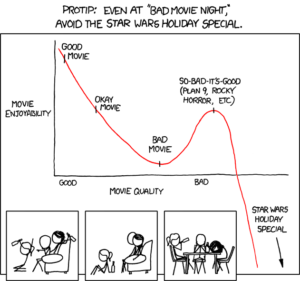
True. Absolutely true.
Update: It’s true. All of it.

And the award for Most Disturbing Use of an Alarm Clock in a Prime Time Show goes to… FlashForward! I got a weird kick out of recognizing it as Clocky (before the disturbing part).
After last weekend’s trip to storage, I was planning to re-read Greg Keyes’ Kingdoms of Thorn and Bone series, until I remembered that the new Wheel of Time novel, The Gathering Storm (why, oh why did they have to pick such a generic title?), comes out next week. Not the best time to start a four-book epic.
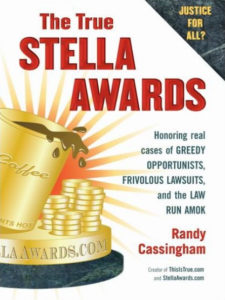 So I rummaged through the to-read box this morning, looking for something to bring along and read at lunch, and settled on The True Stella Awards. I picked it up when it was new, four years ago, but somehow never got around to reading it.
The nonfiction book is by Randy Cassingham, author of the long-running This is True newsletter, and is a collection of write-ups of frivolous lawsuits. It’s named after an email forward that used to go around with the title “The Stella Awards” (only that used made-up lawsuits like the one about the guy who supposedly put his Winnebago on cruise control and went into the back to make a sandwich). That list was named after Stella Liebeck, the woman famous for suing McDonalds after spilling scalding hot coffee on herself. Cassingham decided that using fake examples to illustrate a real problem was counterproductive, and started a newsletter featuring real cases of legal abuse, eventually making it into a book.
It’s been interesting to see which cases have been included. One of the first examples was a 2003 lawsuit against Nabisco for using trans-fats in Oreos (they’ve since been reformulated, IIRC)…which was dropped as soon as the filer had racked up enough publicity.
With Barnes & Noble’s new eBook reader, you could read a Nook book in a book nook.
It’s cool that sunset/sunrise can make distant mountains stand out in silhouette even when they fade into the haze in broad daylight. The San Gabriels to the north, the Santa Monica Mountains to the northwest, Signal Hill Palos Verdes* to the west, and even a small segment of Catalina Island to the southwest were all visible, though I don’t remember seeing any of them during the day today.
I remember riding in a shuttle back from LAX once before dawn, and I could swear that I could see the silhouette of the San Jacinto Mountains from Los Angeles. They’re out near Palm Springs. Not exactly something you normally see from LA.
*There’s a wedge-shaped hill that’s visible in the west from north Orange County on really clear days. Somehow I had it in my head that it was Signal Hill, but I noticed when I went to Long Beach Comic Con a few weeks ago that (a) I passed the city of Signal Hill on the way to the con and (b) the hill I can see from Orange County was still visible to the northwest from Long Beach. Thanks to Google Earth for helping me figure out just what hill it actually was!
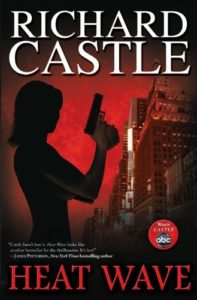 Hah! It turns out those ads for Heat Wave during Castle aren’t fake: ABC actually had someone write the Nikki Heat book as a tie-in.
The first time I remember seeing something like this was with (appropriately enough) Murder She Wrote, with a paperback mystery novel credited to Jessica Fletcher. In that case, though, the show had been on for years and was a television staple. DC Comics got into it in 1997 with The Life Story of the Flash, credited to Iris (West) Allen, which had previously been referenced in the comic books.
More recently, Lost had an in-universe book published in the real world: Bad Twin was billed as the final novel by one of the passengers on Oceanic 815 who didn’t make it through the first episode. I actually read that one. It was interesting enough, though it had little to do with the show beyond the presence of the Widmores.
I’ve been seeing spam with subjects including, “Every macho should have a cool watch” and “Look like real macho with that trendy watch!” I’ve also been seeing spam saying things like, “Don’t miss your chance to become a real macho and by that we mean increasing your male dimensions.” At first it was funny that two spam campaigns were using the promise of machismo to hawk completely different products for completely different purposes.
Then I thought: what if they’re not different purposes. What if they’re saying that once you’ve “increased your dimensions,” you’ll be able to wear another watch? 😯