I just can’t figure out what this message is supposed to be. My first thought was that someone was replying to spam that used a forged sender, but it scored 11 points in SpamAssassin for forged headers (it claimed to be from Yahoo, but wasn’t), a date stamp from the future, and Bayesian analysis.

From: Stock Advisor <probably fake address>
To: Stock Advisor <target address>
Subject: Go where?

>Go Away!

To top it off, it showed up in several spam traps with different subjects and senders, but the same two-word body. Maybe it’s a probe of some sort?

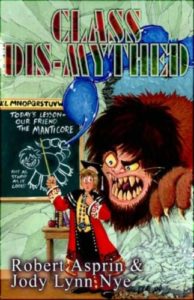
Class Dis-mythedPhil Foglio once again illustrates the Myth Adventures universe in the next book in the series: Class Dis-Mythed.

I don’t know how much of it is Jody Lynn Nye’s influence and how much of it is just Robert Asprin being re-energized about the series, but since they started collaborating the books have improved drastically. The new ones have much more of the feel of the early series, before Asprin burned out on it and spent a decade working through writers’ block.

(via the Studio Foglio newsletter.)

Remember the guy who noticed the same model in a ton of spam and started stringing the ads together into An Unsolicited Commercial Love Story?

In the past week I’ve noticed the same model showing up in ad banners on various sites, particularly IMDB and Comics.com—some of them using the same stock photos. (And someone should tell Comics.com that they’re being extremely rude by not only bypassing attempts to block pop-ups, but popping up two windows per visit. Stick with the banners, willya?)

Incidentally, the mystery model was eventually spotted eating lunch in a cafe in Auckland by a reader of cockeyed.com, and she added her own comments to the story.

Opera BrowserThere’s a saying about the elephant in the room that no one will talk about. Everyone knows it’s there, but by some unspoken rule no one will mention it. I’ve noticed that when web browsers are compared, there’s one thing Opera supporters tend to ignore or downplay: Opera’s business model.

Internet Explorer and Safari are bundled with their respective operating systems, and so they’re perceived as free. Firefox is free in both the gratis and libre senses of the word. Opera, however, is ad-supported by default and will disable the ads if you pay for it.

You can use Opera without paying money, but you’re still paying it in attention (a persistent chunk of space dedicated to advertising), so in comparison to the other three leading browsers, it’s perceived as being less free. Think of it in terms of television.

So the perception of cost looks like this:

  • IE, Safari, Firefox (commercial-free TV)
  • Ad-supported Opera (network TV)
  • Paid-for Opera (cable or satellite)

Most people really do prefer free without ads to free with ads or paid subscriptions. Why else is skipping commercials one of Tivo’s most popular features?

I’m certain this impacts marketshare, and it definitely impacts media coverage. Just look at CNET’s recent IE vs. the world review. Opera 8 gets high marks for features, but what’s the summary? “Despite a ton of great technology in Opera, few consumers will be likely to pay for the app. ” Whether you think the review is otherwise fair or not, the business model clearly lowered it several notches on the reviewer’s scale.

Next: Firefox’s blind spot.

Disclaimer: I’m a regular Firefox user these days, but I’ve also paid to register Opera since version 3.5 was current back in 1999. I used Opera as my main web browser on Windows back when Netscape 4 was aging and Mozilla hadn’t yet stabilized enough to replace it.

A thought: the original Teen Titans are beating the Justice League when it comes to passing on their super-genes. Leaving out possible-future stories and backstories, it comes down to just Aquaman of the core group, and Green Arrow as the most prominent member outside the “Big 7.”

As for the original 5 Teen Titans (now in their mid-twenties):

Speedy – now Arsenal, has a preschool-aged daughter, Lian (by way of international super-villain Cheshire).
Wonder Girl – now Troia, had a son Robert with her husband, but both were killed in a car crash.
Aqualad – now Tempest, has an infant son Cerdian with his wife Dolphin.
Kid Flash – now Flash, nearly had twins, but a villain beat his wife Linda so badly she not only miscarried, but lost the ability to have any more children. Update Nov. 2005: Time travel altered the attack, and Linda gave birth to healthy twins (who have yet to be named in print).
Robin – now Nightwing, no kids.

And of course if you do add in future stories, all five had children in Kingdom Come… who came back to visit the present-day mainstream DCU in “Who Is Troia?” in 2001.

Admittedly the mortality rate is high, but the 60% 80% birth rate certainly beats the core League’s 14%.

I don’t know if it was the show time we picked or just a matter of who sits where in the theater (we were about halfway back), but the largest demographic group in the audience when we watched Revenge of the Sith was not teenage boys, thirty-something men, families with kids, or twenty-something couples, though there were plenty of all of those. It was teenage girls. And they weren’t tagging along with dates or with families. They were out with their friends on a Friday night, willing to pre-order tickets and wait in line for an hour, looking for people they knew and chatting on their cell phones during the interminable bad-music-and-advertisement pre-show.

This was hardly a geek-only audience. If anything shows that a sci-fi movie has hit the mainstream, it’s the presence of thirteen-year-old girls with Hello Kitty blankets in the audience.