Last month I finally got around to installing antivirus software on the one Windows computer we have at home. While I’ve found Norton Anti-Virus has worked well on my system at work, I ended up choosing McAfee Internet Security Suite for two reasons: (1) unlike Symantec, they don’t use a product activation scheme, and (2) since McAfee bought Deersoft, purchasing a McAfee-related anti-spam product should help fund SpamAssassin development.

Big mistake.

Since installing McAfee, this computer has crashed at least once each time I’ve turned it on (usually with a McAfee dialog box visible). The privacy service adds another login prompt, whether you want it or not. It tends to pop up dialogs when you’re in the middle of, say, running ScanDisk to make sure the system survived the crash McAfee caused five minutes earlier. And, ridiculously, the software and virus definition update runs through Internet Explorer.

By this I don’t mean that it expects you to go to the website and download an installer. That would be inconvenient, but acceptable (since you could choose what web browser to use). No, it pops up a “Check for updates” dialog box which then opens Internet Explorer, goes through a set of redirects until it opens a pop-up that looks like a download manager (but is clearly done using HTML), and then downloads and installs the update.

Now forget any issues you might have with buggy rendering, feature parity, monopoly abuse, antitrust, etc. Just look at IE’s track record on security.

Why would you want a security system to rely on something so notoriously insecure?

Symantec has its own update program that calls out, checks for updates, downloads them and installs. You can run it manually, or you can set it to grab and install virus updates automatically. Nowhere in this whole process does Internet Explorer come into the picture – or if it does, it’s hidden away where the power user won’t see it and say “What the hell do they think they’re doing?”

Cliches aside, it appears that as a result of the trademark suit by Microsoft, Lindows is now going by the name Lin—s (LinDash) in parts of Europe.

Lindows — or Lin—s if you prefer — is a company that has been selling an ultra-user-friendly version of Linux. Criticized by many for lax security (they’ve chosen many of the same convenience vs. security trade-offs that have made Microsoft products so vulnerable) and for odd business practices [archive.org], they’ve nonetheless managed to get Linux into new places — like on cheap Internet-ready computers sold in Wal-mart, or pre-installed on Seagate hard drives. For all their baiting (face it, picking a name like Lindows is just asking for trouble, like opening a burger restaurant called McDowells), dumbing-down the software to the point of making it dangerous, and (in some people’s views) “tainting” the Linux philosophy with — gasp! — money — they’ve at least come up with new distribution models and gotten some form of Linux out there where “consumers” — the average Joe who just wants a computer and doesn’t care what the OS is, as long as it lets him use the web, email, and a word processor — can see it.

All that said, I’d never actually buy, use, or recommend their product. If I wanted a very-user-friendly Linux, I’d probably end up with Lycoris, or maybe Xandros.

For myself, I’m happy with Fedora Core — though I may take a serious look at the upcoming double-digit Mandrake release and the latest version of SuSE. I’ve tried out earlier versions (mostly of Mandrake), but I just kept coming back to Red Hat.

Miss two weeks and they pull the rug out from under you:

…the cast, crew, writers and producers of Angel deserve to be able to wrap up the series in a way befitting a classic television series and that is why we went to Joss to let him know that this would be the last year of the series on The WB

At least the WB had the decency to let them know in time to do some sort of wrap-up, unlike the way certain other shows were treated by channels that shall not be named.

Unfortunately we live in a world where the offbeat has to make way for the mainstream. I don’t care if the WB puts up some new “reality” show, as long as I can find the kind of shows I like to watch. With so many hundreds of cable and satellite stations available, you’d think there’d be room for shows like VR.5 and Crusade.

Still, Angel managed five years, which is pretty damn respectable – especially in the modern era of cancelling shows without even airing half a season.

Joss Whedon sums up the perils of producing anything that strays too far from the beaten path:

“Two roads diverged in a wood,
and I took the road less traveled by
and they CANCELLED MY FRIKKIN’ SHOW.
I totally shoulda took the road
that had all those people on it.
Damn.”

Since our apartment complex was taken over by new ownership and management last year, they’ve embarked on a months-long project to “rehab” the complex. In some cases, this meant long-overdue repairs like replacing all the plumbing and water heaters, or rebuilding the balconies with less termite-laden wood. In some cases, this meant cosmetic changes like prettying up the main entrance with a trellis and new steps (still in progress).

There’ve been problems along the way. The plumbing work forced us to move everything out of our storage space for several months, and they’ve delayed things with little explanation and started up again with no notice. They tried out new color schemes in our section back in August, and still haven’t gotten around to a final paint job. They told us to move everything off our balcony just before Thanksgiving, but didn’t actually remove it until January (by which time many of our neighbors had moved things back).

Sometimes the changes themselves have been ridiculous or annoying. They’ve decided to fence off the lawn in our courtyard so that it can be attached to an expanded pool-and-picnic area. I don’t think it occurred to anyone that people liked having a lawn that wasn’t behind a locked gate.

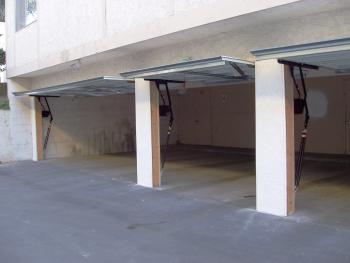
But the most bizarre change has to be the garage doors they’re adding to the carports. They’ve widened and squared-off the posts so that they can put in standard-sized garage doors, despite the fact that this (a) makes it very hard to park in the middle spaces (I’ve already scraped the bumper once, and this is with a Sentra. I’d hate to think about parking here with an SUV or pickup. A Hummer? Forget it!) and (b) accomplishes absolutely nothing. The section is shared by five cars, and two of the doors are double-width, meaning that four of those cars have to share a door with a neighbor:

Image of open garage doors, lightened to showing more clearly that there's no separation behind them.

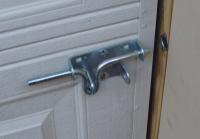
But what’s really annoying: There are locks on these doors – even the shared ones:

Close-up of a standard garage door lock.

Yes, your neighbor can lock your car in or out of its space by locking his own garage door. Yes, you need to buy your own lock in order to prevent someone else from making your car immobile. No, having the garage door there in the first place does nothing to protect your car – from anything.

What the heck were these people thinking?

While looking for more ideas related to my earlier post on fighting link rot, I came across some interesting articles:

Web Sites that Heal [archive.org] considers some of the causes of linkrot, including: changing CMS systems (which I’ve dealt with here twice), poor structure (starting small and simple, but finding that as the site grows, the old design doesn’t work anymore), lack of testing, and plain apathy. More interesting are some of the reasons it becomes a problem, in particular the difficulty in setting up redirections and informing other sites that you’ve moved. That’s something else I can relate to: My site hasn’t been on the UCI Arts server in four years, yet despite a massive attempt to get people to update their links, Altavista still shows 82 pages linking to my site’s old location. Something I think the article leaves out is the number of sites – particularly people who set up a free Geocities account back in the dot-com era – that just aren’t maintained anymore. The pages are there, but they’re six years out of date – and so are the links.

The article then proceeds to suggest an automated server-to-server system that will detect incoming links to a moved page, then contact the referring site, report the new location, and instruct it to update the link with no human intervention whatsoever. A great idea, though it will require people like me to drop the edit-locally-and-upload model of development.

“Web Sites That Heal” referred to a Jakob Nielsen column on Linkrot. Nielsen’s advice is frequently useful, though not always applicable [archive.org]. Sadly, his recent columns have tended toward rehashing old ones or applying to ever more specialized niches, but sometimes his advice is spot-on. In this case, the article from six years ago still applies to today’s web: run a link validator on your site from time to time, and keep old URLs on your own site active (whether with actual content or with a redirect). The comments on this article are worth reading as well.

Lastly, I found a remark on Consequences of Linkrot [archive.org] as applied to weblogs. Most of the post is actually an excerpt from Idle Words, where the original author notes that the classic blog post – a single line linking to something of interest, or a series of the same – is particularly susceptible to linkrot. Without the original material, there’s nothing (or next to nothing) left. And it happens fast: The Web isn’t that old, and blogging is even younger, yet information is disappearing rapidly enough that you really have to wonder how much of what exists today will still be around – in any form – ten years from now. One of the key lessons DeLong takes from this article: it’s “critically important not just to link but to quote–and to quote extensively.”

The lesson is clear: The site you link to today may not be there tomorrow, and you may not have the time (or inclination) to go chasing it down. Quote it, summarize it, add context, write lots of commentary, whatever. Make sure what you post can stand on its own… just in case it has to.

There was an article in this morning’s LA Times about the latest radio station to broadcast on FM 103.1. Calling themselves Indie 103.1, and billed as “alternative alternative,” they have a lot of the things that were great about the “world class rock” format: a wide-ranging playlist, spanning several decades and including deep album tracks instead of just singles. Mainstream radio is so focused on new-new-new, with the occasional flashback to a small list of songs from the 80s and 90s.

Anyway, we tuned in on our commute this morning: so far, so good. And just in time for KCRW to go into full pledge-drive mode. Who knows how long they’ll last, but between this and Ryan Seacrest finally leaving Star for TV, the state of LA/OC radio is considerably better than it was a year ago.