The suggestion box on my Flash site has picked up a couple of requests for the Flash’s “weakness.” The concept doesn’t really apply to the Flash’s powers, though. Thinking about it, if your hero has to have an off-switch, that’s kind of a sign that they’ve been over-powered, isn’t it?

It reminds me of a line that bothered me in Unbreakable. (Minor spoiler.) Samuel Jackson’s character explains to Bruce Willis that water is his Kryptonite. That’s hardly the case, though: a glass of water isn’t going to take him out of commission. He’ll still be invulnerable and super-strong while swimming. All it means is that he still has to breathe (and, presumably, eat and drink). A plastic bag over his head would be as effective as drowning.

Compare that to, say, Superman and Kryptonite, or Wonder Woman and being tied up, or past Green Lantern books and yellow objects or wood. It’s not in the same league (pun not intended).

Which brings us back to the Flash. What “weakness” does he have? Well, he’s a specialist, so he doesn’t have the advantage of super-strength or invulnerability. He can get tired. Like David Dunn, he has to breathe. He can get distracted. He can make mistakes. He can act without thinking. Are any of these really “weaknesses” in the Kryptonite sense, though?
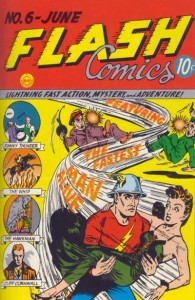
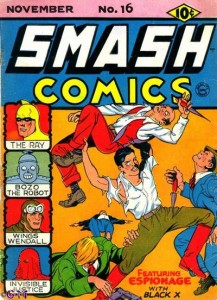
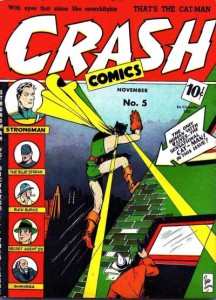
Hmm, I wonder how many newsstands displayed these books next to each other:

Flash Comics 6 Smash Comics 16 Crash Comics 5

An explanation: I recently stumbled across a mention of Smash Comics, a series from Quality Comics that ran more or less concurrently with the more familiar Flash Comics. Just for kicks, I searched the Grand Comics Database (which is where I got the cover images) for Crash Comics, and found Crash Comics Adventures, which ran for 5 issues in 1940 before spinning off a series on the original Cat-Man. So the three books would have been on sale at the same time!

I couldn’t find any other books with the same pattern in the title. The GCD does substring matches, and “ash comics” only brought up variations on these three series. Though it did remind me that DC resurrected the Smash Comics title for one chapter of the 1999 The Justice Society Returns! event.

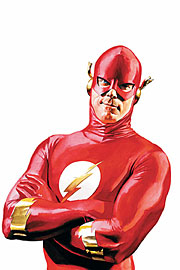
Flash poster by Alex RossDC Comics released their July solicitations today, along with some of the books due in August. They managed to say absolutely nothing informative (or, to be honest, particularly interesting) about Flash #14—just that it’s going to be big. C’mon, show, don’t tell!

On the plus side, we now have a cover and a confirmed date for Flash: The Greatest Stories Ever Told: August 15. The table of contents hasn’t changed from the initial announcement, so it sounds like it’s final. At least for promotion, they’re using Alex Ross’ portrait of the Flash.

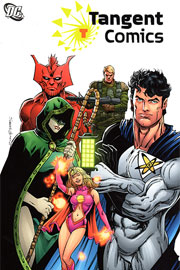
Tangent ComicsOddly enough, the one thing on the list that actually got me excited was the first collection of Tangent Comics, due August 29. (Edit: I’ve updated the image at the left to the final cover. Originally, DC posted the cover from Tangent Comics: The Atom)

Tangent Comics was a fifth-week* event back in 1997 that built an entirely new fictional universe using only the names from DC’s stable of characters. The Atom became a nuclear-powered Superman type. Green Lantern became a mysterious figure whose lantern could bring souls back from the dead to complete unfinished business. The Flash was a human made of light. The event consisted of nine books, each designed as if it were the first issue of an ongoing series, and was successful enough that they followed it up with a second round in 1998. Continue reading →

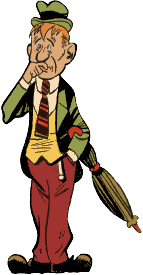
The Worry Wart. One of the characters I encountered early in my exploration of Golden Age Flash stories was Ebenezer Jones, the Worry Wart. In fact, All-Flash #24 (1946) was one of those first two GA Flash books I bid on just to see if I could win. The story in that book referred to previous meetings. If it had been the Silver Age, it would have included a helpful editor’s note telling me “See issue #X,” instead of just a recap.

As I kept watching auctions and looking on sites like the Grand Comics Database, I identified at least two more appearances. I finally tracked down the last of the three in March, and was able to write up a bio of the character.

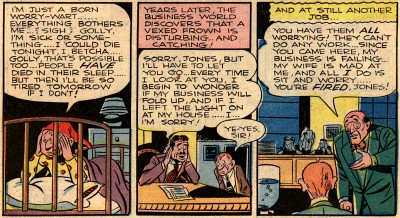
Who is the Worry Wart? In short, he was an ordinary man who had a case of anxiety so bad it was contagious.

Jones worries about dying in his sleep, and about not getting enough sleep. He gets fired from two jobs because his bosses and coworkers start worrying about every little thing when he’s around.

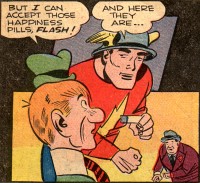
The Flash gives the Worry Wart his happiness pillsThere’s an odd subtext to the character’s stories, though. The reason he returns to Keystone City is that the Flash had previously set him up with a supply of “happiness pills,” which had run out. In Flash Comics #76 (1946), Ebenezer Jones deliberately overdoses on the happiness pills, causing a euphoric delirium just as contagious as his anxiety.
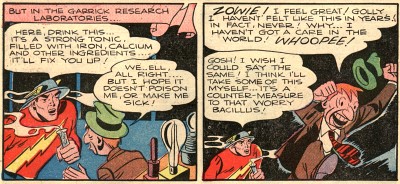
Looking back on this from 2007, it’s hard not to think of it in terms of the vast numbers of people today taking medications for depression or anxiety. Not to mention people who abuse prescription medications. Or just people who abuse drugs. There’s a disturbing drug-dealer vibe in that panel.

It gets better, though. In the Worry Wart’s first appearance, in All-Flash #15 (1944), the Flash makes him a serum to counteract his anxiety:

The Flash gives Jones a tonic to counteract his anxiety... and it really works.

Yes, that’s right. The Flash gives him a bottle, and he drinks his cares away. No subtext here!

I haven’t seen 300 yet. But not because I’m not interested in the story.

I hadn’t heard of the Battle of Thermopylae until a few years ago, when I picked up a book called Atlantis Gate, by Greg Donegan. It was a sci-fi/fantasy thriller involving a war across time for the fate of the world. One front was ancient Greece, with one side aligning with the Spartans, and the other with the Persians. IIRC, the Spartans had to protect a gate in the pass until either someone could get a message through, or someone could close it. I actually found that the most interesting part of the book. The rest felt too much like it wanted to be an action movie. (About 2/3 of the way through I discovered it was actually the final book in a series of four. It didn’t grab me enough to pick up the earlier ones.)

Not long afterward, I started reading Harry Turtledove’s Videssos Cycle, in which a Roman legion gets transplanted to a sword-and-sorcery world. Among their number is a Greek doctor, who remarks at one point about the very same battle. At this point I realized that Donegan wasn’t making everything up, and started reading up on the actual battle.

So when I heard about the Frank Miller/Lynne Varley graphic novel, I put it on my wish list. Eventually I picked it up, read it, and enjoyed it. Then I heard they were making a movie, which sounded really promising.

Then the first previews aired, and it looked… well… overblown and hammy. Even the good reviews make it sound like two hours of hack-n-slash.

I think I’ll wait for the DVD.

(Sort of vaguely a response to Warren Ellis’ recent remarks on “Bad Signal” that he hasn’t seen 300 because he read the book—and didn’t like it.)

[Logo: Wizard World Los Angeles]I went to Wizard World Los Angeles today. I almost went last year, and decided not to—and regretted it when I learned that Sunday (the day I almost went) was sparsely attended. So not only would I have had no problem getting in, but it should be a low-stress experience overall, rather than the insane crowds of San Diego.

The convention itself did turn out to be a nice, low-key experience, and I found some interesting stuff, but getting to the convention was a bit of an adventure. Continue reading →

Irish and Mexican FlagsI caught a story on The World (PRI) today about Los Angeles band Ollin’s song tribute to Saint Patrick’s Battalion (in Spanish, El Batallón de Los San Patricios)—a group of several hundred primarily Irish Americans who, during the Mexican-American War (1846–1848), left the US Army to fight alongside the Mexicans. They fought fiercely for a year, but came to a bad end: most were captured by the US and executed as traitors.

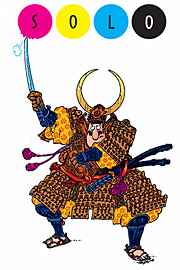
Cover of Solo #11It reminded me of a story Sergio Aragonés told last year in his issue of Solo (#11). In “Heroes,” he talks about growing up in Mexico, where the San Patricios are national heroes. They have statues, memorials, and a commemorative ceremony every year on the spot where they were executed. After telling the story of how he learned about the battalion, he jumps forward a few decades. Living in the US, with his daughter going to American schools, he wanted to see how she would learn about the heroes of his youth. So he looked through her textbook to the section on the Mexican-American war, and found only a fleeting remark about how a bunch of drunk Irishmen deserted the US Army, surrendered, and were executed.

It was a surprisingly serious story from an artist known for his comedy (some of the other stories in the issue are drop-dead funny), and an interesting commentary on how nationalism shapes our views of history, with one side elevating the battallion, and the other trivializing them.

»All pages site-wide with this tag