Regarding the furor over Revenge of the Sith/Post-9/11 parallels: Get over yourselves.

You know, I could see parallels in Star Wars: Episode II and post-9/11 America. Palpatine’s emergency powers = PATRIOT Act. Militarization in response to the separatist movement = attacking Afghanistan and rattling sabers at Iraq. And there are conspiracy theorists who think that Bush arranged for 9/11 to generate an excuse for a power grab—just as Palpatine/Sidious manufactured his crisis by having Dooku/Tyranus arrange for the clone army under the name of a dead Jedi, then wait for the appropriate time to start fomenting a rebellion. But you know what, Episode II was filmed before 9/11, so Lucas couldn’t possibly have intended all that as commentary on the War on Terror any more than JMS could have been commenting on the same subject with the Nightwatch arc on Babylon 5.

So now, with Episode III, sure, he could mean it as commentary. And he admits seeing parallels. Note: seeing, not writing. But he states that the story grew out of looking at historical democracies’ descent into dictatorship (Los Angeles Times this morning):

Lucas began researching how democracies can turn into dictatorships with full consent of the electorate.

In ancient Rome, “why did the senate, after killing Caesar, turn around and give the government to his nephew?” Lucas said. “Why did France, after they got rid of the king and that whole system, turn around and give it to Napoleon? It’s the same thing with Germany and Hitler.

“You sort of see these recurring themes where a democracy turns itself into a dictatorship, and it always seems to happen kind of in the same way, with the same kinds of issues, and threats from the outside, needing more control. A democratic body, a senate, not being able to function properly because everybody’s squabbling, there’s corruption.”

That’s the model he’s been basing the transformation on. The prologue in the original 1976 novelization of Star Wars refers to the Republic “rotting from within” and describes Palpatine’s rise to power:

Aided and abetted by restless, power-hungry individuals within the government, and the massive organs of commerce, the ambitious Senator Palpatine caused himself to be elected President of the Republic. He promised to reunite the disaffected among the people and to restore the remembered glory of the Republic.

Lucas originally described Palpatine as becoming a figurehead Emperor, with the Imperial governors behind the Empire’s “reign of terror” (note the French Revolution reference there), but had clearly changed his mind by the time he wrote Return of the Jedi. But the description of how Palpatine gets into power tracks exactly with what we’ve seen him do in the actual films. In fact, throughout the prequel trilogy he uses the same strategy in each film. He creates a crisis as Darth Sidious (the invasion of Naboo, or the Separatist movement), then offers to solve it as Palpatine—as long as people will give him the power to do so.

In other words, Palpatine’s tactics were set in stone back when Bill Clinton was President.

As far as dialogue… Please, if you think a variation on “If you’re not with us, you’re against us” is a deliberate attack on a statement Bush made, you really need to get out more. How many centuries has that phrase been around?

I’m reminded of Yoda’s words to Luke on Dagobah, when he asked what was in the cave. “Only what you take with you.”

Y’know, something I just can’t understand is the tendency, in rants about how the Star Wars prequels have not measured up to and/or sullied precious memories of the originals, to make sure there’s a dig about them being soulless computer-generated films, often citing the superiority of earlier effects with actual models and the presence of real actors.

Haven’t Pixar and DreamWorks demonstrated that it’s entirely possible to make a well-constructed, entertaining film entirely with CGI? Hasn’t Hollywood’s studio machine demonstrated that it’s entirely possible to make a shallow, soulless film entirely with real actors? Remember the original reviews of Jurassic Park that accused the milestone CGI dinosaurs of being more lifelike than the actors?

It ain’t the CGI, folks.

The effects are top-notch. The visual design, even when referencing other films, is impressive. Acting. Directing. Writing. This is where Episodes I and II have broken down. And if you’ve seen the right movies, you know the leads can act—when they’re given a chance.

No, it’s the dialog and the directing—both primarily Lucas’ work, and both tasks he let others take on or at least polish in earlier films. From what I hear Tom Stoppard has polished the dialog in Episode III. One can only hope that Lucas’ “practice” directing the last two has given him the experience needed to make the final film stand out.

Two weeks ago (April 25, specifically) we went to a Tori Amos concert in LA. It was a vastly different experience from the others we’ve been to. You see, she started out as basically her and a piano, and each album has added more and more layers of instruments. It always reminds me of a scene in Death: The Time of Your Life (Neil Gaiman has been friends with Tori since she was working on Little Earthquakes) in which Foxglove’s manager(?) is explaining that as she gets more popular, they have to book bigger and bigger venues, and beyond a certain size just a girl and her guitar isn’t going to cut it: she needs to hire a band.

Well, the “Original Sinsuality” tour provided some clues going in: It was a short tour, the venues—in this case UCLA’s Royce Hall—were comparatively small (which is why the show sold out in 10 minutes), and it was named after a “quiet Tori” song. She dispensed with the band entirely. It was just Tori Amos, a grand piano, two kinds of organs and another keyboard I couldn’t quite identify. We heard songs you never hear in concert (“Yes Anastasia,” “Doughnut Song”) or wouldn’t expect to (“Toast”), even when she takes a break from the band and does a piano set.

So, onto a review: Continue reading

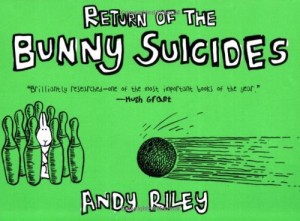
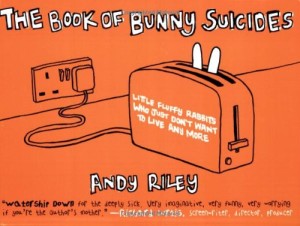
Looking at the list of “most popular” links on Del.icio.us, it seems someone has scanned the entire Book of Bunny Suicides and its sequel, both by Andy Riley.

Good grief, people—you can pick up the book for $7.00 at any bookstore. I can understand posting a couple of excerpts, but from what I can tell, these people have scanned and posted the entire book. They haven’t even credited the source! In the blog postings that show up on a “bunny suicides” search, most of them don’t even seem to know where the cartoons are from. Heck, even with pirated MP3s you usually know who sang the song.

Google has pulled a few of the sites from their index in response to a DMCA complaint. (Interestingly, Google themselves linked to the Chilling Effects entry.)

It always amazes me how rude people can be.

Book of Bunny Suicides Return of the Bunny Suicides

A new Angel comic book mini-series (from IDW, rather than Dark Horse), Angel: The Curse, picks up after the end of the TV series.

In this first issue of a new Angel tale, Angel has survived the conclusion of his TV show and finds himself in a mysterious Romanian forest. There, his search for the Gypsy tribe that cursed him years ago takes a turn for the worse.

I suspect we’ll get a “once out of the pit…” explanation (i.e. no explanation at all) and the cliffhanger’s resolution will remain open for Joss to deal with in a movie-of-the-week or something.

But what galls me is that the book is supposed to have four covers. OK, one variant every once in a while is nice, and I can even go for Dark Horse’s early efforts to have one drawn cover and one photo cover to get the newsstand audience (is there such a thing anymore?)… but the only reason to do four covers for one book is to get collectors to buy four copies. It was an insulting gimmick in the early 1990s, and it annoys me that the practice never quite went away. Worse, TV Guide took it mainstream. I guess we’ll know we’re in trouble when Time or National Geographic starts doing multiple collectors’ covers.

*grumble*

Let’s see… what have I picked up recently?

Otherworld (Vertigo). I picked this up on the strength of Phil Jimenez and part of the concept. A group of people from present-day Earth get dragged into an extra-dimensional war—which, of course, has been done before. After issue #2, I’m still not entirely sure what’s going on, beyond the basics. We’re still figuring out who gets transformed how, and as for what’s actually going on in the other world, I think we’re going to have to find out along with the leads. (Heck, I’m still trying to figure out which character is narrating the whole thing.) I’m hoping things will become clearer with #3.

The Atheist (Image/Desperado). A skeptic paranormal investigator (nicknamed the Atheist by his colleagues) comes up against the one case he can’t debunk: the dead are returning and taking possession of the living. In some ways this reminds me a bit of Simon Spectre and Frank Ironwine, the two Apparat books inspired by Doc Savage and the detective pulps. Definitely continuing with this one.

Beyond Avalon (Image/Desperado). King Arthur’s daughter takes up a sword and leaves the island of Avalon to see what’s out there. #1 was just interesting enough to get me to buy #2. But I haven’t actually read #2 yet.

Mnemovore (Vertigo). The concept of this one intrigued me enough I had a dream about it a few nights ago. (Appropriately, I can’t remember much of it.) The main character, injured in a snowboarding accident, has amnesia…but something is causing everyone around her to lose memories as well. Something alive, that Kaley encounters at the end of the first issue. Another one I’m definitely following.

Countdown to Infinite Crisis (DC). I have to admit I had very low expectations for the latest big event book. But the 80-page giant was actually quite good. Three of the four spinoff minis are out now, and they’ve been hit or miss. On one hand, I like the idea that each series focuses on a different corner of the DC universe—Day of Vengeance for the magical characters, Rann/Thanagar War for the sci-fi, The OMAC Project for the superhero/thriller types and Villains United for…well, you can probably guess. On the other hand, at 6 issues apiece plus the 4-issue Return of Donna Troy, that’s already 29 books, plus however many issues Infinite Crisis itself will be. This is all for the 20th anniversary of Crisis on Infinite Earths, which was only 12 issues! And, frankly, the “Which one will lead to Infinite Crisis? Buy them all and find out!” gimmick offends me.

Anyway, I liked the first issue of The OMAC Project, Day of Vengeance #1 left me just curious enough to pick up #2, and Villains United didn’t intrigue me much at all.

Rising Stars: Voices of the Dead. Now that JMS and Top Cow have resolved their dispute and finished Rising Stars, the publisher can start releasing Fiona Avery’s spinoff minis again. First out of the gate is this one, focusing on Lionel Zerb, who talks to the dead. Unfortunately I can’t help but wonder what happened to Rising Stars: Untouchable, the mini about telekinetic assassin Laurel Darkhaven announced two years ago. My impression was that it was done, or at least completely written, with publishing held up by the dispute. I’ll have to reread VotD without that question in my head. (Strangely, I can’t find anything about either series at Top Cow’s website)

»All pages site-wide with this tag