

Not what they usually mean by LAN security, but certainly effective.
Not what they usually mean by LAN security, but certainly effective.
It was hazy, and the weather forecast was partly cloudy, but the sun stayed visible and the eclipse glasses (used here for the photo) haven’t cracked!
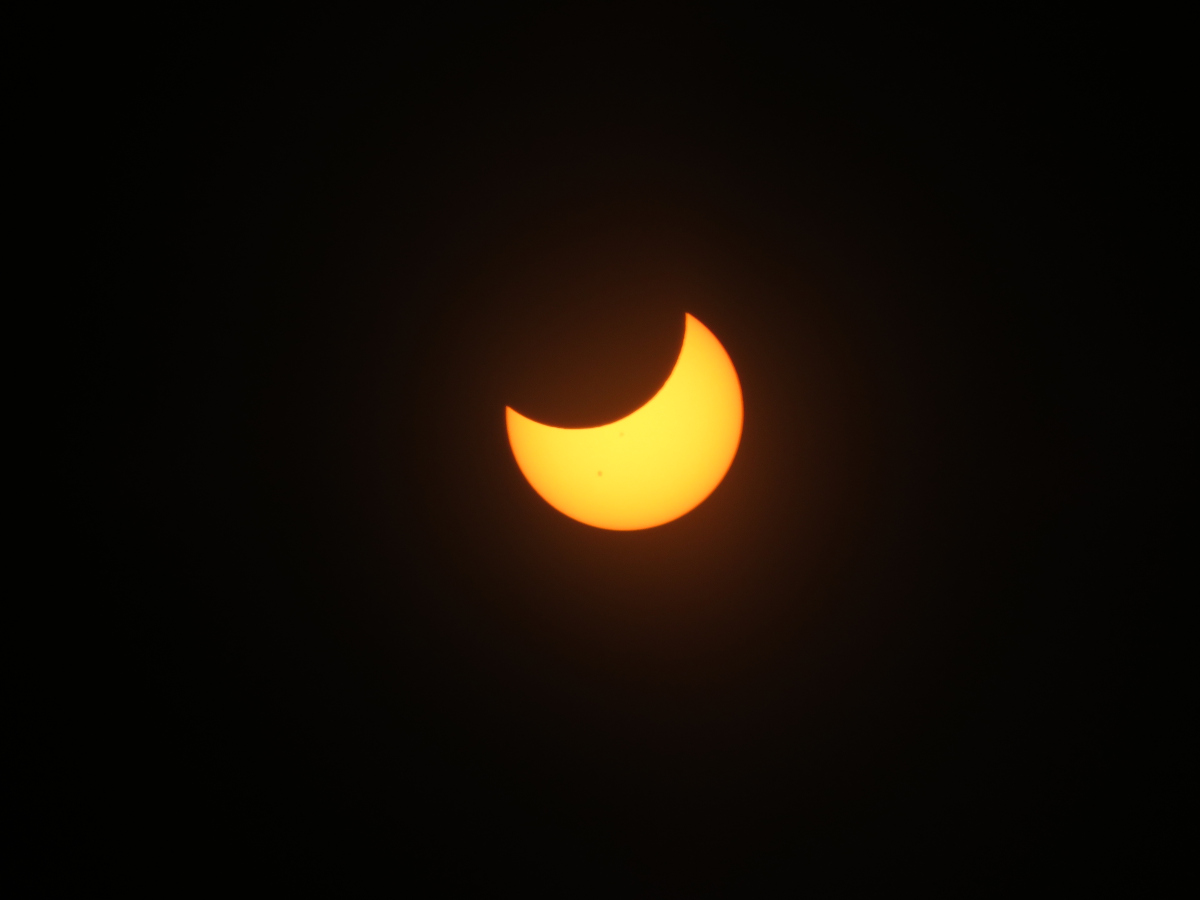
We didn’t do anything complicated this time: just took the glasses with us as we went about our morning, looking through the glasses every 15-20 minutes to see how much was covered until it reached its maximum coverage of 78% of the sun’s apparent diameter.
And at projections. Leaves are nature’s original pinhole camera!
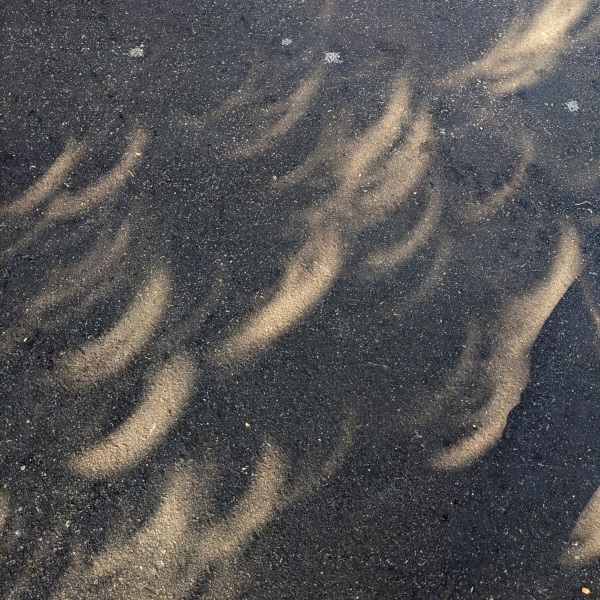
A road trip like 2017 to see the full annular eclipse would have been cool, but it just wasn’t something we could do this time around, and with clear visibility, there wasn’t any need to seek higher ground like 2012.
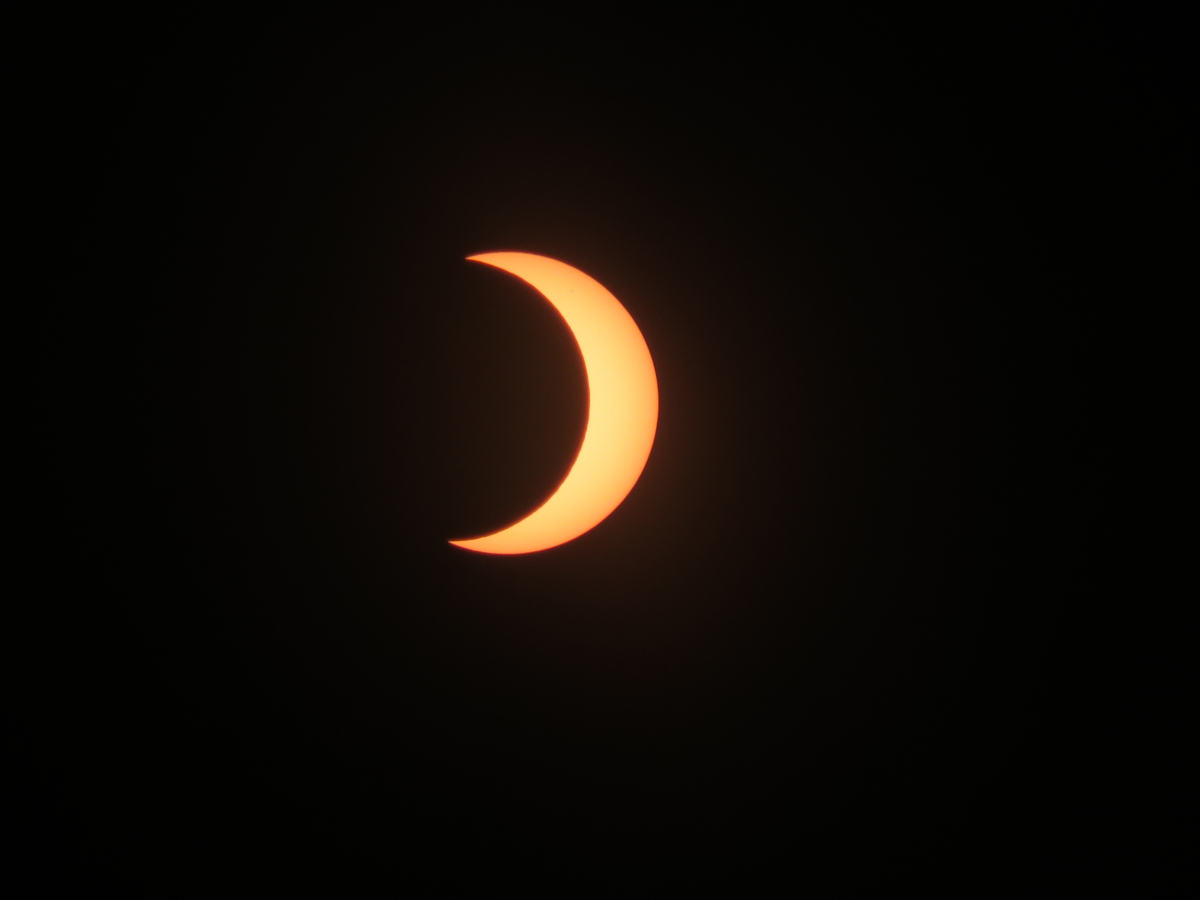
Here’s peak coverage for this area, again viewed through eclipse glasses.
It’s been 18 years since drug companies replaced pseudoephedrine with phenylephrine to keep their cold medications available over the counter when the people waging War On Drugs(tm) decided to restrict the main ingredient in Sudafed (and what it was named after) because it could be used to make meth.
Though I remember some other decongestant plugging the idea that “unlike those medications, we chose not to change our formulation…” Yeah, because you weren’t using an ingredient that got semi-banned!
From the start, the new formulation clearly wasn’t as effective. When I found out that I could still buy the real medication as long as I asked at the pharmacy counter (and showed ID so that the DEA or whoever knows I’m not trying to get around limits by hitting every pharmacy in town), I stopped bothering with the OTC versions entirely.
I wasn’t surprised when studies showed that phenylephrine doesn’t work.
Back in 2015.
(Restricting sales of the real stuff didn’t seem to make much of a dent in the meth problem, either.)
“Only” eight years later, the FDA reached the same conclusion.
And yet the industry is complaining that “if oral phenylephrine were not available over the counter, it would be a significant burden to consumers.”
HOW?????
It doesn’t work. People who buy it are wasting their time and money on snake oil instead of buying a different medication that might actually do something for them. (Not that this is a problem for the supplement industry, where “not evaluated by the FDA” might as well be a selling point.)
We all ended up worse off: cold meds that don’t work, submitting to surveillance to get the meds that do work, and it didn’t even slow down the meth epidemic.
Update: It took another year for the FDA to recommend pulling it.
Imagine a small village near a valley, so isolated that they just call themselves “the people.” One day they find out about another village on the other side of the valley, and they start calling them “the people across the valley.” They can keep talking about “the people,” but sometimes they need to make a distinction: right now, we’re talking about the people on *this* side of the valley, not the people on both sides.
Not incidentally, the Latin prefixes for “this side of” and “the other side of” are cis- and trans-. English uses trans more frequently, as in transport, transform, transmit, transnational etc., all of which involve something crossing a divide. Sometimes it’s quite literal, like the old terms Transjordan and Cisjordan referring to the lands on the far and near sides of the Jordan river. Or more modern terms, like the cis- and trans- forms of a molecule that can have more than one structure. Or in space exploration, translunar space (beyond the moon) and cislunar (including the moon’s orbit and Lagrange points). (Who’s that contractor for the new moon missions, again?)
Come to think of it, the moon’s another good example of the same sort of thing. When we’re just talking about life here on Earth, we can say “the moon” and it’s clear which one we mean. But if we’re talking about the whole solar system, and how Earth’s moon compares to Titan or Europa, we have to specify which one we mean.
So if we’re talking about transgender people and their experience compared to non-transgender people and their experience, the clear term to use based on English grammar is cisgender, and just as transgender is often abbreviated as just “trans,” cisgender is abbreviated as “cis.”
It’s a description, just like “acoustic guitar.” They’re still guitars, but when you need to talk specifically about non-electric guitars vs. electric ones, that’s the term we use.
“Cisgender” or “cis” isn’t a slur, no matter what Twitter’s owner thinks. It’s not casting negative judgement any more than “acoustic” is casting negative judgment against the guitar, or insisting that space on one side of the moon is better than the other.
You wouldn’t think that books about astronomy and archaeology would have a lot in common, but Four Lost Cities (Annalee Newitz) and Under Alien Skies (Phil Plait) pack some odd similarities.
Both are about places we (mostly) can’t visit in person: Faraway planets in one case, the distant past in the other.
We have to piece together parts of the experience from what has come to us through time or through space: Telescopic observations, space probes, spectral analysis, and our understanding of physics — ruins, artifacts, aerial surveys and
what we know about people (both contemporary and in general).
For some sites we have very detailed and solid information: Angkor’s stone temples are still standing. Pompeii was well-preserved under volcanic ash and we still have first-hand writings about the city and its destruction. Mars and the moon have been extensively surveyed, including multiple landers and photographs from the surface. (And, in the case of the moon, a handful of people!)
Others require a lot of speculation: There’s a solid core of what we’ve figured out about Cahokia, but a lot of unknowns that we can sorta-kinda extrapolate from the histories and tales of surviving tribes in the area — but only to a point. Similarly, we know the rough structure of the TRAPPIST-1 solar system and some of its planets, but we have to speculate: if one of the planets in the habitable zone actually is habitable, what conditions would that require?
Both include major discoveries made within the last decade: Pluto and Charon were just a pair of dots until the New Horizons mission flew past it in 2015, bringing us pictures and measurements and so much data it took months just to download it from the probe back to Earth. Lidar surveys at Angkor in 2012 revealed the foundations of a vast metropolitan area around the temple complexes, upending our sense of how big the city was and identifying new sites to investigate.
It’s kind of funny how I read them so close together. Synchronicity and all that. They’re also both good (see also my review of Four Lost Cities and review of Under Alien Skies), and I’d definitely recommend them!
One of many cool facts brought up in Phil Plait’s new book, Under Alien Skies is that Martian sunsets are blue!
On Earth, nitrogen scatters light randomly, with bluer colors scattering more than redder colors, so the ambient sky is blue, but when you’re looking toward the sun at a shallow angle (like sunrise or sunset), most of the blue light is scattered into the next timezone and you see red and orange.
On Mars, tiny dust particles of iron oxides (rusty dust?) reflect yellow-orange light, making the daytime sky mostly a butterscotch color…but the particles that can stay aloft in the thin atmosphere are about the size of the wavelength of blue light, so they scatter blue light forward instead of randomly. So at the shallow angles of sunset and sunrise, the sky in the direction of the sun has more blue light than the yellows that are scattered in other directions.
Essentially the same process, but reversed because of the different content of the atmosphere!
Update: I’ve finished the book, and it’s well worth reading! Here’s a link to my review!
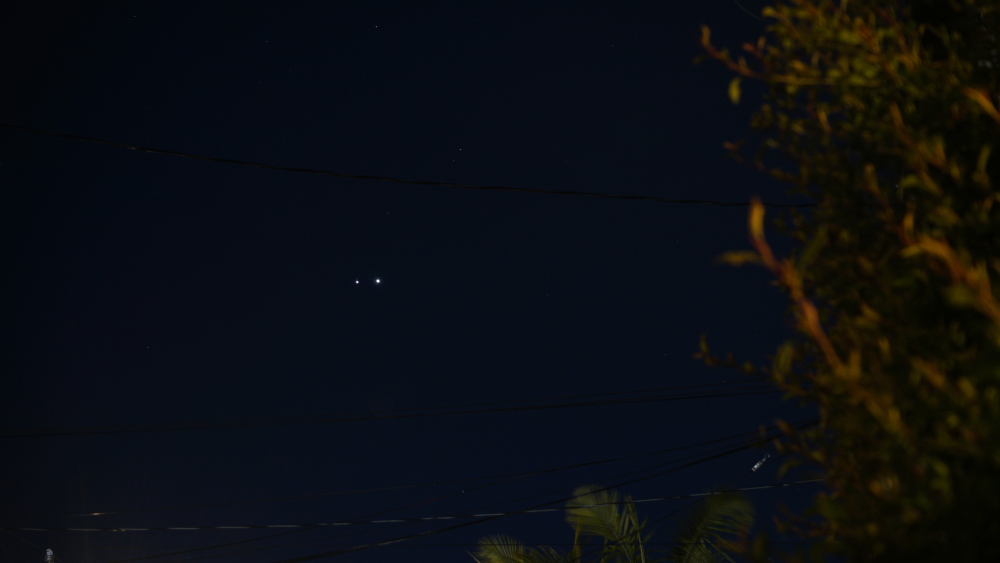
With rainstorms for the first half of the week, I figured the sky would be clouded over, and I completely forgot about the conjunction of Venus and Jupiter tonight.
Despite wind, rain and even hail today, it cleared up this afternoon. I happened to run out for groceries and looked up from the parking lot to see a blue sky with Venus and Jupiter right next to each other!
I snapped a quick shot with my phone. And then got out the good camera and tripod when I got home.
And…I think I may have caught some of Jupiter’s moons?!?
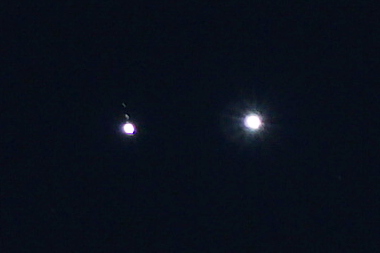
The brighter planet to the right is Venus. The almost-as-bright one to the left is Jupiter. Venus shows diffraction rays, but Jupiter doesn’t…but those dots lined up on one side of it? They’re in the right location to be Callisto, Ganymede and (possibly) Io!
I’ve got to remember to use the telephoto after getting the wide shot the next time I’m taking night sky photos with planets. Just in case.