Having picked up the Comic Cavalcade archives, I decided to go through all the Golden-Age Flash stories I had and catalog character appearances. I did the same thing with the Silver-Age stories a couple of years ago, when I completed my collection. Since $100+/book is a bit steep, I’m sticking with reprints, so it only took me a few hours to get through my collection instead of several months.
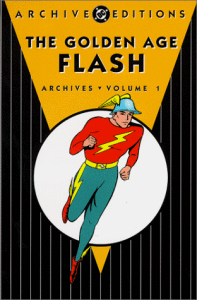
Golden Age Flash Archives Vol 1Now, there are lists and databases online already, but I like to be able to verify things directly when possible. I know how easy it is to make a mistake on a website and not catch it for months or even years. Also, most indexes aren’t really interested in the supporting cast. If I want to find a villain like the Fiddler, chances are I can find a complete list. But if I want to know which issues featured Jay’s old college buddies, I’m on my own.

And speaking of Jay’s old college buddies, he runs into five of them during the issues featured in The Golden Age Flash Archives, Vol. 1. And four of them are named Jim. There’s Jimmie Dolan, Jim Evans, Jim Carter, and Jim Dane. (Interestingly, the fifth friend is named Wally.) Jim Carter and Jim Dane are both in silver mining. Jimmie Dolan and Jim Evans both know that Jay is the Flash, but Jim Carter and Jim Dane don’t. I suspect that Carter and Dane are the same guy, but the writer didn’t remember the name he used before and didn’t feel like looking it up. (Comics were episodic back then, and you didn’t have continuity police among the readers ready to pounce on every coloring error.)

Also interesting: In the 17 issues collected in that book, no super-villains appear. The villains are all gangsters, kidnappers, corrupt politicians, crime bosses, etc. Even the story with the giant lizards has gangsters creating them. Skimming one list, the first recognizable villain to show up is the Shade—in issue #33! For the first three years (or at least the first year and a half), most of the Flash’s enemies wore ordinary business suits!
Comic Cavalcade was an anthology series that ran from 1942 until 1954, publishing super-heroes and other adventures for the first six years. Wonder Woman, the Flash, and Green Lantern were the headliners. Earlier this year, DC reprinted the first three issues as The Comic Cavalcade Archives, Vol. 1. (At 100 pages per issue, it’s still a pretty big collection!) I bought a copy a few weeks ago, mainly for the Flash stories, and it finally arrived yesterday.

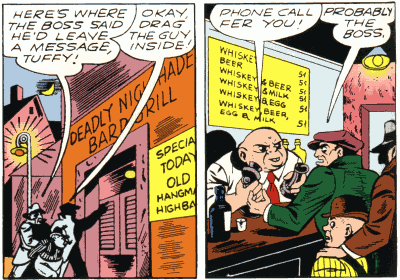
I read a few of the stories this afternoon, and these panels from the Green Lantern story in issue 1, “The Adventures of Luckless Lenore,” made me laugh out loud.

Two panels from Comic Cavalcade #1

Green Lantern’s sidekick, Doiby, has been trying to romance Lenore, whose “bad luck” seems to be engineered. At this point he’s been captured. I didn’t even notice the name of the bar the first time through, it was the menu that caught me off-guard. Continue reading

A tale of the Browser Wars on the high seas.

Harken, lads, and listen to my tale. It is the tale of the FyreFawkes, a vessel that turned the tide in the never-ending battle for the high seas.

In this day, shipping lanes criss-cross the ocean like a Web, and in years past, that web was commanded by the Fleet of the Navigators. Wherever ye wanted to go, a Navigator ship was there to take you. But the wealthy My Crows’ Loft Company controlled the ports, and knew that if they did not take command of the high seas, someone might use the Navigator Fleet to build their own harbors, outside My Crows’ Loft’s sphere of influence.

So My Crows’ Loft built their own fleet, a fleet of Explorer craft, and after a great trade war, their fleet dominated the ocean. The Navigators’ fleet shrank, nearly forgotten.

But My Crows’ Loft grew complacent in their victory, and the Explorer fleet aged. Worse, the vessels had weak spots and leaks that pirates and brigands of all sorts knew how to attack. What was once a pleasant voyage across the sea became a journey fraught with danger, with spies, phishermen, and great wyrms lying in wait for the unsuspecting voyager. Continue reading

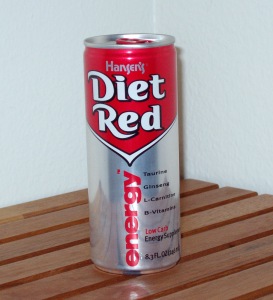
It’s always strange when you throw out wacky ideas, then see them turn into reality. About four years ago, a bunch of us were sitting around talking, and someone uttered the remark, “Diet Spite.” From there we filled an entire page with culinary brand names made from abstract concepts, not unlike the Wheat-Free Chaos we found a month ago.

One exchange went like this:

Kelson: “Diet Red.”
Daniel: “Sure, that’s red.”

So it was a surprise to find this can at Trader Joe’s:

Can of Hansen's Diet Red

Truth is stranger than fiction. It just takes time to catch up.

I’m thinking of a word. The definition is “a feeling of shock, sadness, compassion and sometimes guilty relief in response to a disaster that happens somewhere else.” It’s not “horror,” “rage,” pity,” or “sympathy.” It could be German in origin. It’s what a good chunk of the world felt after last year’s tsunami, and it’s what a goodly number of Americans are feeling now about Hurricane Katrina.

And it doesn’t exist.

People are good at making up words. The variety of creations added to the OED each year, and the number of suggestions that are rejected, prove that beyond a doubt. We even make up words without meaning to, running together utterances like “bighuge” and “goaheadand.” We have a word—emo—for “loud, emotionally charged pop-punk music.” Some of us know the word schadenfreude and aren’t afraid to use it. If we can encapsulate stuff like this, we should be able to pick a word or two to define the enhanced survivors’ guilt and horrific fascination, laced with uncharacteristic compassion, gripping so many of us.

So far, we haven’t.

Disasters happen all the time, and always have. We’re just getting better at broadcasting them all. Before the age of telegraph and radio, it was often too late to send rescue-type aid by the time bad news arrived. Today, we can get the news in an instant, but the majority of us are simply unable to give the kind of aid—airlifts, rebuilding, law and order—we perceive as most meaningful. We are isolated by distance and circumstance, so we send money, and watch, and hope. The more we are able to watch, the more we need a word for what’s making us watch. So everybody who’s working on the projects for how to write “whole nother” and finding the modern negative of “used to,” you have a new assignment. Due date: next disaster.

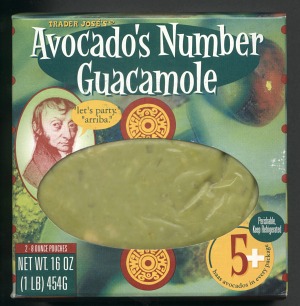
I’m sure every English-speaking chemistry student has joked about “Avocado’s Number” (the number of particles in a guaca-mole). Now the joke has gone professional, with this package we found at Trader Joe’s.

Avocado's Number Guacamole package from Trader Joe's

The back has a bit about Avogadro’s number, and admits that “there aren’t 6.0221367×10²³ avocados in here, but 5 plus avo’s isn’t bad!”

»All pages site-wide with this tag