
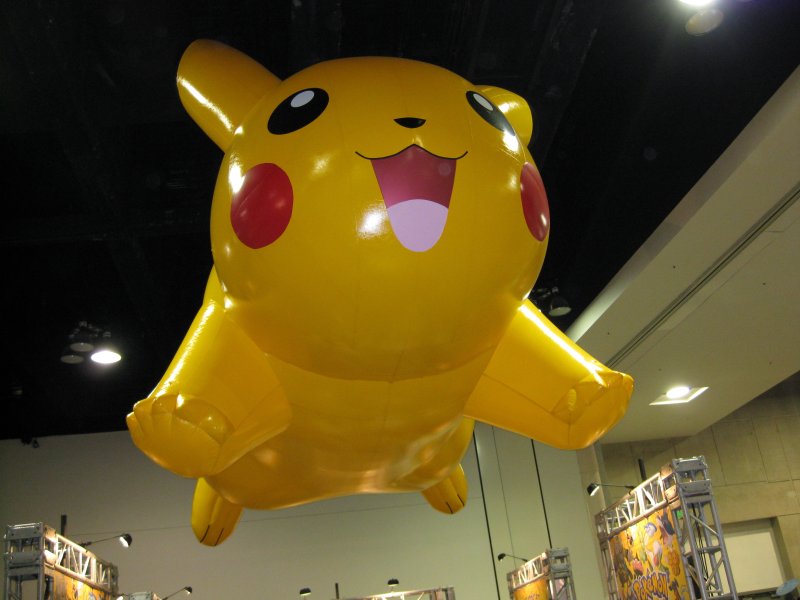
Here they are: Comic-Con 2008 Photos.
I’ve only got the first page or so labeled for now, but the photos should finish uploading by the time I post this. I’ll fill in the captions and titles over the next few days.
Here they are: Comic-Con 2008 Photos.
I’ve only got the first page or so labeled for now, but the photos should finish uploading by the time I post this. I’ll fill in the captions and titles over the next few days.
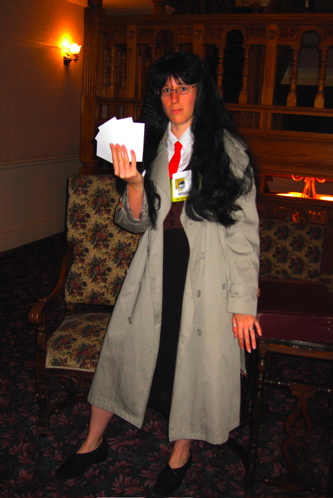
Katie’s hall costume for the day: Yomiko Readman, Paper Master — from the anime series Read or Die.
Friday was a good day for costumes at Comic Con.
*ahem* Sorry about the title, but when you read that a truck carrying 60,000 pounds of meat flipped over and burst into flames, it comes to mind.
I hope the driver pulls through.
The accident shut down the 5 freeway for most of the day Thursday. We were fine since we drove down yesterday, but a lot of people coming from the LA/OC area or farther north — including my parents, a lot of panel guests, and the driver with all those copies of Comic Book Tattoo — were stuck in the traffic jam for hours. It took us about 2 hours yesterday, including navigating the downtown streets to find our hotel during rush hour. My parents, coming from roughly the same distance today, made the drive in 6½ hours.
The problem is there just isn’t another way to get from there to here. Between Anaheim and Oceanside, there’s only one route inland, the Ortega Highway, and it’s a twisty little mountain road. And there’s miles and miles of freeway bordered on one side by the ocean and the other by Camp Pendleton. Naturally, it was in the middle of that stretch that the accident happened.
(Link via aeryncrichton)
A couple of years ago, Starbucks bought all 30 or so company-owned Diedrich Coffee stores. There were a couple of franchise locations left (well, kiosks, really) in Orange County, and one of the Texas stores, but that was it. Most of them were converted or shut down, with only two keeping the Diedrich name and menu (both in Irvine, oddly enough). The one across from UCI eventually got converted.
The Diedrich nearest where we live was always busy. After it had been assimilated, though, we never saw it full. People didn’t go there just because of the location, they went there because it was a Diedrich.
Now it’s on the list of stores that Starbucks is closing, along with a newer one that opened about a quarter-mile away. (They haven’t updated the web page yet, but it’s on the PDF.)
In essence, Starbucks bought an (apparently) successful business and ran it into the ground. I really hate when that happens.
Obviously the place, when it was a Diedrich, wasn’t taking money that would have gone to Starbucks, since their customers didn’t stick around when it was converted. And the one store that does still have the Diedrich name and menu always has customers whenever I end up in the area — so it’s not just people avoiding the parent company. It’s people who don’t like the Starbucks coffee and atmosphere. (And possibly the name.)
I have to wonder how that other store would have done if they’d kept it intact instead of homogenizing it.
Update: Martin Diedrich picked up the empty storefront after Starbucks left, and opened his second Kéan Coffee in March 2009. Once again, it’s always busy. Funny, that!
At lunch today, I saw a woman, probably in her 50s, wearing a fitted black T-shirt that said, in sparkly letters, “BOTOX”. Srsly. I couldn’t find any pictures of the design, but a commenter here says it’s a promo handed out to staff at plastic surgery clinics.
Comic-Con has completely sold out. Hmm, let me rephrase that. There are no more memberships available for this year’s Comic-Con International in San Diego.
Spam Karma has gone GPL — After years of support Dr. Dave has decided to stop maintaining his spam plugin and turn it over to the open-source community. The project is now on Google Code. Update 2015: And now it’s on GitHub.
This morning I found myself asking the question: How do you tell someone their gas cap is open at 65 MPH?
I was on one of those giant, arcing ramps connecting one freeway to another, and noticed that the car in front of me (a PT Cruiser, I think) had something flopping around on its side. It quickly became clear that it was the gas cap, still tethered to the car, with the open flap above it. As we both merged onto the next freeway, I contemplated: how could I tell the driver?
On city streets, I’d try to pull up next to the car at a red light, roll the window down, wave, maybe honk the horn, and then say, “Your gas cap is open.”
But on a highway with no stopping points, at a speed where safe driving distance would keep us out of earshot?
I thought about honking the horn. But what good would that do? A horn only says one thing: “Hey!” Sure, you can vary it a little to give it a sense of urgency — “Hey! Hey!Hey!” “Heeeeeeeey!!!!!!” But it doesn’t allow much for specifics. I suppose you could try Morse code, but I wouldn’t count on most people being able to understand it — I’m an Eagle Scout and I only remember 4 letters — and it would take too long to spell out a message anyway.
Should I try to get in the next lane, match speeds, wave, and try to point to the back of the car? No, that didn’t seem safe.
Flash my headlights? No, that had the same problem as the horn. Too vague.
Outside of the basics (turn signals & brake lights) and a few standard signals (flashing the brights to tell someone you’re passing) — there really isn’t a good way to tell another driver something specific, like “Your lights are off,” “You’ve got a coffee mug on your roof,” or “Stop trying to crawl into my trunk.” Which I suppose is just as well, judging by a random sampling of bumper stickers and the way people treat other drivers. The enhanced road rage might cause more hazards than the enhanced communication would solve.
As for this morning’s PT Cruiser, I eventually I saw it move over to the shoulder. I guess there must have been a warning light on the dashboard.
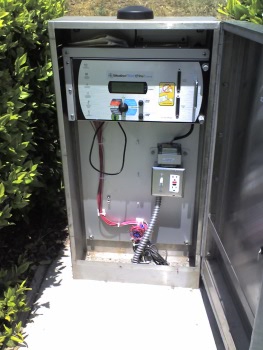
I’d always assumed these boxes were just the usual electrical, cable, phone or other utility access points. But I walked past this one a few weeks ago and saw it open. It turned out to be a station for gathering weather data.