I heard someone on the radio refer to the year as “two double-oh four” (2004), a pronunciation I had never heard before in my life. This fits somewhat with what seems to me the American tendency to speak the year 1906 as “nineteen oh six,” but we also tend to say “two-thousand four.” I have it in my head that people in England say things like “nineteen hundred six,” but then I’ve seen Orwell’s novel spelled out as Nineteen Eighty-Four.

Branching to other languages, my German classes taught me to speak the date as “neunzehn hundert vierundachtzig”—effectively the same phrasing I’m used to—but my Spanish classes taught me to say “mil novecientos ochenta y cuatro,” the equivalent of “one thousand nine hundred eighty-four.” Either could have been simplified for teaching purposes.

So I have to wonder—is this an American/Commonwealth issue, a regional issue, a romance/germanic issue? How do you say the date where you live?


Apparently [giant]* tsunamis are so rare in the Indian Ocean—once every 700 years—that there is no warning system in place. When the USGS detected the quake, they scrambled to send a warning, but couldn’t reach anyone in the area:

“We tried to do what we could,” McCreery said. “We don’t have contacts in our address book for anybody in that part of the world.”

Within moments of detecting the 9-magnitude quake, McCreery and his staff were on the phone to Australia, then to U.S. Naval officials, various U.S. embassies and finally the U.S. State Department.

Even with a warning system in place, it would have caused massive devastation, but there would have been time for many—maybe even most of the people who died (at least from the immediate deluge) to reach higher ground and safety.

Reportedly efforts are underway to set up a network.

Red Cross donation info.

*Update: I was recently looking back over this post & noticed the claim at the beginning, that tsunamis only hit every 700 years in the Indian ocean, and immediately thought, “this doesn’t make any sense!” I mean, Indonesia is kind of a hotbed of tectonic activity. Krakatoa, anyone?

The CNET article is still up, but didn’t offer any clarification. The exact quote was that “such catastrophes only happen there about once every 700 years.” But some quick searching turned up some clearer information: Tsunamis of this massive size are rare in the Indian ocean, not tsunamis in general. Here’s a 2008 Nature article on geological evidence for Indian Ocean megatsunamis over the past 2500 years, with previous events in the 1300s and 800s.

Dear [insert advice columnist here],

I moved out of my parents’ home four years ago and have been speaking to them and my sister less and less over time. They rarely have time to visit us, and it is impractical for us to visit them at their home, due to the amount of junk accumulated in their house and my husband’s allergies to their cats. When we do see each other, I find myself uncomfortable with them, both politically and socially, as our interests have diverged. Last Christmas, rather than give generic gifts that would go unused and further clutter their home, my husband and I chose to make donations to charities in their names, and picked foundations and causes important to them. At the time, they seemed to approve of our choice. However, three days ago, my mother called to ask if we would be doing this again so that she could tell everyone to donate for us instead of giving gifts. They are apparently displeased with our nontraditional method of holiday giving and do not want to give us tangible gifts if they will not receive them in return. I don’t mind this for myself, as I dislike the commercial mess Christmas has become, but I’m curious to know if others have received similar reactions, and what you make of the situation. I’m getting the impression that for some, the thought isn’t what counts.

Looking up past a bronze statue of a woman, seen from behind, toward an ornately carved balcony set in the wall of a stone building with three levels or peaked windows and doors. Vines trail from a wooden walkway the next level up from the balcony. It seems that the city of Verona wants people to text-message “Juliet” (of Romeo and…) [note: originally linked to Reuters] instead of writing notes and sticking them to the walls with gum. (Too bad it wasn’t in Singapore.) Apparently the notes are damaging the walls of the 13th-century building, and they want to set up a screen and have people send text messages to it using the phone.

There’s a small courtyard with a balcony, a gift shop, and a statue of the Shakespearian heroine. According to the article it was originally an inn, but has long been associated with the Capulets. “Acquired by the council a century ago, it was officially designated ‘the house of Juliet’ in 1935.” I don’t recall seeing any notes on the walls when I was there in 1999. Either I’ve just forgotten, or it really has gotten worse in the last five years.

Wow… a new issue of Rising Stars! To be honest, it was a bit of a let-down. Usually JMS is better at showing, rather than telling. He’s infamous for laboriously laying groundwork in the B-plots and character moments of what seem like “ordinary” stand-alone stories, then kicking the arc into high gear and making use of it all. He did it with Babylon 5 and Crusade, with the first arc of Rising Stars, seems to be taking the same approach in Supreme Power, and from what I’ve heard (though I’ve seen very little of it) he did the same with Jeremiah as well. If you’ve seen B5 once the story got going, go back and look at some of the first season episodes, and you’ll be surprised how early some elements are established.

This issue, however, though it had some nice moments, was basically a plot summary. “Poet tells the story of…” It seemed an odd narrative choice, particularly for an issue so near the end of the story (#22 of 24) and for the first issue to hit the shelves in nearly two years. Maybe it’ll read better in context.

Anyway, that’s not what I really wanted to talk about. What’s interesting is that in this issue, one of the Specials runs for President. It reminded me of something about the way comic books tell campaign stories. When a fictional character is in the race (or the office), he (it usually is a he) is almost always running under one of three circumstances:

  • As an independent.
  • On a fictional third-party ticket.
  • On an unidentified party’s ticket.

As we all know, third party candidates are rarely high-profile, and they rarely get significant numbers of votes, and I don’t think one has ever won the office*. Yet in comics, it happens all the time. Of course, heat vision, teleporters, and people who wear purple tights to fight crime are also commonplace. Continue reading →

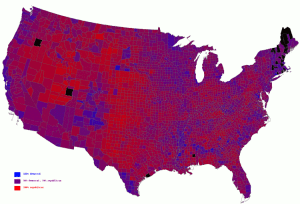
Veeery interesting! By now everyone’s seen maps colored in red/blue by state, which make the vote look very regional (the South and Midwest pull red, and the northeast, the West Coast, and the Great Lakes area pull blue). A map by county makes the country look extremely red, until you realize that many of the blue counties are the more populous ones, highlighting the fact that the split is primarily urban/rural.

A Princeton professor has taken the election results and produced a shaded map by county, with a full red-purple-blue continuum. Looking at this map, it’s clear we’re a lot more integrated than we think we are.

Thumbnail of map

Hat tip: from a comment on peterdavid.net.

»All pages site-wide with this tag