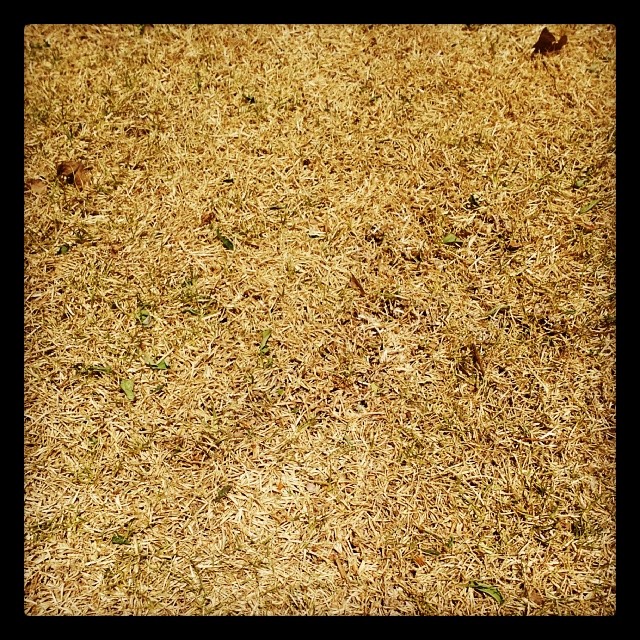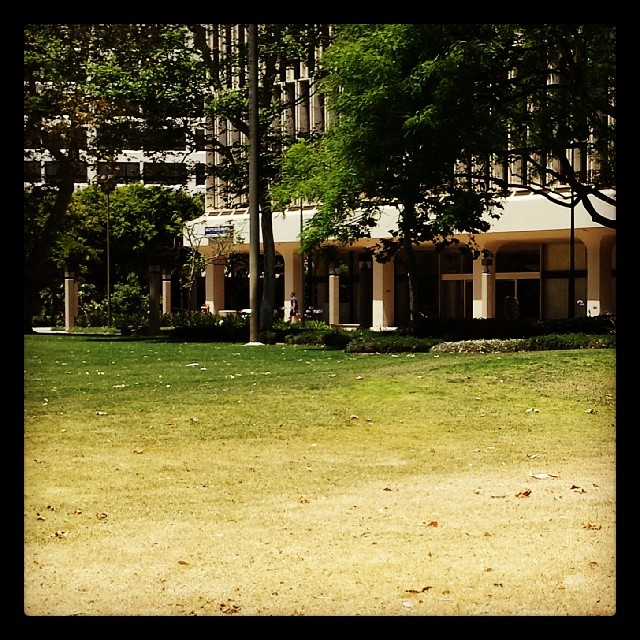
Since speculating idly on replacing roadside and median grass with more drought tolerant landscaping, I’ve started noticing spots around town that have done just that — some of them on my daily commute! An office building here, a mini mall there, an island, or the sidewalk strip in front of a single house. Not a sea change, but a beginning, or at least an experiment.

I’ve also spotted a few more houses that have taken out their lawns in favor of wood chips or rocks and a less-thirsty garden. Maybe it’s the variety, maybe it’s just that the people who’ve put in the effort to convert their lawns have actually, you know, put some effort into it, but they actually look better than a lot of the lawns out there. (As renters, we don’t really have the option of replacing the lawn, but we’re trying to be smarter about our patio and the strip we manage alongside a walkway.)

Spiky shrubs, lavender flowers, agave, and tufts of scrub grass are all common. Some of the roadside strips look like well organized chaparral. Birds of Paradise are common too, but I’m not sure how well they handle low-water conditions.

On the other hand, none of that helps if you keep watering like it’s grass, or use sprinklers that water the street and sidewalk as much as the soil around the plants. Just on my lunchtime walks I’ve found patches of grass where the dirt is always on the verge of becoming mud, and driveways that always seem to have puddles below them. Someone didn’t get the memo.

And then there are the strips of bare dirt that remind me why ground cover of one sort or another is necessary: erosion has left concrete plugs sticking up out of the ground around fence posts, or brick walls leaning out toward the street.

I suppose you could go the route I saw along one street: fill the island with concrete and paint it green. But that’s not only uglier than dirt (literally), it has the critical disadvantage that when it does rain, the water doesn’t even have a chance to sink in. And we desperately need to convert that rain to groundwater instead of flushing it all out to sea.

Landscaping

The city of Los Angeles recently finished replacing all of its streetlights with high-efficiency LED lights. They use less power, last longer, and require less maintenance than even the sodium vapor lights — an all-around win. They also cast a slightly bluish light, eliminating the amber look of sodium. But my first thought was that with all that work, they could have taken the opportunity to combat light pollution. The night sky doesn’t seem any darker than it did when we moved up to this area.

Then I took a good look at these LED street lights near work. The new fixtures actually do aim all the light downward, shielding upward leakage. They’re plenty bright from the ground, but from a few stories up, I couldn’t tell which lights were on without looking below them to see whether there was a pool of light on the ground.

So if the streetlights really are leaking less light into the sky, why is it still so hard to see stars to the north? Seriously, I can see Orion clearly most nights, but the Big Dipper is practically impossible to pick out.

  • It was a city project, not a county one. There are plenty of other cities in the area that either haven’t been converting their lights, or have only converted a few.
  • They didn’t actually convert all the streetlights in town, just the standard, boring ones (141,089 of them). Phase 2 is converting decorative street lights.
  • There are lots of other lamps that leak light upward: Parking lots, building lights, private roads. LAX is to the north, and there’s a reason for the phrase “lit up light a landing strip.” There’s also a park nearby with a baseball field; those lights drown out quite a bit when they’re on.
  • The ongoing drought has caused smog levels to climb, making the skies hazier.

Rain lit up by a car headlight.Speaking of the drought, I found myself wondering: How much water would we save if the city did a similar project to replace all the grass along street medians, parking lot boundaries, etc. with drought tolerant native plants? A home lawn at least has a potential use as a gathering place, or a play area. But a little strip of lawn six feet across? What’s the point?

And what do they do with medians out in the high desert, anyway? I remember driving out to Joshua Tree once and noticing in one of the towns along the way that all the houses were built on a standard suburban lot plan with space for a lawn, but that they used it for rock gardens, or native plants, or just left it empty. But I can’t remember what they put along the sides and middles of city streets.

And that gets me to the other article: It was a summary of a study on the vulnerability to climate change in various parts of the region. Most of LA will handle a rise in sea level fine, except for the beaches, Marina del Rey, and San Pedro…but depending on how the climate changes, most of LA would be vulnerable to severe flooding.

In any given decade in California, you can expect at least one drought and at least one winter of heavy rains and flooding. And sometimes those floods can be spectacular. A flash flood in 1825 changed the course of the Los Angeles River (it used to flow into what’s now Marina del Rey). And then there’s the Great Flood of 1862, which covered huge swathes of California and Oregon with water, including all the lowlands of what are now Los Angeles and and Orange County.

So in addition to planning for drought, the region also plans for the occasional flood — unfortunately, by trying to channel all that water out of the way as quickly as possible, because, as the study pointed out, more than 80% of the ground in the area is covered with impermeable surfaces — you know, asphalt, concrete, buildings, etc.

They do have spreading ponds to replenish groundwater from at least part of the storm drain system, but a lot of that water just goes straight into the ocean, and in heavy rains, the ponds get overwhelmed anyway.

It just seems like there ought to be a better way to capture the rain we do get.

The recent approval by the EU of King.com’s trademark on the words of their own title “Candy Crush Saga” for use in game and app titles, and the resulting flurry of infringement allegations, is of particular interest to me. Not as a CCSaga player, although I am one. (Level 491, used to comment on my levelup posts with helpful advice for other players, have accidentally spent real money but never won a level by using purchased powerups.) Not because I think it’s ridiculous, although I do. Not because I’m outraged about one more case of the big guy going after the little guy (“All Candy Casino Slots – Jewels Craze Connect: Big Blast Mania Land” excepted and notwithstanding), although I am. Not because I think CCSaga has used underhanded tricks to winkle money out of its players, or because I dislike the deliberate manipulation of addiction mechanisms by game developers, or because I resent the social gaming model for making participation as much a responsibility to your friends as a pastime for yourself. All relevant and true, but the real reason I’m following this story is that I’ve been involved with King.com since before CCSaga existed. I know where it came from, I’ve been watching its evolution, and I’m interested to see what this episode does for (or to) the company as a whole. Continue reading

My first hint that something was wrong this morning was the extremely yellow sunlight coming in around the blinds as I got ready for breakfast, the color you expect right at sunrise or sunset, not after the sun’s already up. Once I walked outside it was clear there was a fire somewhere in the area, and as I walked around the building I could see smoke filling half the sky.

It only filled half the sky, though. The smoke rose from the fire near Glendora, at the base of the San Gabriel Mountains northeast of Los Angeles, and drifted south to Orange County before winds blew it west across Long Beach, San Pedro, and the Palos Verdes peninsula.

Off to the west of the plume, the skies remained clear. Clearer than usual, in fact, because high winds had blown all the smog out to sea over the last few days. To the north and west, the sky was a gorgeous blue, the mountains and distant city skyline crystal clear. (If you view the larger image on Flickr, you can spot downtown LA right next to the first telephone pole on the left.) Smoke in the southeast turned the sun orange, bathing the area in light more suited to the golden hour.

A few miles north and a bit later, this view looking south shows the clear blue northwestern sky reflected in the building, the smoky southern sky behind it, and another building lit orange by the smoky sunlight.

Looking up at a whole bunch of old-fashioned lampposts clustered together, ridged columns and lit globes seen against a dark blue sky.

Urban Light at LACMA is a large square filled with over 200 lamp posts that the artist collected from various locations over several years, spaced wide enough to walk through comfortably. It’s like being in a forest of lamp posts — perfect for this week’s challenge.

The funny thing is, I wasn’t even planning on going there. We went to see the La Brea Tar Pits and Page Museum at the other end of the park. Oil has been seeping out of the ground for thousands of years, trapping animals and preserving their bones in an incredible collection of ice age fossils. But the parking lot on that side of the park was full, so we parked in the LACMA structure at the other end.

Photo challenge (WordPress): Light Continue reading

»All pages site-wide with this tag