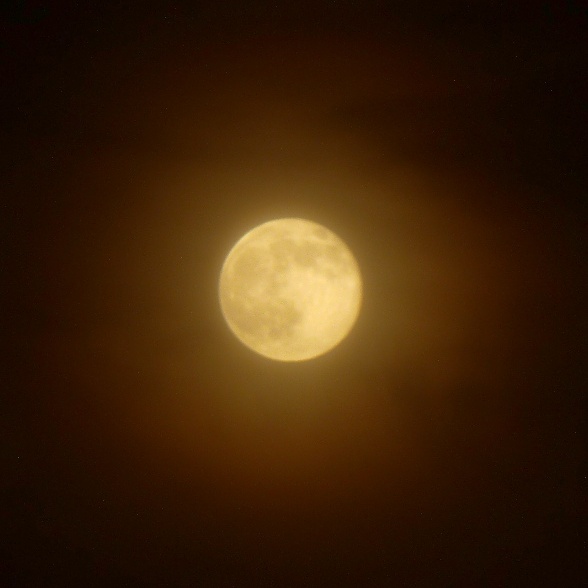
Supermoon July

Last night’s “supermoon” rising through light clouds. Spotted, oddly enough, while walking past a Supercuts.

It wasn’t quite as cool as a week ago, when I was driving home late at night and watched the first-quarter moon setting like a giant orange slice near the horizon. But I didn’t have my camera, and wasn’t sure about stopping somewhere unfamiliar at midnight to take photos.

As it happened, last night I did have my camera in the car. I took a few shots bracketing the clouds and the moon face. I combined them with Luminance HDR, mostly to see if I could. It’s not fantastic, but it’s better than my phone would have managed (though it actually takes better photos in broad daylight than my camera does).

Times like this make me wish I had a DSLR camera, but I have to be honest: Chances are I wouldn’t have had it with me.

Speaking of HDR, my brain decided that it needed to be pronounced as a word instead of initials. Three guesses as to what vowels it decided to add!

Go ahead. Just try parking there.

The office building where I work shares a parking garage with two other office buildings, two hotels, and an airport parking service. It can get crowded, and the spaces are so narrow and tightly packed that it’s a safe bet any given row will have two or three “open” spaces that won’t actually fit anything but a Smart car or a motorcycle, because the cars on either side are just a little bit too close to each other.

Or sometimes they’re parked at an angle into the next space, or flat-out taking up two spaces. That’s when I wish I could call them out by, I don’t know, slapping a sticker on the car that says “I’m an asshole who doesn’t know how to park.” Or starting youcantpark.tumblr.com — oh wait, someone’s done that.

It’s infuriating, especially on days like this past Friday, when I drove up and down the entire structure for half an hour looking for a spot. It took so long that my Prius shut off the electric motor due to low battery…and then turned it back on later, because all the driving on the gas motor had charged it up again.

I finally stopped at the end of a row, when two men got into a van in the last space and turned on the engine. Next to it was one of those technically-open-but-not-really spots. Behind me was another car whose driver had been following me down from the top floor, checking and discarding the same too-narrow spaces along the way. We sat there, waiting, while they sat with the engine on and the doors closed. Eventually I put my car in park, went back to talk to the guy waiting behind me, went up to talk to the guys who insisted they just needed a few more minutes before they could leave (really? they couldn’t back out, let two cars park, and find a place by the side of the aisle to let other cars by?), and just as I was about to pull over to the side so he could go around, they started backing out. I pulled into the second spot, leaving the last one clear for the car behind me.

FINALLY!

But why had it been necessary? I had passed probably 30 spaces that I could have parked in, if only the people who’d parked on either side had put in a little more effort. Obviously, people are jerks, right? They chose to park badly…but they didn’t make that choices in a vacuum.

  • Narrow spaces make it tricky to begin with.
  • Small errors compound as a row fills in.
  • On a bad day, it gets really frustrating to find a space you can use, and when you finally do, chances are you just want to get it over with and get the hell out. On the off chance that you found two spaces next to each other, you’re not necessarily going to be thinking about whether you’ve left room for someone next to you.

Sure, people have made a lot of individual choices to park in ways that make spaces unusable…but this isn’t a problem in most parking lots. The design of the garage encourages people to park badly. I suspect that re-striping this lot to have fewer spaces per row would actually allow more cars to park here. Maybe splitting up the width of one space along the entire aisle would be enough to lessen the impact of small errors — and frustration — that often leaves them with two or three useless spaces each. That’s a net gain of one or two cars per aisle, which doesn’t sound like much, but at 2 sides × 8 lanes × 7 floors, that’s an extra hundred or so cars that could fit, with less frustration on the part of the drivers. That sounds like a win to me.

It’s clear that many people online don’t understand the concept of dosage or concentration when it comes to substances of any sort (food, drugs, additives, environmental factors, chemicals*, radioactive isotopes): Something can be harmless or even beneficial in small amounts, but dangerous in large amounts.

Trivial examples:

  • You need salt for neural function, but if you drink sea water you’ll get sick.
  • Vinegar is dilute acetic acid. It’s useful for cooking and great on salads. Highly-concentrated acetic acid is corrosive.

Think of it like turning the steering wheel on your car (or the handlebars on your bike, if you prefer):

  • Turn it too far, and you go off the road, lose control, spin out, or otherwise crash.
  • Turn it just right, and you change lanes, avoid an obstacle, or go down a different road.

Also, most things will have multiple effects, some positive and some negative. (Consider aspirin: pain relief, fever reducer, blood thinner, but high doses can cause ulcers.) The balance of how strong each effect is will change with dosage, so you might have a strong positive and mild negative at one dosage, and a mild positive and strong negative effect at a higher one, and at an even higher dose even the positive effects would become negative as described above.

So the next time you see a warning about how hazardous something is in high concentrations…think about whether that has anything to do with the level at which people are actually exposed to it in the typical case.

*Remember: Everything is made of chemicals, including raw organically grown food.

Dried-up lawn Lawn gradient

The office building next door to work is being converted into a hotel, and the lawn has become a staging area for the renovation work. They’ve turned off the sprinklers, leaving the lawn around the building dried into very short straw and producing an interesting gradient in the transition from watered to unwatered.

I kind of hope they’ll put in something less water-intensive than a new lawn when they’re done, but I’m not counting on it.

In February, a 55-gallon drum of radioactive waste burst at a storage facility in New Mexico. The investigation has pinned it on a surprising culprit: Kitty litter.

It turns out that the clay is perfect for stabilizing volatile compounds, so they use it when storing radioactive waste. But somewhere along the line, someone switched to organic kitty litter, which was plant-based…and chemicals in the litter reacted with the chemicals being stored, causing it to heat up and expand.

The off-the-wall nature of the story appeals to me, but it also nicely illustrates several points:

  1. Just because something has a scary industrial use, that doesn’t make it harmful for more mundane uses, like lining the cat box. (See also: cleaning with baking soda and vinegar.)
  2. Everything has chemicals in it, even totally green organic products. That’s what complex materials are made of!
  3. Organic/natural is not always better. It depends on what you’re using it for. (Though to be fair, clay is natural too.)
  4. Swapping out ingredients might be fine sometimes, but not always. Write clear specs if you’re designing, and follow them if you’re building/procuring. (See also: Substituting a common allergen for a rare one, and “I chose X because of Y.”)
  5. We still don’t have a real solution for disposing of radioactive waste, only storing it.

»All pages site-wide with this tag