If you’ve been following the Firefox 4 betas, you’ve probably noticed that they’re dumping the status bar. OK, a lot of people didn’t use it, but here’s the thing:

When you hover over a link, the status bar tells you where it will take you.

This is important (especially for security) — important enough that they’ve moved the functionality elsewhere…but in a broken manner. They’ve put it into the location bar — you know, the field where you type in a URL, or look to see where you are.

The problem is that there isn’t room in the location bar to show the full URL of a hovered link except for very short links. The status bar has the entire width of the browser. The location bar has to share that space with the navigation buttons, the search box, the feedback button (during the beta), any custom toolbar buttons, the site name on secure websites, etc.

Just about every link I hover over ends up with critical information cut off in the “…” between the start of the hostname and the parameters at the end. That’s almost useless. (Almost, because at least the hostname is visibla, but it would help to see the page name as well.)

Displaying the target URL in some way is core functionality for a web browser, and you shouldn’t remove or break core functionality. In some ways this is worse than the proposal a few years ago to remove “View Source,” because that at least isn’t core functionality for a browser (though it is core functionality for the web, because it encourages people to explore and tinker and learn how to make their own websites — which is exactly why that was put back in). It’s crazy that I need to install an add-on to get back something as basic as a working preview for links.

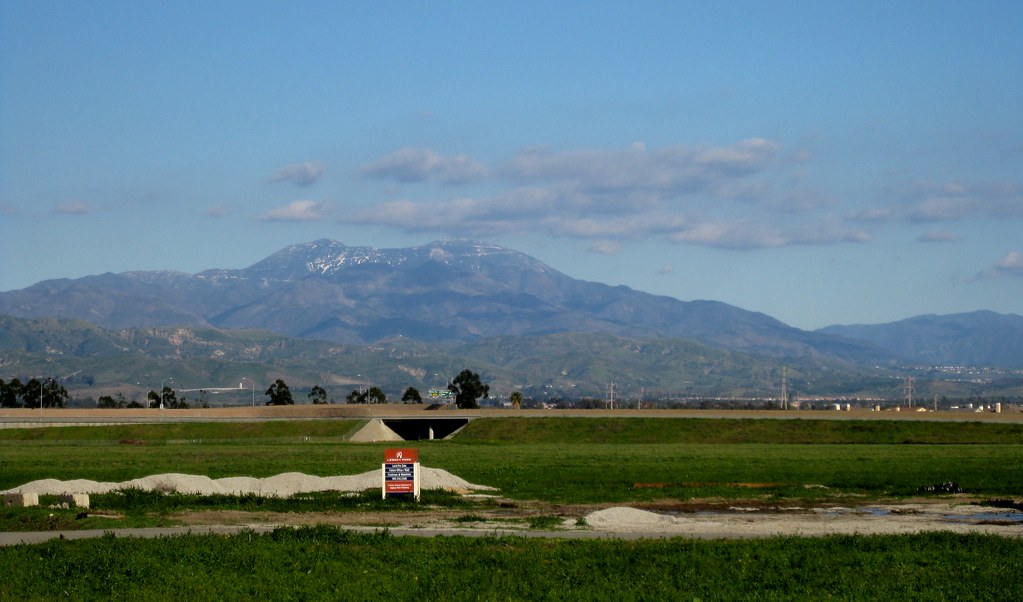
Well, technically, during a lull in the storm. The clouds were moving very fast, with light and shadow moving over the empty fields and office parks, and I waited several minutes for the sun to play over this scene.

I particularly liked the contrast of the dead brown tumbleweeds scattered around the bright green meadow.

My one regret with this photo is not being able to capture the steep drop-off into a wash right below the frame. I could get the wash, or the sky, but not both.

The large barn-like structure used to be a packing house for the Irvine Ranch farms, and is now split between a motel (the La Quinta Inn) and a group of restaurants.

While writing up my last post, I remembered something that really bugs me on Metrolink’s website.

The fare calculator tries to make the train cost look more appealing by showing you how much you’d spend driving the same trip, using a factor of 54.1 cents per mile from AAA’s driving cost formula.

Two problems:

1. They’re using the average value of all the cars on the road. Drive a gas-guzzling Hummer? A fuel-efficient Prius? Same cost estimate.

2. They’re using the formula wrong. It’s not intended to answer the question of “How much does this trip cost?” but “How much am I spending overall to use this car?” So in addition to fuel and maintenance, it also includes static costs of owning a car, like registration, insurance, interest payments, etc. Things that you’ll be paying whether you drive it today or not.

So unless you own an average car and plan on getting rid of it entirely, the comparison doesn’t actually tell you anything useful. But it does make Metrolink’s ticket prices look cheaper.

A couple of months ago I started a job near LAX. I live in central Orange County, 40 miles away. Unfortunately, that includes driving through the mess of Los Angeles freeways during rush hour. It’s a horrendously frustrating slog through stop-and-go and slow-and-go traffic that has me ready to gnaw off my own leg well before I get to work.

To make things easier, what I’ve been doing is driving about half-way to the end of the LA Metro Green Line in Norwalk, then taking the train the rest of the way. It’s worked out pretty well so far:

  • It cuts my driving time in half.
  • The part of the drive that it cuts out includes the worst of the traffic (east-west on the 105, or 405, or 91).
  • I get some extra reading time.
  • It’s relatively cheap ($1.50 each way, plus 35¢ to transfer to a local bus for the last mile).

It saves a lot of stress. The main downside is that I can’t drive anywhere during lunch, but at least there are a lot of options within walking distance. Unfortunately, the parking lot in Norwalk is often full when I get there, so some days I end up driving the whole trip anyway.

In theory, I could take trains the entire way. There’s a Metrolink station a couple of miles from where I live. Unfortunately, the Metrolink system and Metro system only share one transfer point: Union Station in Downtown Los Angeles. I’d have to go really far out of my way, and transfer across two or three different Metro lines. Or else stop at Norwalk/Santa Fe and take a bus across town to the Green Line. With all the extra transfers, it didn’t seem worth it.

Still, the first day back at work after J was born, I figured my sleep-deprived self could use the break.

The Metrolink Experience

The thing to remember is, Metrolink isn’t light rail. It’s commuter rail.

The ride itself? Great. The trains were nice and roomy. Some of the cars had seats with tables. I even tethered my laptop to my phone to catch up on some blogging.

On the downside…

It’s expensive. Metro costs $1.50 to ride anywhere in the system, plus 35 cents to transfer to a bus for the last mile. Metrolink costs me $7.75 each way, but includes free Metro & local bus transfer. Monthly passes, of course, would cut down both prices.

Trains don’t run as frequently. I missed a train and had to wait 40 minutes for the next one. (I actually missed two trains, the first because I had to drive around the block to the alternate parking lot…so I spent an hour waiting just to get on the train.)

Trains don’t run into the evening. The last Metrolink train heading south from Norwalk leaves at 6:51. With two buses and a train between me and that train station, and every transfer a potential delay. This time I lucked out: The bus I took from work got me to Aviation station just in time for me to catch the green line, which got me to the end of the line just in time for me to catch the Norwalk bus, which got me to the Metrolink station with 5 minutes to spare. Just a couple of minutes at any of those points could have added 10-20 minutes of waiting and left me scrambling for an alternate way to make those last 20 miles home.

That last one is the kicker. For me, the main point of taking the train instead of driving is to reduce stress so that I can focus better when I need to. If I have to spend half the trip home worrying about making that last train, what’s the point?

»All pages site-wide with this tag