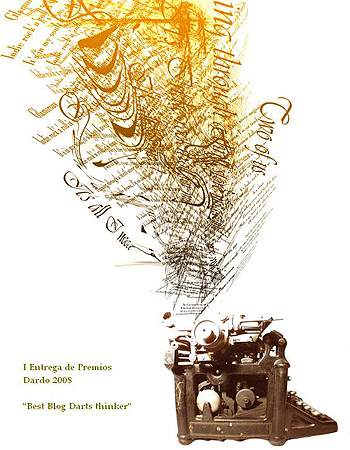
The “Premio Dardo” award has been sweeping through comics blogs over the last week or two, and Groovy Superhero bestowed it upon my comics blog, Speed Force. The idea is that someone gives you the award, then you pass it along to other bloggers you appreciate.

It’s basically a chain letter or tagging meme, in the form of an award.

I was curious as to where the meme actually came from, and did some digging. I didn’t find much of anything conclusive, but I did find some interesting things:

Premio Dardo: I Entrega de Premios, Best Blog Darts Thinker

  • “Premio Dardo” means “Dart Award” in Spanish, which fits with the “I Entrega de Premios Dardo 2008” text. (This means that “Premio Dardo Award” is kind of like “La Brea Tar Pits” in that it literally means “Dart Award Award.”)
  • The oldest post I could find in English was October 29, 2008
  • Looking up the Spanish phrase from the image, I was able to trace it as far back as February 2008 on Spanish-language blogs.
  • There are at least two versions of the image: One large, with text in the empty space at the lower left. The other small, with a black border and text in the border like the much-parodied motivational posters, and labeled as “Premio Dardos.”
  • There are at least two different descriptions of the award in English:

    This award acknowledges the values that every blogger shows in his or her effort to transmit cultural, ethical, literary, and personal values every day.

    and

    The PREMIO DARDO is designed to recognize unique voices and visions on the Web as well as to promote fraternization amongst bloggers of all sorts.

  • The number of blogs you’re expected to pass along the award to is variously given as 5, 10, 12, and 15.
  • Blogspot’s search doesn’t seem to work.

The text on the oldest version I could find reads:

La I Entrega de Premios Dardo 2008 se abre paso entre un gran elenco de Premios de reconocido prestigio en el mundo de la literatura, y con el reconoce los valores que cada blogger muestra cada día en su empeño por transmitir valores culturales, éticos, literarios, personal, etc.., que en suma, demuestra su creatividad a través su pensamiento vivo que está y permanece, innato entre sus letras, entre sus palabras rotas”. El premio debe acoger en su interior a un mínimo de 15 bloggers

Roughly translated:

The Dart Awards Ceremony I 2008 appears among a large list of prestigious awards in the world of literature, and recognizes the values that each blogger shows each day in their efforts to convey cultural ethical, literary, personal, etc. values… in short, it demonstrates his creativity through his vibrant thoughts, which remain innate within the letters, torn between his words. ” The prize must encompass at least 15 bloggers

I surmise that:

  • Somewhere late last year, the meme jumped from Spanish to English, with only a partial translation of the description.
  • Somewhere along the line, the description fell off, and someone wrote a new one.
  • Many recipients found it hard to choose 15 blogs, and shortened the list. The shorter number got passed along.

I do have to wonder about the branching factor.  Each recipient passes the meme along to 5–15 new recipients, which means that if they react quickly, the number of Premio Dardo recipients will increase dramatically (think Tribbles).  If it started out more than a year ago, it’s had plenty of time to overrun the blogosphere.  I can only assume that a significant fraction of people who receive it just ignore it, producing dead ends on its path.

Or maybe there are just a lot more blogs out there than I think there are.

The Top 10 Reasons I Will Not Follow You in Return on Twitter is making its way around…well…Twitter today. Just reading the tile makes me wonder: why would someone expect to be followed in return? I guess it comes down to this question: What does it mean to follow someone? Is it different from friending them? And just what does “friend” mean in this context, anyway?

The way social networking sites use the term “Friend” has always bugged me. The actual software for Facebook, MySpace, or LiveJournal seems to use it to mean two distinct things:

  • An actual friend, someone with whom you interact on a personal basis.
  • An entity whose posts you’re following because you’re interested in the content, rather than invested in the person.

Wishful thinking aside, reading Neil Gaiman’s blog regularly doesn’t make me his friend.

Okay, so “Friend” is shorthand, but it brings in a load of connotations, blending the two meanings. People will freak out when a stranger “friends” them, will feel insulted if someone that they’ve friended doesn’t friend them back, or will feel rejected if someone de-friends them. I’ve heard it suggested that one reason people move from one social network to another is to start over with a clean slate of friends, and not have to worry about the drama of removing anyone from their current friends’ list.

Twitter, with the simple and direct term, “Follower,”, doesn’t seem like it would bring in the same level of baggage. To me, clicking “Follow” doesn’t feel like it has the same emotional weight as marking someone as a friend. I follow accounts that I find interesting, and that I actually have a chance of keeping up with. If someone follows me, I don’t feel obligated to follow them, and if I follow someone else, I don’t expect them to follow me.

So I was perplexed when I started seeing new followers showing up on my personal Twitter account who clearly had only done a keyword search on my latest tweet, or looked at who I was following. What were they expecting? That I would look at the “XYZ is following you!” email and trace it to their website? That I would follow them back?

It didn’t make any sense to me.

Of course, now I’m sure they were expecting me to follow them back. As this article suggests, a lot of people do see “Follow” as a synonym for “Friend”, and they were most likely trying to game that system.

In other words, despite the terminology, Twitter’s stuck with the same old baggage that clogs up other social networks.


It’s been a little over a month since I upgraded to a T-Mobile G1. Overall I’ve been very happy with it. The Internet-related features are great, I’ve gotten used to how most of the functions work, and I’ve tried it out under various circumstances and played with a bunch of applications. The only problems I have, oddly enough, are with its functionality as a telephone. Continue reading

For the longest time, I figured Twitter was little more than a social toy. But after signing up two months ago, I’ve completely changed my view. Here are five lessons I’ve picked up.

1. There are many ways to use it.

Twitter asks the question, “What are you doing?” Some people answer that, and post things like, “eating dinner.” Some people ignore it and post other thoughts. Among the uses I’ve seen:

  • Running commentary throughout the day.
  • Random thoughts.
  • Announcements, particularly bloggers announcing new posts, or news sites announcing new articles.
  • Hey, look at this link I found. (The classic linkblogging post.)
  • Conversations with other users.
  • Even a story told one line at a time. (@Othar, a side story connected to Girl Genius)

It can replace a blog, or complement it.  Mine started out just as another feed for updates, but I quickly realized I could post small stuff on Twitter and save the blog for the long posts like this one.

I’ve seen some people who post 20 times a day, and others who post once or twice a month.

2. Writing short posts can be liberating.

You don’t need to think of a catchy title. You don’t need to worry about structure. You don’t need to worry about fully developing an idea. And the rapid-fire nature of the site gives you a sense that you’re only worrying about now. No one expects you to be profound. All you have to do is jot down your thought and fire it off.

3. Writing short posts can be frustrating.

One of my high school teachers used to quote this adage: “If I had had more time, I would have written a shorter letter.” It’s easy to ramble. It’s hard to edit. And it’s really easy to run into that 140-character limit, especially if you’re including a link (even if you use a URL shortening service like tr.im).

Sometimes I think what I want to say is short enough to fit, but I find myself spending several minutes trying to rephrase it, use shorter words, cut out unnecessary phrases, and, if I have to, abbreviate words just to cram it into that tiny space.

On the plus side, the result is usually very concise.

Continue reading

»All pages site-wide with this tag