The wind shifted during the day, and by mid-afternoon the sky near where I work was considerably clearer—even though the fire seemed to be getting closer.

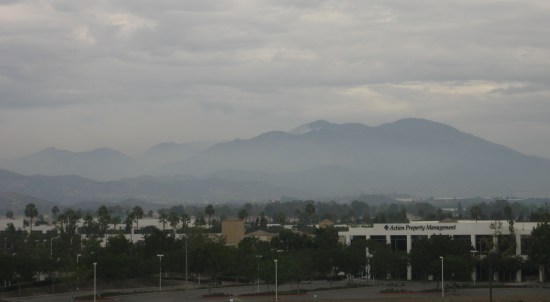
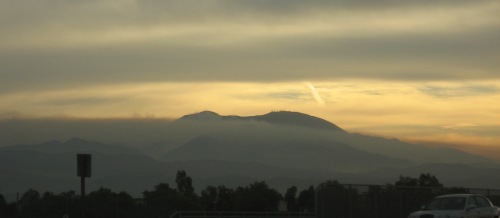
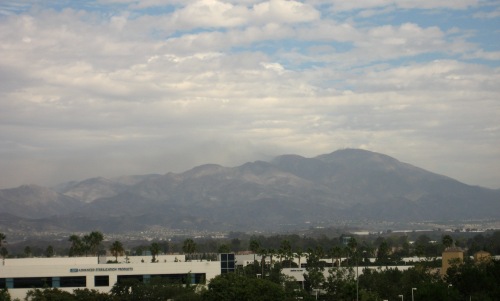
Mt. Saddleback viewed from Tustin foothillsLenticular Line (large)Some geography: The Santa Ana Mountains run parallel to the coast, and form the northeast border between Orange County and Riverside County. Here are a couple of photos from older blog posts showing the hills and the mountains in the background (though from very different angles).

The fire “broke out”* in the foothills on the western side of the mountains. One side went straight over the line of hills and down toward the flatlands, threatening homes in northeastern Irvine last night. That was stopped, but it continued along the canyons to the end of this set of hills, and last I heard had reached the edges of neighboring Lake Forest.

I think the front may have gotten within 4–5 miles of where I work, though we couldn’t see anything but smoke in that direction until late in the afternoon. Every so often I’d wander over to a conference room that normally has a clear view. Off to the northeast, everything faded to brownish gray. It faded to the southwest as well, but at least I could see silhouettes of the hills in the opposite direction.

I did, however, watch ashes floating by horizontally, 4 stories up.

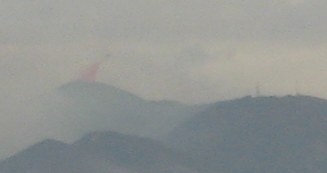
Toward mid-afternoon, the wind (and fire) shifted, moving the worst of the smoke plume away, and outlines became visible. I took this one around 5:30, and you can just see the (likely) charred and smoking hills. (Notice also the orange balloon off toward the left.)

Smoking Hills

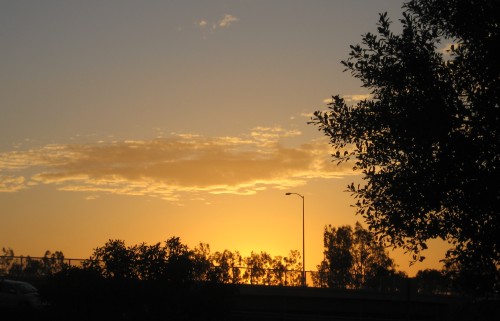
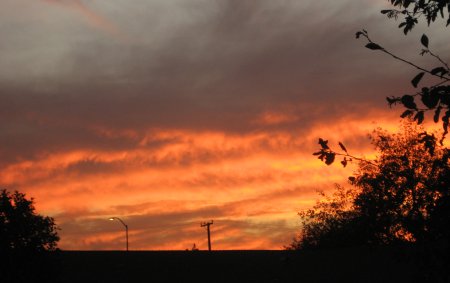
With all the smoke in the air, the sunset colors were intense. As the sun sank, it was a brilliant orange.

Orange sunset

Magenta sunAs it neared the horizon, dipping deeper into the layer of smoke, it turned almost purple, and was dim enough to look at directly. (Not that I stared—I’ve seen Pi after all!)

We got a break from the wind for several hours, which just ended minutes ago.

*Reports are that it was arson. What the hell is wrong with people who do this sort of thing? It’s not enough to set a bonfire, or even just burn down one structure—you have to burn down 15,000 acres of wilderness and possibly people’s homes?

Fire map as of 8:00 AMNo 3AM evacuations, though we’re several miles away from the danger zone anyway. The Santiago fire we spotted yesterday was stopped before it crossed into suburbia, but judging by the OCFA map it was a near thing. Now it’s burning southeast, into the hills and toward the canyons. Some of which are inhabited. (Yes, there is a rural Orange County.)

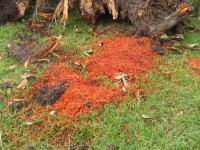
Downed TreeWe got some pictures of the fallen tree this morning. It managed to rip up a chunk of grass and displace a plastic divider, but it doesn’t seem to have damaged the walkway or stairs.

The winds are still going, which made the drive this morning… interesting. Leaves skittered across the road, swirling in dust devils. Some eucalyptus trees looked like they were bending at at least a 30° angle (and back again). My office turns out to be directly in the path of the smoke plume, which made for an odd view as I drove into it.

Passing into a smoke cloud

I’ve got some photos of a sepia sky, orange sun, and palm trees with all their leaves on one side, which I’ll try to post tonight, though it looks rather like the photo I posted during the October 2003 fires.

Smokey Spectrum

When I got to work, a few ashes were floating to the ground. I’m sure some of them managed to get into the car when I opened the door, which is rather annoying. There didn’t seem to be that many of them on the ground, until I noticed movement on the pavement. The ashes might look light-gray in the air, but they managed to blend in perfectly with the asphalt. That, and the wind seems to have blown most of them up against the curbs, where there’s a solid layer of ash.

The building, normally an off-white color, looked decidedly beige in the orange light. Everything looked faded. Well, almost everything. The iceplant around the parking lot edges looked greener than usual. It makes sense, since it’s normally bluish-green, and the orange-yellow lighting would cancel out the blue. Inside, the smell of smoke has permeated the building.

Update: Added photos.

The Santa Ana winds arrived in earnest overnight. We spent most of the day indoors, going about our usual business with the howling wind and occasional thump in the background. I’d glance up from my book (I’m about halfway through Regeneration, the conclusion of Julie Czerneda’s 3-part Species Imperative) and look out at the trees as the branches shifted, making the leaves shimmer.

We went out for a late lunch/early dinner, and noticed it smelled like smoke outside. There wasn’t any smoke visible, though. There were lots of trees bending as the wind gusted, including a conical juniper whose tip would bend over even further than the rest, then flip back, like a finger beckoning or a hand waving good-bye.

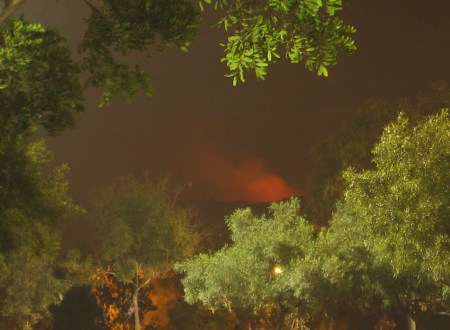
After dinner we ran a few errands. Around 6:00, we walked out of the S-Mart* in Tustin and saw a huge billowing cloud of smoke rising in the distance. All we could tell as we walked through the parking lot was that it was coming from the hills off toward Saddleback. I decided to go to the Best Buy parking lot, where I knew there was a much better view of the hills, and on the way, Katie managed to spot actual flames on the hillside.

Column of smoke

By the time we reached Best Buy, the smoke plume had grown, the flames looked like they’d crept down the hillside, and the buildings across the way blocked more than I remembered.

But there were over a dozen people standing out in the lot, looking at the smoke, and taking pictures. In fact, as I ran around looking for a better view of the hillside, I noticed that people were walking out of the store, stopping, and getting out their cameras.

Hillside Flames

It was clear that we weren’t in imminent danger where we were, so we continued on with our errands. After sunset, we walked out of another store. While the smoke was invisible against the dark sky and the glare of the street lights, the moon was clearly visible—and deep red, not unlike during an eclipse (except with only a first-quarter moon). As the smoke shifted, the color changed to a lighter orange, then back to red. By the time we got home, we were clear of the smoke cloud and the moon looked normal.

Most news coverage seems to be focusing on the fire in Malibu, but the OC Register has an article on this one (link via Aeryncrichton). The location—near the 241/133 interchange and Portola Parkway—sounds like it’s near an area I drove through a few months ago, looking for random scenic views and finding the beginnings of new housing construction (and the “Ridge Valley” sign). That puts it disturbingly close to actual neighborhoods, though the fire authority site only indicates voluntary evacuations in that area.

When we got home, the sidewalk leading up to our apartment was blocked off. As we worked our way around the long way, we realized that the tree in front of our balcony had fallen over. Fortunately, away from the building and not into it. Just a few hours earlier, we’d been looking out at the courtyard and thinking it was a good thing all the table umbrellas were closed up, or someone on the other side would find one smashing through their window.

At this point, the smell of smoke has worked its way into our living room, but not anywhere else. Tomorrow morning’s gong to be interesting, that’s for sure. I’m just hoping it’ll be interesting on a normal Monday schedule.

*It used to be a K-Mart. Now it’s a “Sears Home Essentials”—as my brother once suggested, as opposed to “Sears Useless Crap You Don’t Need.”

I had an interesting thought looking at the Blog Action Day, um, blog, which remarked on what, for me, was Sunday:

And so we come to it at last… Blog Action Day has now officially begun for the first countries closest to the International Dateline.

I realized that it wasn’t going to stop after 24 hours the way that, for instance, Slashdot’s April Fools days run (GMT midnight to midnight). The event was designed to be October 15—not October 15 in a particular time zone. If you start with the first zone to reach a date, and run through the last zone to finish it, “October 15” would last about 48 hours.

I’m too sleepy to do the math myself, so I’ll trust Wikipedia’s entry on Time Zones:

Because the earliest and latest time zones are 26 hours apart, any given calendar date exists at some point on the globe for 50 hours. For example, April 11 begins in time zone UTC+14 at 10:00 UTC April 10, and ends in time zone UTC-12 at 12:00 UTC April 12.

So there you have it: a worldwide event tied to a calendar day but no time zone lasts 50 hours.

And here you thought things moved faster on Internet Time!

It’s funny: When Microsoft releases a new OS, my inclination is to sit it out and wait for the first service pack, usually a year or so in. When Apple or Fedora releases a new OS, my inclination is to upgrade as soon as I have the time. Even though all of them have had histories of significant problems on one release or another—the broken video driver I ran into on Fedora 7, for instance, or the firewire drives fried by one version of Mac OS X.

I’m not sure why that is. Maybe it’s trust. Maybe it’s speed of the fixes: Linux vendors will have updated packages within days to weeks. (Heck, some Linux distros have updates available by the time the ISOs go live, because a bug was fixed after the contents were frozen.) And you can count on a Mac OS 10.5.1 in a month or two. Maybe it’s the scale of problems. You risk things like broken drivers or software with anyone’s major OS upgrade, but Windows always seems to have some problem that’s bigger than just a bug fix, something that needs more time and effort to redesign. In short, something that won’t get fixed until the next service pack.

Update 2026: Sadly, this is no longer true. For the last few years, I’ve been holding off my macOS updates for at least a year, which usually means waiting until the next version after it launches. As for Windows…I put in for the extra year of Windows 10 fixes and downgraded a device from Windows 11 because the one piece of hardware I “upgraded” turned into an unusably slow mess.

Somewhere along the line I got in the habit of waiting a couple of weeks on Fedora updates to make sure third-party graphics drivers catch up, which turned out to be fortunate with the most recent release.

Dry lot in Irvine SpectrumOver the last week or so, newspapers and radio announcements have been proclaiming that California is experiencing drier than usual conditions, already using its reserves for day-to-day living, and we should really start saving water now.

Finally.

We really could have used this campaign earlier in the year. We knew by the end of spring that it had been a really dry season. There were articles in the newspapers, though they weren’t screaming for attention on the front page. Water districts were aware of it. Or, if you’re the sort to pay attention to such things, you might have noticed that the hills still hadn’t turned green by April.

But ads on the radio, encouraging people to conserve, plugging a website with water-saving tips?* I didn’t hear a single one until a few days ago.

I grew up in California in the 1980s, during which we had some really wet years followed by a major drought. It never got really bad where I was, but I remember a lot of little things that changed. Before, restaurants would set down one glass of water for each person, as soon as they showed you to your table. Afterward, they asked whether you wanted water. They taught us water-saving tips in school, like not leaving the water running while you brush your teeth, or taking what they called “navy showers”—turning off the water in the middle of the shower, when you’re not actually using it.

I’ve been looking around some sites on water conservation, and so many of the tips are things I remember from 20 years ago.

Mt. Saddleback viewed from Tustin foothills

It seems like the population has been slowly forgetting these water-saving habits. Or maybe we’ve just had enough people come in from other areas that don’t have them. In the last few years, I’ve seen some restaurants plopping down those glasses of water without asking. I’ve seen people hosing down sidewalks. And while I turn the water off when I brush my teeth, I went back to normal showers years ago (though lately I’ve made an effort to keep them short).

And now, suddenly we’ve got a crisis on our hands.

A lot of the standard tips aren’t massive inconveniences. They’re simple tactics: Water your lawn in the morning, so that the water doesn’t evaporate before it has a chance to seep in. Fix leaks. Keep your showers short. Don’t toss stuff in the toilet that can go in the trash can. Use a broom instead of a hose to clean the sidewalk. These are things we should be doing all the time, not just when things get bad enough to start tossing around the “d” word.

Something to think about when things settle back to normal. Well, as normal as they get around California, anyway.

*According to the whois record, bewaterwise.com has been around for 4 years.

Posted as part of Blog Action Day.