As of two weeks ago, DC was still talking about its upcoming Infinite Christmas special. Yesterday, the book came out, complete with a logo based on the Infinite Crisis logo.

Only it had been renamed the Infinite Holiday special, ruining the joke.

No word on why they changed it, but someone on the Newsarama forums suggested “Christmas on Infinite Earths” would have been even funnier.

Note to those who are likely to cite this as more evidence for the non-existent “War on Christmas:” Most of the stories in the book are Christmas stories. Many of them with the word in the title. And in a country where atheists are the most distrusted minority, the idea that Christians are being persecuted is laughable. (Why do I think this footnote is going to get more comments than the actual post?)

A few years ago, it seemed like everyone was using X in their software versions. Mac OS X. Windows XP with DirectX and ActiveX*. Flash MX, ColdFusion MX, and anything else by Macromedia MX. Macromedia managed to confuse things by releasing two rounds of MX versions, such as Flash MX, Flash MX 2004 (essentially versions 6 and 7).

It’s fallen a bit out of favor. Among those still unwilling to use plain version numbers, vintages are still popular. Office 2007, Norton Security Suite 2006, etc. Even though Apple still uses the X to promote its operating system, the last two have put a lot of emphasis on the cat-themed code names: Panther, Tiger, Leopard. And then there’s Windows Vista.

What do you think the next naming fad will be?

*ActiveX was actually a cross between two naming fads. For a while, everything Microsoft did seemed to be Active—Active Desktop, Active Directory, etc.)

Official NaNoWriMo 2006 WinnerYou may have noticed the National Novel Writing Month banner in the sidebar this month. I’ve been participating in it, starting from literally no idea what the heck I was going to write on November 2 and working towards 50,000 words by the end of the month.

It turned into a fantasy novel with elements of time travel, though over time I moved away from the initial experiments in non-linear storytelling.

This past Sunday afternoon, I finished the story at about 47,000 words. So I’ve been going back, looking at areas that needed more development (and there were some significant character changes that I had glossed over initially) to fill in the remaining 3K.

About 15 minutes before tonight’s Veronica Mars, I finished a scene and checked my word count. It was 50,145. On Sunday, I had compared the OpenOffice and NaNoWriMo word counters and calculated the difference at 50K would be 144 words. I figured, what the heck. I saved it to a text file, scrambled the letters as directed, and uploaded it.

50,000 exactly. I have officially completed National Novel Writing Month.

I have no illusions as to the quality of those 50,000 words. But it’s only a first draft. I’ve never written a first draft of a novel before, so that’s pretty cool!

The main things I’ve learned are:

  1. I actually can sit down with no idea of what I’m going to write and come up with characters and a story.
  2. Discussing writing issues with another writer, even in vague terms, can help solve problems and crystallize ideas.
  3. When I really get going, I can write about 800 words an hour (at least on the computer).
  4. I can actually sustain a story over ~110 pages.
  5. I need to do a lot more research on medieval Eastern Europe, Scandinavia, and snow.
  6. Writing follows a bell curve: it’s hard to come up with ideas when you’re starting out, gets easier in the middle as you start running with things, and when you get near the end, it’s hard to pull everything together and wrap it up. (added)

Next step: sleep. After that, start revising, and figure out how soon I’m willing to let beta readers see it.

Me: Oh, that’s too many syllables for this character!
Katie: What are you trying to replace?
Me: Sanctimonious.

By writing like a madman over the Thanksgiving weekend, I’ve managed to get ahead of the goal, and complete a 47,000-word novel. Unfortunately I need a 50,000-word novel, so I’m going back and looking for things that I glossed over the first time through. There are a couple of spots where I knew I needed more scenes to show character changes, so that’s where I’m going to be focusing.

Still, I’ve got three evenings to write 3,000 words and be done by the 28th, with Thursday as a safety valve. But given the occasional outages at the Nanowrimo website this weekend, I don’t want to take any chances.

Word Count: 47037

Current Mood: accomplished

Been watching Heroes and loving it. Recently we read a list of names for the characters’ alter-egos. Inspired by this, I bring you my inventions:

Charlie – Flashdrive
Claire – Rebound (or, if you want silly, Anti-Maim)
D.L. – Fade
Eden – Hpnotiq (because somebody’s got to have a cool alternate spelling)
Isaac – Visionary
Micah – Wiretap (because I think Spark would get me in copyright trouble)
Nathan – Rocketman (I’m not the man they think I am at home . . . )
Niki – Evil Twin
Peter – Tabula Rasa (because anything with Mirror sounds too much like Mirror Master)
Sanjog – Dreamtime

I can’t think of anything for Mysterious Haitian Dude, and I just can’t bring myself to use Thought Police for Matt or Mr. Fusion for Ted. And I agree with the OP that Hiro is just Hiro because he rules.

I set up a slide-show screen saver on one of my computers at work. To start, I dropped in some of my wallpapers, including several from the Astronomy Picture of the Day, then snagged some photos from my website to add a little variety.

Of course, 800×600 (or smaller) images don’t look so great blown up to 1400×1050, so last weekend I grabbed some higher-res copies from home.

What surprised me was how blurry the older photos were. Most of the digital photos I have older than 2003 are scanned in from 3½×5″ or 4×6″ prints. And half of those were done with a point and shoot camera. Even the photos that I scanned at a higher resolution tended to be much blurrier than the 5-megapixel images I’ve been taking since we went digital.

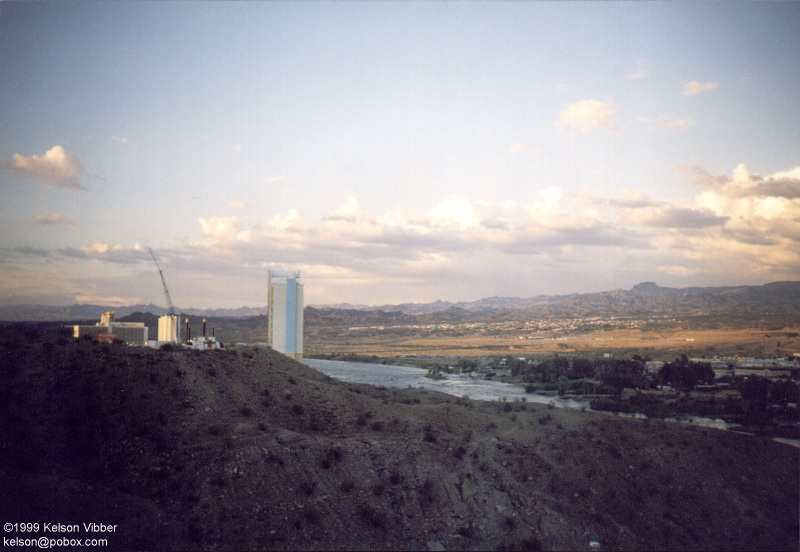
It also pointed up a problem with the point-and-shoot camera and lighting. Compare the following photos from my American Southwest page:

Moon over Springdale, Utah (SLR) Looking Back at Laughlin

The one on the left (of the moon above a rock ridge) was taken with an old SLR camera that my grandfather gave me when I was maybe 12 or so. It was entirely manual except for a built-in light meter. I loved the control and the photo quality I could get out of it, but it was big and bulky, and eventually I stopped carrying it.

The second photo (with the one tall building sticking up out of nowhere) was taken with the point-and-shoot camera I picked up during high school and used right up through that first Hawaii trip. Notice the difference in the sky? The sky does vary in color—you only need to walk outside on a clear day to see that—but something about that camera just collected less light from the corners of the image. The Laughlin picture is a good example because you can see the circle continue across the lower half of the frame as well.

The ones from the 2003 Hawaii trip are actually not too bad, even though they were done on the cheap camera, because they were scanned straight from the negatives by Kodak. I suspect they have a slightly better scanner than I do! 😀

ISC is reporting a new type of vulnerability in web browsers that the discoverer has termed as “Reverse Cross-Site Request,” or RCSR.

Basically, on a site with user-generated content—like a hosted blog—it’s possible to add a form that looks like the site’s login form. If the victim has an account on the same site, and has asked their browser to save their password, it will auto-fill the form. If the attacker can somehow trick the visitor into submitting the form—say, with an invisible image submit button (ever clicked randomly? Or to get back to the page after looking at another window?)—the attacker gets the visitor’s password.

What’s new about this is that all it requires is plain HTML, not scripting, which most blog hosts and similar sites already block.

Chapin Information Services discovered the bug in Firefox 2, and reported it to Mozilla. It turns out that Internet Explorer 6 and 7 are also vulnerable, but only if it’s on the same page as the real login form. Mozilla is currently trying to determine the best way of resolving the problem without breaking all the passwords people have already saved. The ISC article links to the bug report, so you can follow the discussion. Microsoft has only said that they’re “aware of the issue.”

At the moment, I’m glad I don’t let web browsers save my passwords.