
Notice anything odd about this Flashback Features movie marquee? (Hint: Look at the dates.)
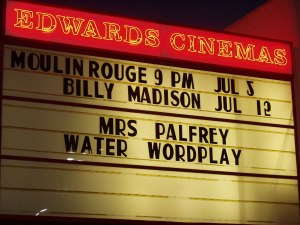
I think I can see a solution to their problem…
Notice anything odd about this Flashback Features movie marquee? (Hint: Look at the dates.)
I think I can see a solution to their problem…
We found this in the gift shop when we went to the Pirates dinner show back in May. IIRC, it’s a toy/prop musket.

But who comes up with these names? I mean, “Party Weapon?” By actually calling it a weapon, you’re suggesting it’s something I don’t want at a kid’s party. Well, unless I’m raising Klingons or something.
Random Addendum
Completely unrelated: while typing this, the “w” key on my keyboard got stuck. Or rather, my computer was somehow convinced that it was stuck, because it kept filling in Ws even after I unplugged the keyboard. After unplugging it and plugging it back in a couple of times, I moved my hand away from the connector and knocked over the top 3 or 4 jewel cases in a stack of CDs on my desk. They landed on the keyboard. After I put them back, the problem was fixed. 😕
Some interesting comments by Warren Ellis in today’s Bad Signal on film budgets, and Superman Returns in particular.
$250 million puts you in spacelaunch-budget territory. For $250 million WB could’ve given Bryan Singer his own communications satellite and spent the change on a George Clooney movie.
This is the absurdity of modern Hollywood; that taking more than the GNP of Luxembourg in a single weekend is not actually enough to put a movie in the black.
It’s the “spacelaunch” comment that I find most interesting, as I made the same comparison a few years ago, from the other side of the fence: Assuming that the Spirit and Opportunity missions to Mars are typical, price-wise, it doesn’t make sense to complain that we’re “wasting” money on space exploration when a mission costs as much as two summer blockbusters. Manned missions are, of course, more expensive, but robotic missions? If we, as a society, toss away $250 million several times a year on mindless action flicks, what’s so terrible about spending a similar amount to learn something about our universe?
Yes, I know the difference is public vs. private funding. Movies are financed by studios and private investors, and space exploration is usually financed by governments, and therefore by taxes. But comparing the dollar amounts puts things in a different perspective—whether you’re astonished by the literally astronomical movie budgets, or realizing that exploring outer space is more down to Earth than it seems at first glance.
I saw a bumper sticker today that read, “The road to hell is paved with liberals.”
That would explain a lot. I mean, conservatives have been walking all over liberals for the past six years. Now we finally know where they’re going with it!
In the past two weeks, a new variant of the advance fee scam has dropped into our spam traps: supposed UK-based artists needing help selling their works overseas.
The classic Nigerian scam involves someone claiming to be the relative of a deceased or deposed dictator, general, etc. is trying to smuggle money out of the country and needs to borrow your bank account to do it.
It’s usually a third-world country, often one with political strife, so that the average westerner won’t be too suspicious of the level of corruption implied. You never see this scam claiming to come from, say, France, or Japan, because the process would set off too many alarm bells. Someone needing to transfer that much money would either do it through normal banking channels or through organized crime—not by firing off an email to some random citizen in a foreign country.
The first-world variation, at least up until now, has been the “International Lottery” scam. In this variation you get a winning notice, but of course you need to pay them before they can send you the money, etc. This one generally claims to be based in Europe, often several countries in one message. The idea of a lottery seems much more plausible in the first world.
Someone has come up with a way to bring the 419 scam into the first world. The two samples I’ve seen so far both involve UK-based artists trying to sell their works in the US. The premise is that their customers want to pay by some method that is “difficult to cash” in the UK, so they want you, a US resident, to accept the travelers’ checks, or money orders, then wire them the amount minus a 10% commission.
Right.
I’m seriously waiting for someone to offer a commission on the Brooklyn Bridge.
The setting has changed—instead of a dictator’s widow who has hidden away ill-gotten gains in “darkest Africa,” it’s a happy Londoner living with his or her “two kids” and “the love of [their] life” and selling art on the international market. All shiny, happy and yuppie (with just a hint of bohemian). But the script is the same: Someone wants to clear huge amounts of money through your bank account.
I was going to post some quotes, but as I started looking at them, the similarities really go through the entire message. Continue reading
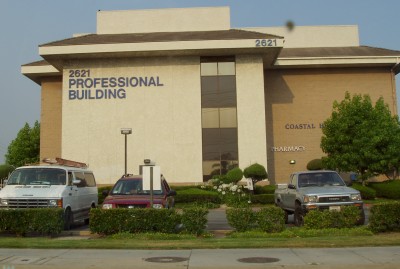
Don’t trust your office to some amateur building! Hire a professional!
Of course, what I’m really concerned about is what it does on its day off…
Found on the side of an AM-PM convenience store today:
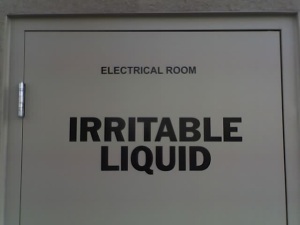
That’s one cranky glass of water.
Or maybe Odo?
My best guess is that they were trying to say something like “inflammable,” decided it wouldn’t fit, and misused a thesaurus.