Here’s our first view of the island of Hawai‘i, as our plane approached on Sunday morning, April 3. Snow-capped Mauna Kea is rising out of the clouds, with Mauna Loa behind it.

View of Mauna Kea from the plane

A week later, we spent Sunday evening waiting for our flight out of Kona Airport. (After a disastrous experience at LAX in which we arrived 2 hours ahead and got to the gate with maybe 15 minutes to spare, we showed up early for the flight home. But Kona’s much smaller and better organized, so it took us maybe 15 minutes to check in. There wasn’t even a line to go through security!)

Kona airport at night

I hope you’ve enjoyed this series on our Hawaiian vacation. I’m sorry it took so long to finish it, but hey, I managed (just barely) to beat the 6-month marker!

Flashback to April and Hawaii. On the day we drove to Kilauea we stopped at various places along the way. And since it’s a nearly-100-mile drive from Kailua, there was a lot to see.

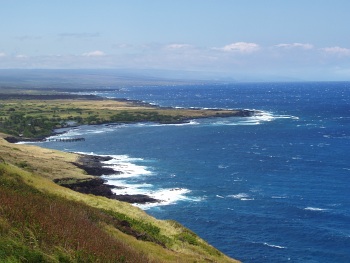
We never made it down to South Point (the southernmost tip of the island), partly because of time and partly because—believe it or not—our car rental contract forbid us to drive on the 12-mile road out to the point! Supposedly it’s poorly maintained—or it used to be, and the policy hasn’t kept up—and they don’t want the wear and tear on cars that aren’t designed for it. As I recall, rental trucks and SUVs don’t have the restriction. This was the closest we ever came to it, and you can only barely see it way off in the distance.

Coastline with coves and points

If you look at the end of the spray near the visible point, then go straight up toward the horizon, you’ll notice that the sky-sea line dips downward slightly and there’s a faint darker patch of sky. As far as we could tell, that’s the promontory heading out toward South Point. Even then, we weren’t quite sure. Update: It’s not. I checked the map when I finally uploaded these images to Flickr, and the highway doesn’t get close to the ocean on the west side. It’s a viewpoint near Haleokane, east of Naalehu and east of the turnoff to South Point Road. We’d already passed it!

Continue reading

It’s refreshing when a movie you’ve anticipated for years actually lives up to your expectations. It’s unprecedented when it happens twice in one weekend. MirrorMask and Serenity were both amazing.

The MirrorMask theater listing looks like a tour schedule, with the film opening in a few more cities each week. Unfortunately, at least some theaters that have it now won’t have it by next weekend, so we’re going to have to catch it again one night this week. Then we’ll seek Serenity again on the weekend. Somewhere in there we’ll find time for the other movies we wanted to see.

We’ve got a more thorough review of Serenity planned…

Yesterday, Mark Evanier quoted Justice Antonin Scalia using an aphorism in a debate on government funding of the arts. The phrase he used:

“He who pays the piper calls the tune.”

It’s a reminder that the person who funds something invariably has a say in just what they’ve funded. (In this case, he pointed out that simply by choosing to fund some artistic endeavors, you have to choose which arts you fund.) But it reminded me of a similar phrase with a very different meaning:

“It’s time to pay the piper.”

In this case, the meaning is basically, OK, you’ve had your fun, now you need to pay the price. I don’t know for sure, but I suspect it comes from the story of the Pied Piper of Hamelin, in which the townspeople refused to pay him after he led all the town’s rats to drown in the river—so he exacted revenge by leading all the town’s children away. Not surprisingly, it’s this phrase that’s most often used with the Flash villain/ally of that name.

It’s interesting that two phrases with the same archaic base—who would describe a musician as a “piper” these days?—should be so different.

Having picked up the Comic Cavalcade archives, I decided to go through all the Golden-Age Flash stories I had and catalog character appearances. I did the same thing with the Silver-Age stories a couple of years ago, when I completed my collection. Since $100+/book is a bit steep, I’m sticking with reprints, so it only took me a few hours to get through my collection instead of several months.
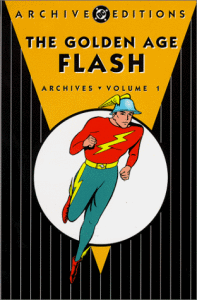
Golden Age Flash Archives Vol 1Now, there are lists and databases online already, but I like to be able to verify things directly when possible. I know how easy it is to make a mistake on a website and not catch it for months or even years. Also, most indexes aren’t really interested in the supporting cast. If I want to find a villain like the Fiddler, chances are I can find a complete list. But if I want to know which issues featured Jay’s old college buddies, I’m on my own.

And speaking of Jay’s old college buddies, he runs into five of them during the issues featured in The Golden Age Flash Archives, Vol. 1. And four of them are named Jim. There’s Jimmie Dolan, Jim Evans, Jim Carter, and Jim Dane. (Interestingly, the fifth friend is named Wally.) Jim Carter and Jim Dane are both in silver mining. Jimmie Dolan and Jim Evans both know that Jay is the Flash, but Jim Carter and Jim Dane don’t. I suspect that Carter and Dane are the same guy, but the writer didn’t remember the name he used before and didn’t feel like looking it up. (Comics were episodic back then, and you didn’t have continuity police among the readers ready to pounce on every coloring error.)

Also interesting: In the 17 issues collected in that book, no super-villains appear. The villains are all gangsters, kidnappers, corrupt politicians, crime bosses, etc. Even the story with the giant lizards has gangsters creating them. Skimming one list, the first recognizable villain to show up is the Shade—in issue #33! For the first three years (or at least the first year and a half), most of the Flash’s enemies wore ordinary business suits!