I read Shadowpact #2 last night. So far the book does read better than Day of Vengeance, probably in large part because Bill Willingham can set his own schedule instead of the must-be-6-issues policy of the Infinite Crisis lead-ins.

One of the villains struck me as familiar, though: an albino swordsman with a magic sword, apparently allied to a sinister god-like being, who has picked up the nickname, “the White Rabbit.”

Elric: The Making of a Sorcerer #3Maybe it’s just the timing—just a few days ago I read a comic about Elric, an albino swordsman with a magic sword, allied to a sinister god-like being, with the nickname, “the White Wolf.”

Michael Moorcock's MultiverseActually, I was first reminded of Count Zodiac from Michael Moorcock’s Multiverse, largely because Zodiac is based in the 20th century, rather than an ancient sword-and-sorcery landscape. Count Zodiac is one of at least three versions of Count Ulric von Bek*—the others appear in The Dragon in the Sword and the trilogy that begins with The Dreamthief’s Daughter—and, like Elric, an incarnation of the Eternal Champion.

The Eternal Champion in all his forms fights for the balance between order and chaos, and often finds himself fighting for order while indebted to a lord of chaos. At least two versions** of von Bek are albinos who wield the Black Sword (Ravenbrand, rather than Stormbringer), and while I don’t recall Ulric himself being linked to a demon the way Elric is reluctantly linked to Arioch of Chaos, the von Bek family has ties to Lucifer going back to the Hundred Thirty Years War. Continue reading

Character collage: Portraits of two women, looking downward to the left and right. Behind each is another woman standing, one regally in an elaborate blue dress with a necklace and hair ornaments, the other in a plain white dress. They are also looking away from the center. In front are three men standing, two in armor with swords drawn. The man in the center is holding up his sword, dividing the image in half. The man on the right is holding his sword pointing downward. The man on the left is wearing middle-ages-looking clothes and balancing the point of a dagger on a fingertip.The first issue of the New Spring comic book was surprisingly good. I wasn’t sure how well Robert Jordan’s writing would translate to the medium, and of course a lot of details are lost, but Chuck Dixon has done a good job adapting the story, and Mike Miller’s art is incredible.

The book opens with a brief description of the world, then a series of splash pages showing the scope of the Aiel War, starting with thousands of Aiel pouring over the Dragonwall. From there it moves to Lan’s story, then to Moiraine’s. Two pages stand out for me: The panorama of Tar Valon, and Gitara’s Foretelling, the latter of which is most effective because it contrasts with the very realistic style of the rest of the book.

Believe it or not, I’d recommend this. Who would’ve thought I’d be excited about The Wheel of Time again?

Wheel of Time Book 11: Knife of DreamsI finally talked myself into reading New Spring, the prequel novel to Robert Jordan’s interminable long-running Wheel of Time series. It’s actually a very interesting character study of young Moiraine, and much more engrossing than the last two books in the series have been—perhaps because I don’t expect it to advance the plot.

Anyway, I’ve spent the last week thinking, “I really ought to see if there’s any news on Book 11.” I finally remembered it when I was in front of a computer, and discovered that Knife of Dreams has just been finished, the cover announced last week, and the book is scheduled to be released on October 11.

I came into the series when Book 8, Path of Daggers was the latest, and Winter’s Heart was released during the year it took me to read the series up to that point. I really liked books 1 (once it got going), 4, and 5, and book 2 still managed to keep me up for hours trying to finish when I really should’ve just gone to bed. The problem is that after book 5, he stopped writing novels, and started writing a novel. A really long one that spans multiple books. (Seriously, how long can he drag out the Faile kidnapping story?)

[Cover]Also in comics news, the nine-part adaptation of Neil Gaiman’s Neverwhere begins in June.

The basic premise is this: In urban areas, we tend to tune out the homeless to the point where we don’t even see them. What if we really don’t see them? What if there’s another world, just slightly out of sync with this one, where the rules are all different. (JMS used a similar springboard for Midnight Nation, but took it in a completely different direction.) There’s poverty, and scavenging… but there’s also magic, and honor, and a society with its own strange codes. The story follows everyman Richard Mayhew as, through a simple act of kindness, he slips through the cracks from London Above to London Below. In order to get back, he has to help a mysterious girl named Door on her quest to find her family’s killers and honor their legacy…and escape the assassins tracking them both!

It’s hard to guess how well this will work. Neil Gaiman’s comics and prose are both fantastic (in every sense of the word). Comic book adaptations of his prose, though, haven’t been nearly as good. The writers have a tendency to preserve too much of the text, and it gets bogged down in narration. It happened with “Murder Mysteries,” with “Only the End of the World Again”, and with “The Price.”

Neverwhere has two advantages, though. It started life as a TV script (he only wrote the novel because he realized that budget limitations and producer interference would prevent them from doing the story “right”), and TV, like comics, is a visual medium. And with nine issues, there should be plenty of room to show, not tell, the story.

Miss two weeks and they pull the rug out from under you:

…the cast, crew, writers and producers of Angel deserve to be able to wrap up the series in a way befitting a classic television series and that is why we went to Joss to let him know that this would be the last year of the series on The WB

At least the WB had the decency to let them know in time to do some sort of wrap-up, unlike the way certain other shows were treated by channels that shall not be named.

Unfortunately we live in a world where the offbeat has to make way for the mainstream. I don’t care if the WB puts up some new “reality” show, as long as I can find the kind of shows I like to watch. With so many hundreds of cable and satellite stations available, you’d think there’d be room for shows like VR.5 and Crusade.

Still, Angel managed five years, which is pretty damn respectable – especially in the modern era of cancelling shows without even airing half a season.

Joss Whedon sums up the perils of producing anything that strays too far from the beaten path:

“Two roads diverged in a wood,
and I took the road less traveled by
and they CANCELLED MY FRIKKIN’ SHOW.
I totally shoulda took the road
that had all those people on it.
Damn.”

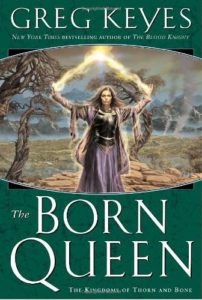
J. Gregory Keyes has fast become one of those authors whose work I will pick up knowing nothing more than who wrote it. I enjoyed his work in the Babylon 5 and Star Wars universes, but after reading the four novels of The Age of Unreason and these two, I can say I’ll definitely be picking up The Briar King when it comes out in January.

Now, The Age of Unreason is probably Keyes’ most well-known work to date. (If the title doesn’t sound familiar, chances are you’ve heard of the first novel, Newton’s Cannon). It takes place in an alternate Eighteenth Century in which Isaac Newton discovered the key to alchemy, transforming the world with new technology… and setting off an arms race of sorts. What begins as an alternate history becomes an epic battle for the future of the world, and ultimately of humanity itself.

While I’d recommend someone curious about Keyes’ writing start with Newton’s Cannon, I’d like to call attention to his earliest published novels, The Waterborn and The Blackgod, collectively known as The Chosen of the Changeling.
Continue reading

ยปAll pages site-wide with this tag