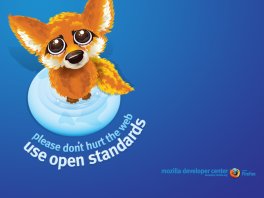
Overly-cute fox with puppy-dog eyes, captioned: Please don’t hurt the web. Use open standardsThe Mozilla Developer Center has just posted some desktop wallpaper promoting open standards, (and the MDC itself) with the theme, “Please don’t hurt the web. Use open standards.”

Apparently the design was a big hit as a poster at SXSW.

For those who haven’t seen it, the MDC is a great developer resource for web developers, describing lots of standards along with Mozilla-specific information.

(via Rhian @ SFX, who notes that the image is available for use under the terms of the Creative Commons Attribution-NonCommercial license. These wallpapers are also covered by the Mozilla Trademark Policy.)

Firefox.Opera.Opera Watch posted an interview with Firefox co-founder Blake Ross yesterday, in which he talks about Firefox, Opera, and the relationship between the two. When asked about the rivalry between fans of the browsers, he says, “I think it’s ridiculous. Millions of people out there rely on us to make the Web better, not have pissing contests.” I couldn’t agree more. In fact, I launched The Alternative Browser Alliance primarily in response to that rivalry.

I found it interesting that when asked to describe Opera in three words, Ross’ response was: “Our best ally.”

ISC is reporting a new type of vulnerability in web browsers that the discoverer has termed as “Reverse Cross-Site Request,” or RCSR.

Basically, on a site with user-generated content—like a hosted blog—it’s possible to add a form that looks like the site’s login form. If the victim has an account on the same site, and has asked their browser to save their password, it will auto-fill the form. If the attacker can somehow trick the visitor into submitting the form—say, with an invisible image submit button (ever clicked randomly? Or to get back to the page after looking at another window?)—the attacker gets the visitor’s password.

What’s new about this is that all it requires is plain HTML, not scripting, which most blog hosts and similar sites already block.

Chapin Information Services discovered the bug in Firefox 2, and reported it to Mozilla. It turns out that Internet Explorer 6 and 7 are also vulnerable, but only if it’s on the same page as the real login form. Mozilla is currently trying to determine the best way of resolving the problem without breaking all the passwords people have already saved. The ISC article links to the bug report, so you can follow the discussion. Microsoft has only said that they’re “aware of the issue.”

At the moment, I’m glad I don’t let web browsers save my passwords.

There’s a lot of misinformation out there about various web browsers. Opera can/can’t do this. Firefox can/can’t do that. There’s only so much you can do to promote one product when you only know rumors or outdated facts about another.

Opera users: If someone told you that Firefox was better than Opera because it doesn’t have ads, you wouldn’t take them seriously. You’d know the ads have been gone since last year, and you’d wonder what else they have wrong.

Firefox users: If someone told you Opera was better than Firefox because Firefox won’t let you reorder tabs, you wouldn’t take them seriously. You’d know that Firefox 1.5 did just that, and you’d wonder what else they have wrong.

And neither of you will convince an IE fan that Opera is better because of tabs and a built-in search box because they’ll tell you that IE7 has both.

When you’re trying to convince someone that X is better than Y, and they know Y very well, you’d better know Y well enough not to make statements that the other person knows are false. When you do, you’ll lose credibility, and the rest of your argument — the part you do know well — will suffer for it. (I suspect a lot of software flame wars get started this way!)

So here’s my suggestion: If you want to promote Opera, go and download Firefox 1.5. If you want to promote Firefox, go and download the Opera 9 beta. Either way, try out the IE7 beta (if your Windows version will run it) or fire up Safari (if you’re on a Mac). Mess around with them enough that you’re familiar with how they work, what you can do with them, and how they handle your favorite web pages. That way the next time you face an IE fan (to the extent that IE has fans), or a Firefox fan, or an Opera fan, or a Safari fan, you’ll be armed with accurate information.

As for the post title — I don’t think it’s necessary for the major browsers to be enemies. I think there’s plenty of room for cordial competition rather than a cutthroat struggle. But “Know Your Enemy” is a better attention-getter than “Familiarize yourself with the competition.” 😉

*This post originally appeared in two slightly different forms on my blog Confessions of a Web Developer at the My Opera community and on my Spread Firefox blog.

It’s kind of redundant to post a “Get Firefox!” banner to someone already using Firefox, but it’s useful to show them an upgrade banner if they’re on an old version.  It’s also useful to show Firefox users a banner for Spread Firefox.

This can be done easily with PHP or other server-side scripting languages, but sometimes you have to use static HTML files.  That’s where client-side scripting becomes necessary.  Last month I posted some sample code that used document.write, which doesn’t work with XHTML.  (On top of that, the <noscript> blocks I used ended up causing validation errors because of their location!)

I’ve redone everything with DOM scripting, which will work with either HTML 4 or XHTML 1.0.

1. Put the following in a file called sfxlinks.js:

function replaceFirefoxLink(linkID) {
   if(linkNode=document.getElementById(linkID)) {
      var newLink=document.createElement('a');
      var newImg=document.createElement('img');
      var change=0;
      if ( 0 <= navigator.userAgent.indexOf('Firefox/0') ||
         0 <= navigator.userAgent.indexOf('Firefox/1.0') ) {
         change=1;
         newLink.setAttribute('href','YOUR_UPGRADE_LINK');
         newImg.setAttribute('alt','Upgrade to Firefox 1.5!');
         newImg.setAttribute('title','Upgrade to Firefox 1.5!');
         newImg.setAttribute('src','PATH_TO_BANNER');
      } else if (0 <= navigator.userAgent.indexOf('Firefox')) {
         change=1;
         newLink.setAttribute('href','YOUR_REFERRAL_LINK');
         newImg.setAttribute('alt','Spread Firefox!');
         newImg.setAttribute('title','Spread Firefox!');
         newImg.setAttribute('src','PATH_TO_BANNER');
      }
      if(change) {
         newLink.appendChild(newImg);
         var parentNode=linkNode.parentNode;
         parentNode.replaceChild(newLink,linkNode);
      }
   }
}

2. Use your regular Spread Firefox affiliate link and add a unique ID — let’s use id="FxLink" as an example — to the <a> tag.

3. Load the script in your document’s <head> section:
  <script type="text/javascript" src="sfxlinks.js">

4. Call the function in the body onload event using the ID you chose in step 2:
  <body onload="replaceFirefoxLink('FxLink')">

When the  page loads, the script will check the visitor’s browser to see if it’s an old version of Firefox or a current version of Firefox.  If it’s an old version, it’ll replace your standard button with your upgrade button.  If it’s a current version, it’ll replace it with a Spread Firefox button with your referral link.  Otherwise, it leaves the button alone.

This has a lot of advantages over the old version, including XHTML compatibility, no need for <noscript> blocks, easier validation, and it still degrades gracefully (if JS is unavailable or old, it leaves your normal button in place).

You can see it in action on my website, Flash: Those Who Ride the Lightning.

Originally posted on my Spread Firefox blog.

A tale of the Browser Wars on the high seas.

Harken, lads, and listen to my tale. It is the tale of the FyreFawkes, a vessel that turned the tide in the never-ending battle for the high seas.

In this day, shipping lanes criss-cross the ocean like a Web, and in years past, that web was commanded by the Fleet of the Navigators. Wherever ye wanted to go, a Navigator ship was there to take you. But the wealthy My Crows’ Loft Company controlled the ports, and knew that if they did not take command of the high seas, someone might use the Navigator Fleet to build their own harbors, outside My Crows’ Loft’s sphere of influence.

So My Crows’ Loft built their own fleet, a fleet of Explorer craft, and after a great trade war, their fleet dominated the ocean. The Navigators’ fleet shrank, nearly forgotten.

But My Crows’ Loft grew complacent in their victory, and the Explorer fleet aged. Worse, the vessels had weak spots and leaks that pirates and brigands of all sorts knew how to attack. What was once a pleasant voyage across the sea became a journey fraught with danger, with spies, phishermen, and great wyrms lying in wait for the unsuspecting voyager. Continue reading

It occurred to me today that if you lay out the three major players in computer operating systems and the three major players in web browsers, the results track remarkably well.

  • Windows and Internet Explorer. The dominant player. Obtained that position by being good enough, cheap enough, and promoted enough to win a protracted two-way battle. Detractors claim the victory was primarily due to marketing and business practices, not quality. Plagued by a public perception of insecurity. Currently trying to maintain that lead against an opponent unlike any they’ve faced before. Believes itself to be technically superior to the other options.
  • Linux and Firefox. Open source product with a core team and hundreds of volunteer contributors. Originally created as a replacement for a previous major player. Very extensible. Promoted as a more secure alternative, but has faced growing pains with its own security problems. Highly regarded among many computer power users, beginning to gain mainstream acceptance and challenging the dominant player. Believes itself to be technically superior to the other options.
  • Mac OS and Opera. Has been there since the beginning. Constantly innovating, pioneering ideas that get wider exposure when their competitors adopt them. Very dedicated fan base that never seems to grow enough to challenge the dominant player. Has been declared doomed time and time again, but keeps going strong. Believes itself to be technically superior to the other options.

It breaks down, of course. Traditional UNIX is missing from the OS wars, though it provides a nice analogy to Netscape for Firefox. The battle lines don’t quite track either, since the previous wars were Windows vs. Mac and IE vs. Netscape. And Safari’s missing entirely. But it’s interesting to see the same three roles in play.

»All pages site-wide with this tag