
Why is it that Firefox consistently truncates the title “Google Analytics” at the worst possible spot?
Tag: Firefox
Beta Than Expected
 I haven’t been following the progress of Fedora 9 very closely (possibly because it took me until last month to finally upgrade my home PC to Fedora 8), but as the release date of
 April 29 May 13 approaches, I thought I’d take a look at the release notes for an overview of what’s new. Of course there’s the usual upgrades to the various desktop environments, including, finally, KDE4, but something that surprised me was the inclusion of Firefox 3 beta 5.
Admittedly, Linux distributions often include non-final software by necessity. Many open-source projects spend years in the 0.x state not because they don’t work well, but because the authors don’t feel that it’s complete yet. (Often, a project will take their checklist and build feature 1, stabilize it, add feature 2, stabilize that, etc. so that you get a program that’s a stable subset of the target. Off the top of my head, FreeRADIUS was quite stable long before it hit 1.0, and Clam AntiVirus has been quite usable despite the fact that its latest version is 0.93.)
 Lately, though, there’s been a tendency toward sticking with the latest stable release, at least for projects that have reached that magical 1.0 number. Sometimes they go even further. Only a year and a half ago, Fedora planned to skip Firefox 2 and wait for version 3. (Clearly, they expected Firefox 3 would be out sooner!) So it was a surprise to see that this time, Fedora has decided to jump on the new version before it’s finished.
Cleaning up Firefox’s Memory Usage
One of the biggest complaints about Firefox since 1.5 was released has been its high memory usage. Go to a forum anywhere and you’ll get people griping about “have they fixed the leak yet?”
It is, of course, much more complicated than that. There are caches, fragmentation, places where memory is used inefficiently, bunches of small leaks, leaks that only happen under specific circumstances, leaks in extensions, leaks triggered by combination of extensions, etc.—not one single leak that can be fixed. And then there was the unfortunate post in which one Mozilla developer (I’m too lazy to look up who) pointed out that 1.5 stored more information in memory, and that probably had a bigger impact on total memory size than actual leaks, which many people on the Internet jumped on as “It’s not a bug, it’s a feature.” (Why should they bother to read what was actually stated, when they can just read a misleading but sensational summary?)
A lot of the small leaks were patched in bugfix releases for 1.5 and 2.0, but really big changes are coming in Firefox 3. Mozilla’s Pavlov has written a detailed post on Firefox 3 Memory Usage, describing the different categories of memory improvements that have been made in the Firefox 3 development cycle.
I wouldn’t be surprised to find that this is one of the big reasons Firefox 3 has taken so much longer than previous releases. I suspect it’s time well spent, though, and users will be happier with a later, lighter Firefox than with one that shipped earlier, but used just as much memory.
Fire-ony
Five years ago, Mozilla was forced to rename the Phoenix web browser because Phoenix Technologies was working on an in-BIOS browser that would let you get on the internet and troubleshoot/download drivers/etc. even if your operating system was trashed. It became Firebird, and then Firefox. The Phoenix product has finally been released. Ironically, it’s evolved into an embedded Linux distro that runs…Firefox.
Spreading to the Converted
 One of the problems with the ubiquitous Get Firefox! Get Opera! etc. web buttons is that while they might encourage someone unfamiliar with the product to check it out, they’re kind of pointless to someone who already uses your preferred browser. Sure, there’s a sense of, “Hey, this author uses Opera too!” but that’s about all it can do.
To make these a little more useful, on my Flash site, I use JavaScript to switch the button if someone’s using Firefox, and instead promote the Spread Firefox site. I’ve written up a similar method for Opera, though it’s less clear where to send people.
I recently discovered that Flock has taken another approach to solving this problem. As you may recall, Flock is a browser based on Firefox, focusing on social networking. It integrates with blogging sites, photo-sharing sites, bookmark-sharing sites and so on.
The Flockstars Extension expands on this by converting the button into a mini-profile. You fill in information like an avatar, usernames at Flickr, YouTube, etc., and links to your website(s). It generates button code that acts like an ordinary Flock button, but contains all this extra information.
The extension reads this information. Visitors to your site who are using Flock and the extension will see an icon in the toolbar, which will pop up a short profile and a menu of all the facets of your online presence.
It’s a cool idea, and seems to fit perfectly with Flock’s target audience. But it only solves half the problem. The browser promo badge is still there, still taking up space. The fact that the profile data is in the button code doesn’t make a difference; it might as well be stored in a set of META tags in the page head.
Opera Really Satisfies
 The Opera Web Browser is in the news today. First, they’ve just released version 9.20. In addition to the usual security, stability, and compatibility fixes, they’re promoting a new feature called Speed Dial, to make it easier to reach your most-frequently-visited websites.
Meanwhile, a recent survey by NetApplications and Surveyware found that while Firefox is widely considered the best browser, Opera’s users are more satisfied than users of any other browser. NetApplications’ current marketshare shows 79% IE, 15% Firefox, 4.5% Safari and 0.8% Opera for March 2007. (via OperaWatch)
While Opera is an excellent browser, this high level of satisfaction may be in part because of the size of its userbase. Often, when something is only followed by a small fraction of the potential audience, it’s mainly the hard-core fans. The only way to grow past that size is to bring in the casual users, who are less invested in it. Only time (and increased marketshare) will tell.
Webuser decided to lead with the Opera findings, which is great news for what they call “one of the internet’s best-kept secrets.” But they made an odd choice on the image to run with the article:
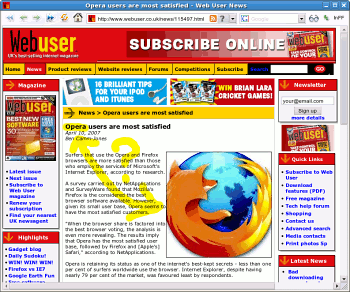
Maybe they figured the Firefox logo was more recognizable, and would get more people to stop and read?
Firefox too mainstream for Alternative Browser Alliance
 I’ve been thinking about this for a while, but it’s time to refocus the Alternative Browser Alliance. Mozilla’s Asa Dotzler has referred to Firefox and Internet Explorer as the “mainstream browsers” for more than a year now, and it looks like that’s become true.
The web is no longer an IE monopoly. It’s become an IE/Firefox oligopoly. Firefox is no longer an alternative web browser. It’s sold out, its ads are everywhere, and it even allows people to build Firefox-only code.
So, starting today (April 1, 2007), the Alternative Browser Alliance will no longer promote Firefox.
So what will replace it? I thought about Opera, but most of its install base is on cell phones and PDAs, and we all know the mobile web browser is dead, right? Safari? Well, it turns out that WebKit is shutting down.
So the site will be putting its weight behind iCab. It’s as alternative as they come, and it’s guaranteed to remain that way (since it won’t run on Vista).
Update: Yes, it’s an April Fools joke.