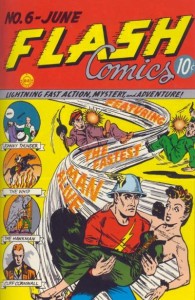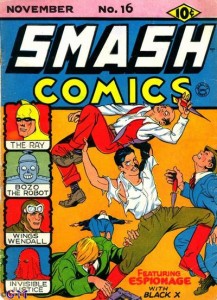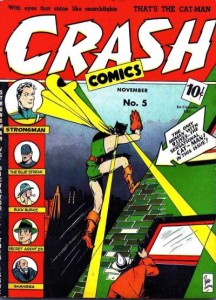
[Logo: Wizard World Los Angeles]I went to Wizard World Los Angeles today. I almost went last year, and decided not to—and regretted it when I learned that Sunday (the day I almost went) was sparsely attended. So not only would I have had no problem getting in, but it should be a low-stress experience overall, rather than the insane crowds of San Diego.

The convention itself did turn out to be a nice, low-key experience, and I found some interesting stuff, but getting to the convention was a bit of an adventure. Continue reading

Irish and Mexican FlagsI caught a story on The World (PRI) today about Los Angeles band Ollin’s song tribute to Saint Patrick’s Battalion (in Spanish, El Batallón de Los San Patricios)—a group of several hundred primarily Irish Americans who, during the Mexican-American War (1846–1848), left the US Army to fight alongside the Mexicans. They fought fiercely for a year, but came to a bad end: most were captured by the US and executed as traitors.

Cover of Solo #11It reminded me of a story Sergio Aragonés told last year in his issue of Solo (#11). In “Heroes,” he talks about growing up in Mexico, where the San Patricios are national heroes. They have statues, memorials, and a commemorative ceremony every year on the spot where they were executed. After telling the story of how he learned about the battalion, he jumps forward a few decades. Living in the US, with his daughter going to American schools, he wanted to see how she would learn about the heroes of his youth. So he looked through her textbook to the section on the Mexican-American war, and found only a fleeting remark about how a bunch of drunk Irishmen deserted the US Army, surrendered, and were executed.

It was a surprisingly serious story from an artist known for his comedy (some of the other stories in the issue are drop-dead funny), and an interesting commentary on how nationalism shapes our views of history, with one side elevating the battallion, and the other trivializing them.

A piece of spam came across the abuse desk the other day hawking something called “Viagra Professional.” Just as some songs aren’t suited for elevator music, some products aren’t suited for Microsoft-style naming schemes.

Think about it: Outside the pharmaceutical industry, what *ahem* profession would have a use for Viagra?

Opera BrowserFollowing the trend of musicians setting up shop on MySpace, the social networking site now hosts a profile for the Opera Web browser. (Just kidding about the musicians part.) On a related note, I’ve found that on the rare occasions I’ve looked at MySpace pages, Opera tends to be more responsive than Firefox, which tends to slow to a crawl on the pages which seem to average about 23 MB apiece.

Of course, this brings up a question of serious importance: Opera lists itself as being “in a relationship.” With whom?

(via Opera Otaku)

[The Thinker]After almost 1½ years, my Golden-Age back-issue hunt finally netted a relatively cheap copy of All-Flash #12, the first appearance of the Flash villain, the Thinker. It’s an odd read, because the origin of the Thinker (a mob boss who plans his heists very meticulously) is interwoven with a slapstick story of the Three Dimwits.

All-Flash #12 (Fall 1943)The Thinker story is played more or less as a straight super-hero vs. organized crime story. I’d summarize it, but the Comics Archive has already written it up in their article on the Thinker. Now, imagine the first five paragraphs over there interwoven with a Three Stooges film and you’ll get the idea. The Dimwits end up buying a restaurant heavily in debt to the mob, and accidentally make salads out of an alien plant that make people turn invisible.

It’s incredibly silly, but it ties into the other half of the story: The original mob boss’ henchmen are caught robbing the Dimwits’ restaurant, so he calls in the Thinker to solve his problem before they can rat on him. And of course, once the Thinker takes over, he’s mighty interested in these salads that turn people invisible.

And yet, the feel is so completely different that it seems like two different stories.

The Three Dimwits

An unexpected discovery was a reference to the planet Karma, where the alien plant comes from. I’d seen two other references in other Golden-Age Flash stories, so it’s clearly part of the background mythos. This is one reason I’ve been looking for the source material. It’s relatively easy to find info on the leads, or the major villains, but the minor supporting characters who appear in three or four issues—Deuces Wilde, Evart Keenan, Dr. Flura, Ebenezer Jones—are mostly forgotten.

On a related note, while looking up the Thinker’s other appearances, I discovered that one of the non-Flash titles I’d been looking for, All-Star Comics #37, was reprinted in The Greatest Golden-Age Stories Ever Told—a book I already had. I felt bad that I hadn’t actually read the entire book, but that meant I could cross off two items from my wantlist instead of just one.

I was browsing the DVD releases at Target this weekend, and saw the box for Bring it On: All or Nothing. I did a double-take, because right there on the cover was Claire Bennet from Heroes:

Bring it On: All or Nothing DVD cover Claire Bennet

Yes, shortly before Hayden Panettiere played a cheerleader with super-powers on Heroes, she played a cheerleader in a direct-to-video sequel to Bring it On. The uniform is even the same color scheme!

She’s probably safe from being typecast, though. She’s done quite a bit of work, and something tells me Claire isn’t going to be cheering—or particularly cheerful, for that matter—anytime soon.

Edit: Forgot to mention, the Heroes Wiki is was a fascinating and addictive site.

An NPR story about an archaeological site in Peru mentioned that the ancient Andean calendars used a 10-day week, and I started wondering what other measurements various societies have used. The seven-day week is (almost?) universal these days, developed independently in both the Middle East (spreading to the West) and in the Far East, but past societies have used anywhere from three days to ten.

Unlike the day, year, or lunar month, there’s no natural unit of time corresponding to the week. So it’s hardly surprising that different societies have chosen different lengths. Ten is one obvious choice (there’s a reason we refer to number places as digits, after all). But aside from the obvious Biblical origins, why seven?

Well, seven days roughly corresponds to a phase of the moon. But humans have long had a fascination with the number seven, no doubt influenced by the seven heavenly bodies: the sun, the moon, and the five visible planets. Sunday, Monday (moon day) and Saturday (Saturn day) are obvious in English, but Tuesday through Friday are a little less clear: you have to work out which Norse god the name comes from—Tyr, Wotan, Thor, Frigg—and convert to the corresponding Roman god—Mars, Mercury, Jupiter, Venus. It’s much clearer in Romance languages, as I discovered when I studied Spanish a few years ago. Wikipedia also has a nice table of weekday names in various languages.

On a related note, if February were a full month, today would be February 30. It turns out there’ve been a few of those in relatively modern times, including an extra-long leap year in Sweden in 1712, and two in 1930-1931, when the Soviet Union tried to use a “revolutionary calendar.” (Funny how those never seem to catch on.)