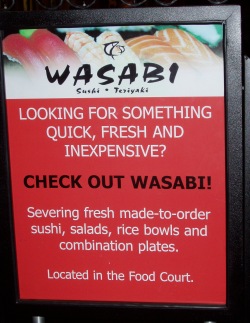
Saw this sign on a display in Whole Foods the other day:

Okaay… but what if you’re allergic to fish?
Saw this sign on a display in Whole Foods the other day:

Okaay… but what if you’re allergic to fish?
This roller coaster ad was supposed to say, “Ready. Aim. Scream.” But when we got stuck waiting for a long turn signal, the view from the passenger’s seat suggested that the Silver Bullet gets some people a little more excited than that.

Katie spotted this example of apostrophe abuse in an office parking lot.

The best service mean is…? Statistical analysis of dumpster service?
Is there any *ahem* meaning for which this would actually make sense?
Up at the visitor’s center for the Mauna Kea observatories, there’s a sign that says, “Beware of Invisible Cows.” It was dark when we were there, and I tried to get this picture without using the flash since there were people with portable telescopes ten feet away, so it’s really blurry:
Fortunately someone in charge recognized the humor value, and the visitor’s center sells bumper stickers:


Of course, it turns out other people, visiting during the day, have snapped better pictures of the sign.
Update 2025: They still sell stickers, magnets and T-shirts featuring the warning! The T-shirts are printed with the words, but not the cows, in glow-in-the-dark ink, so at night, the cows are in fact invisible. I’m tempted…
Note: Our visit to Mauna Kea was on Saturday, April 9, 2005.
I was thinking about Star Wars, the “bringing balance to the Force” prophecy, and RPG character alignments, and realized that while you can neatly map the Jedi and Sith to good and evil (Anakin’s confusion notwithstanding), you can’t map them so neatly to order and chaos.
The Sith are a chaotic organization. They thrive on emotional chaos, they spread chaos to meet their ends… but when they get in charge, they impose order on everyone else.
The Jedi are extremely ordered. They try to purge emotions, they deny attachments. They’re hidebound by tradition. The organization is very structured. And yet they fight not to impose order but to protect it. The Jedi actually strive to preserve the balance of law and chaos.
I’m actually reminded a bit of Michael Moorcock’s Eternal Champion series, in which the cosmic balance between order and chaos is treated as its own faction. The Eternal Champion, in his various incarnations, always fights for the Balance, bringing order to Chaos worlds and chaos to Order worlds.
So the Sith are chaotic, but impose order, while the Jedi are ordered, but fight for balance. The problem, of course, is that the Jedi are not balanced themselves. Anakin does three things to correct this:
Luke and Leia have the opportunity to re-create the Jedi without all the baggage that dragged the old Jedi order down… and they can rebuild it with Jedi who are actually in balance themselves.
An interesting read on the Most Lucrative Movie Franchises, not so much for what it gets right, but for what it gets wrong.
Tonight’s premiere of Batman Begins marks the sixth in the series. And that’s only counting the “modern” era of Batman flicks, dating from 1989’s Batman from director Tim Burton.
Sixth? Are they including the cartoon Batman: Mask of the Phantasm? If so, why not Batman: Sub-Zero? (Curiously, the table on page two only indicates five Batman films.)
And where do they get four Lord of the Rings films? I suppose they could be counting the Bakshi cartoon, but what about the Rankin-Bass Return of the King and The Hobbit?
Where are they getting their numbers?
We went to see Revenge of the Sith again last night. Fourth weekend out, and the theater was still packed. (We were able to get tickets 15 minutes before showtime—or, rather, preview time—but it was pure luck that we managed to find a pair of seats that weren’t in the front three rows.)
And now, Decisions that could have changed everything.
Finally, some thoughts on viewing order. For a new viewer, I think watching the original trilogy first, then the prequel trilogy, probably works best dramatically. There’s so much in the prequels that has impact simply because you recognize elements from the original.
Continue reading