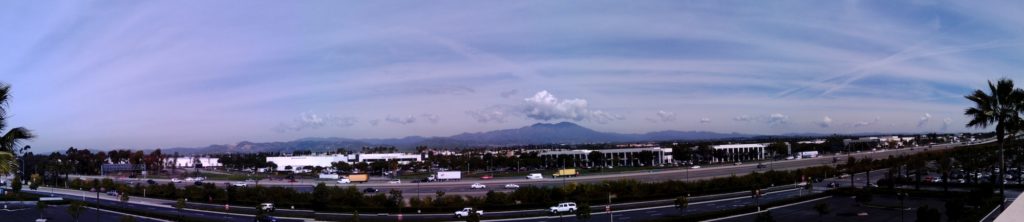
They say that the Southern California car culture is isolating. It’s hard to argue with that, when everyone’s shut up in their own little boxes. But today, on my way to work (delayed a bit on account of dentist), I was listening to KCRW’s Morning Becomes Eclectic and stopped at a traffic signal. They were playing a live version of Elvis Costello’s “Allison.” I looked in my rear view mirror, and realized that the driver behind me was singing along to the same song. Even though it only went one way—she had no way of knowing I was listening to the same music—it was still a moment of connection through shared experience.
Category: Highlights
Not quite botanical
Attended a friend’s wedding last weekend, held at the Quail Botanical Gardens in Encinitas (north of San Diego).
One constant feature of botanical gardens the world over is the collection of placards identifying each type of tree, shrub, or other plant. In the walled garden where the ceremony was held, they took it a step further:

In Your Office
A long row of furniture stores sits in the city of Lake Forest, on a frontage road alongside the 5 freeway. Among them is this:

I can just see the exchange at the workplace:
“Nice chair! Where’d you get it?”
“In your office.”
“Hey! What’s the big idea!”
Pluto Needs Rocks
I went to Worldcon 64/L.A.Con IV on Saturday. Mainly I went to a couple of panels, checked out the art show and the dealer’s room, and looked at some exhibits.
Out in the exhibit hall, near the art show, someone had set up this display:

It’s too small to read at this size, so I’ve transcribed it: Continue reading
Tall Ships of San Diego
I mentioned that on Saturday, we left Comic-Con for a few hours to check out the ships at the Maritime Museum of San Diego. We saw five:
- The Star of India, billed as “the world’s oldest active ship”
- The HMS Surprise, a replica of an 18th century British ship.
- The Berkeley, an 1898 steam ferry
- The Medea, a 1904 yacht
- A B-39 Soviet submarine.
The big attractions, of course, were the Star of India and the HMS Surprise. Naturally, the Star of India was closed when we got there.

The Star of India seen from the Surprise
The Surprise was fun, though. It turns out it was built in the 1970s as a replica of an 18th century British Royal Navy vessel, the HMS Rose. It was sold to 20th Century Fox in 2001 and used to film Master and Commander: The Far Side of the World. After filming was complete, the museum bought the ship and renamed it the HMS Surprise in honor of the fictional vessel.
50 Years of the Flash at Comic-Con 2006
I missed the first half of Saturday’s “50 Years of the Flash” panel because we missed the red line and got stuck waiting to transfer at America Plaza. The shuttle might have gotten us there faster (maybe even on time), but we were pretty sure they wouldn’t let us on with our coffee.
What I did see of the panel was still mostly retrospective, and mainly Mark Waid, Geoff Johns, and Danny Bilson. Carmine Infantino told a couple of stories (one of which he’d told at Thursday’s panel, about the “war” between him and Julius Schwartz: he’d try to draw ever-more-nasty cliffhangers on his covers, and every time, Julie would come up with a story to go with it. So finally he drew one with the Flash and the Golden Age Flash both racing to save some guy, and said, “There! Top that!” The rest, of course, is history).
After a while they started talking about the new Flash book. While the most common answer in the Q&A session was, “Wait and see,” Bilson and DeMeo did answer a couple of questions that I’ve seen people asking about.
For the “legacy pages” in the first two issues, they did a whole bunch of research, sometimes finding conflicting info. (They didn’t mention this one, but the issue of “Who named Impulse” is probably one of those cases.) Any changes in continuity are accidental, and not intentional.
The reason Bart’s acting so morose in these first few issues is that he’s got this problem to deal with, and once he starts to work through it, his impulsive nature will start taking over again.
I almost got the new #1 signed, but staff kept telling everyone to clear the room, and as near as I can tell, Bilson and DeMeo took a different exit than I did.
Update: I forgot to mention some of the other stories. There was a good one Bilson and DeMeo told about how when they pitched the TV show, the powers that be wanted the Flash to be running around in a gray sweat suit. So they got Dave Stevens to design a suit and his rendering convinced them to go with it. Even then, the network resisted bringing costumed villains in until they showed it could work. And apparently what killed it wasn’t bad ratings, but network politics. Someone wanted his show, so he could get a better bonus. A real pity, as the second season opener would have been a two-hour special with the Trickster, Captain Cold, and Mirror Master—a Rogues Gallery episode.
Update 2: Adding more stuff as I remember it (and have time to type). Continue reading
One-Man Team
Something I’ve noticed as I read through various Golden-Age Flash Comics is a repeated subgenre in which the Flash plays an entire team. “Nine Empty Uniforms” (Flash Comics #90, 1947) is the first one I read, since it was reprinted in an 80-page Giant. The bad guys cause problems for a baseball team, so the Flash takes the place of every single player in the upcoming game.
As I’ve picked up comics from the 1940s, and the new Archive book, I’ve found more. In an untitled story from All-Flash Quarterly #1 (1941, reprinted in The Golden Age Flash Archive Volume 2), racketeers hassle a hockey team.The owner needs the money from the “Manley Cup” for an operation for his daughter, so when the racketeers force the players to sit the game out, the Flash steps in.
“Play of the Year” (Flash Comics #39, 1943) breaks with tradition a bit and instead of a sports team, the Flash replaces a troupe of actors. A rival producer tries to financially ruin one of Jay’s friends by preventing his play from opening, in this case faking a measles outbreak among the cast and putting them in quarantine. Once again, the Flash steps in and plays every single role, changing costumes and switching places faster than the eye can see.
The weird thing about these stories is that nowhere does anyone suggest that having a super-powered player—who isn’t even on your roster—just might be cheating. It goes all the way back to his first appearance in Flash Comics #1: Back in college, Jay Garrick was a football scrub. After the accident gave him super-speed, he convinced the coach to put him on the field so he could show off in front of his girlfriend, Joan.
Interestingly, later retellings of the Flash’s origin make it a point that he quit the team immediately afterward because staying would have given him an unfair advantage.