Spent a good chunk of last night looking at travel websites. Accomplished 2 things:

  • Arranged for a hotel to stay in San Francisco next month.
  • Arranged for a back-up hotel for San Diego Comic Con, just in case we can’t get a room through the convention desk.

Hotel rooms during Comic-Con have become a scarce commodity over the last few years, as attendance has shot up by thousands (it actually sold out before the doors opened last year!) but only a few hundred new hotel rooms have been added to Downtown San Diego. Rooms in the convention blocks have been selling out in a matter of hours. The con website has crumbled under the stress, and the phone lines have caved. Last year it took me over an hour just to get through. This year, they haven’t even published a list of which hotels are involved, and it looks like they’ve dropped fax from their options. And booking downtown hotels directly isn’t an option: either they’re sold out, or they want $350/night-plus.

So, just in case I can’t get a room downtown when they go on sale next week, we can at least stay someplace near a trolley station. And if I can get a closer room, even if they charge me $25 to cancel the first reservation, it’s worth the peace of mind.

(Originally posted at LiveJournal. Brought over here to fit with the rest of my convention posts, and as a snapshot of the days when you could get a backup hotel. Not downtown, but in…it might’ve been Old Town? In any case, I cancelled the room once we got our confirmation from the convention block hotel sale.)

Oddly, the usual deluge of election propaganda hasn’t materialized yet, and the election is less than a week away. While looking through the scanty haul, most of which is focused on a quartet of propositions on Indian gaming, Katie found an intriguing statement:

Why PORAC Supports Propositions 94, 95, 96 & 97

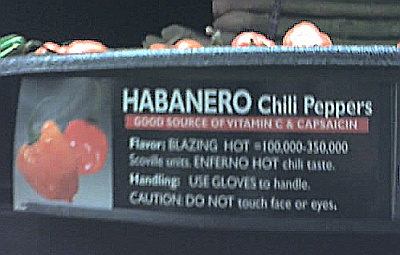
Wait… pubic services? Whoa! And here I thought gambling on tribal lands was hot. This could blow it away… or alternatively, screw everyone over.

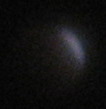
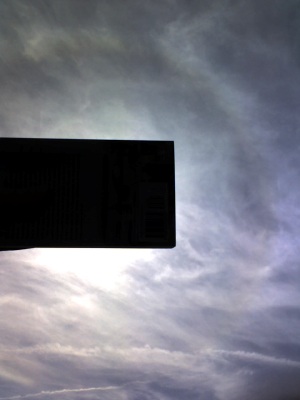
Corona/Iridescent Cloud

Spotted this on Thursday, between rain showers. It’s a slightly distorted corona, formed by diffraction of sunlight around cloud droplets, splitting the spectrum and producing rainbow-like colors. According to the Atmospheric Optics site, the distortion indicates that the droplet size varies across different parts of the cloud.

This was shot through a window, and I’m 99% certain that the straight line running down the middle of the darker foreground cloud is a reflection from inside the room.

We went to The District on Saturday afternoon to catch Cloverfield and check out the Auld Dubliner. I took the Warner exit to go in the back way, and noticed someone standing out on the shoulder of the ramp, taking photos. I looked out past the wide expanse of empty fields and was astonished to see the entire San Gabriel mountain range covered with snow!

Not just the tops of the mountains on the eastern half of the range, but everything, even the lower parts you can just barely see by the Cajon pass, and this huge expanse north of Los Angeles that I’m not sure I’ve ever seen covered.

San Gabriels (mid-range) covered with snow

I pulled over as soon as I found a spot I considered safe, then walked back up to the top of the ramp. I talked briefly with the man I’d seen taking photos, and he said he’d lived in the area for 50 years and had never seen the mountains like this. He also mentioned he had a friend who had served at the base*, and he was going to send him the pictures.

I ended up taking a 12-photo panorama (zoomed) spanning at least 120° from the blimp hangar on the left, across the San Gabriels, past the hills above Orange and Tustin, the foothills of the Santa Ana Mountains, on to Saddleback, which had a few bits of snow clinging to the mountainside.

San Gabriel Snow Panorama
Click to view panorama (424 KB 6648×500 JPEG)

*This is the location of the former MCAS Tustin. The Marine base was closed in the mid-1990s, and the land is only just starting to be developed—notably The District in one corner, which is what brought us to the area yesterday.

Update December 18, 2008: This post is getting a lot of traffic today, but it’s from last winter. If you want to see photos from this week’s snow, check out Misty Mountains: Another San Gabriel Snow Panorama from the same spot on Tuesday, December 16, and my Snowline photoset on Flickr, for those pictures and several of Saddleback and the Santa Ana Mountains today.

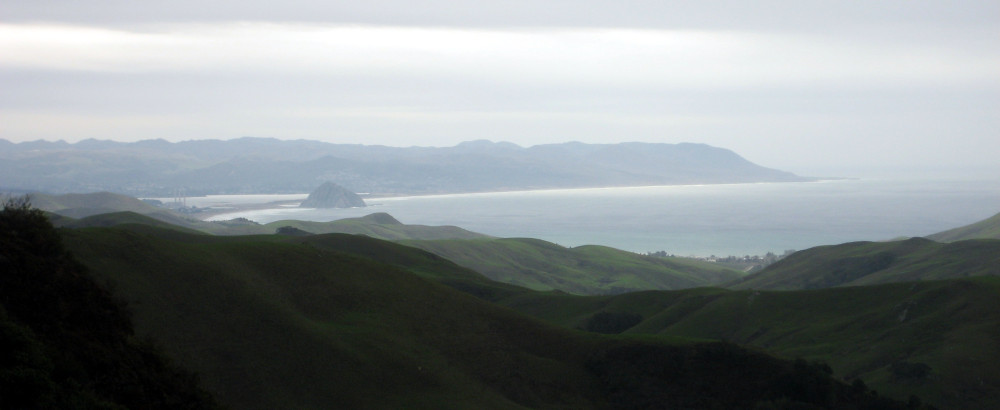
While driving to work this morning, I looked off to the left and saw this beautiful view of fluffy white clouds hugging the mountains, and bright sunlight on the patchy green hills.* When I got into work, I went straight for the corner conference room that has a view in that direction… but the clouds had rolled in and turned everything gray. I kept checking back every so often, but the closest I got was this:

Green patchy hills

It’s been great to have a more normal amount of rain this year. The coastal hills all turned green after the second rainstorm, early in December. The hills up by the mountains took longer, since most of the area had burned off in the Santiago fire. Faint patches of green started to appear around Christmas, and now, the lower hills at least are more green than brown.

The scenery still looks odd, though. There’s a third peak (Flores?) near Saddleback, about 1,000 feet lower, that normally blends in with the mountain behind it. Well, the entire north face of the hillside burned. Then high winds blew the ashes away. People coated it with a green-gray material that I suspect was intended to prevent mudslides (it looked like the stuff they spray on dirt embankments in construction projects before the landscaping kicks in). It rained, repeatedly. Then we had high winds again, clearing all the gunk out of the air…and now it’s got the light brown color normally seen on the lower, closer hills during the dry season, instead of the darker brown of the mountains. It doesn’t blend at all, even from as far away as Tustin.

Saddleback with a large hill in front of it

This was taken from in front of the Ralphs on Jamboree on January 13. You can see the line of hills in front is still a green/brown mix, and then there’s this light brown lump rising up behind them. On the left side you can see some remnants of the anti-erosion substance.

The following day, on my way to lunch at the Irvine Spectrum (7 miles away, and perhaps a 30-degree difference in angle), I went over a bridge and saw Saddleback next to the Ferris wheel. I knew I had to get that shot.

I parked in the west parking structure, then went running around the top floor looking for a spot where I could frame the wheel and the mountains together, and avoid too many light poles, and get above the few cars, and not have to worry that losing my balance would cause me to fall 3 stories to my death. I finally climbed onto one of the support pillars for the light poles in the middle of the deck, where if I fell I’d only fall a few feet.

Saddleback and Ferris Wheel

Here, you can really see the difference between the areas that burned and those that didn’t. Compare this to the third picture in Saddleback Snow, or the second in Ashen Mountains.

Sadly, the best places to take photos from seem to be the middles of freeway bridges and tops of private buildings — in other words, inaccessible.

Had dinner at my parents’ last night, and at one point talk turned to yesterday’s primary election. It’s quite interesting that, within a matter of days, the Iowa Caucus and New Hampshire Primary chose different candidates for both major parties.

It points out something that should be obvious: State-wide primaries don’t tell you how well a candidate would do in a national election. Iowa Democrats preferred Obama; New Hampshire Democrats preferred Clinton. Iowa Republicans preferred Huckabee; New Hampshire Republicans preferred McCain. It shouldn’t be a surprise that people in different regions have different concerns.

Putting too much stock in the results of one state-wide race makes as much sense as having Oregon voters select the next governor of Louisiana.

On a related note, what is it that causes so many fields to settle into the equivalent of a two-party system, with two major players (sometimes balanced, sometimes one dominant and one major alternative) and a bunch of also-rans? Republicans & Democrats, Windows & Macintosh, Internet Explorer & Firefox (and previously Netscape and Internet Explorer), Pepsi & Coca-Cola, etc.

Sure, humans like oppositions. It’s what makes the false dilemma fallacy work so well rhetorically. But why is either-or thinking so prevalent in some fields? And what’s different about fields in which many alternatives hold each other in balance? Car manufacturers, for instance, or movie studios, or cell phone manufacturers.

I wanted to take a look at Firefox’s error page a few minutes ago, so I selected the address bar and hit some random keys. Due to a lack of sleep last night and a day of caffeine, I’d forgotten that if it can’t find a site with a given hostname (and still can’t find one through auto-complete), it automatically does a search for whatever you typed in.

I was rather surprised to see that a search for “klasjdf” turned up 508 hits.

As I think about it, it makes sense. Those letters are 7 of the 8 home keys on the QWERTY keyboard layout, and the eighth is not only a semi-colon, but home to a pinky. A touch typist hitting random keys might be inclined to just hit the ones that are already under his or her fingers. One per finger, leaving out the single non-letter, gets you exactly the 7 that I typed.

As for the letter order, I spot-checked a few permutations, the lowest of which was just 251 for klasdfj. Those with patterns scored higher: 18,400 for alskdjf (alternating left & right, working in from the edges to the center); 99,600 for asdfjkl (left-to-right).

I guess there must just be a lot of people typing random text. Infinite monkeying around, so to speak.

»All pages site-wide with this tag