Parking structure sign showing 264 open spaces on level 5, 326 on level 4, 469 on level 3, 247 on level 2, and level 1 full.

It’s astonishing how many times I’ve seen drivers stop near the entrance of a parking lot or structure and wait for someone else to load their car, get in the car, start the car, fumble around for sunglasses, make a phone call, put the car in reverse, check their messages, and then back out…even though there are 1306 open parking spaces on the upper levels, and a line of six cars behind them waiting just to get inside.

If the other driver is actually ready to back out, then yeah, it’s nice to pause and let them out. But if they’re not even inside the car, or if they haven’t even started it? The only thing you’re accomplishing by waiting for this space is annoying the people behind you.

Though I suppose for some people, that’s reason enough.

Elevated train station above a parking lot at night. A long streak of light indicates the windows of a train in motion.

I haven’t really kept up with the photoblog since moving a few months ago. I’ll try to get back on track with a new post each week.

This is Aviation Station along the Los Angeles Metro Green Line, the closest station to LAX. (It doesn’t actually stop at the airport, but you can take a shuttle bus.) It’s also the nearest stop to my office. Before I moved, I’d sometimes take the train up to this point and a bus the rest of the way to work.

One night I was working late and missed the bus. Somehow convinced that the next one wouldn’t be by for an hour, I decided rather than sit and wait, I’d walk the mile and a half to the station. Three or four buses passed me, so it didn’t save me any time, but it was interesting to watch the planes line up for landing, and I caught this view of a train leaving the station as I was arriving.

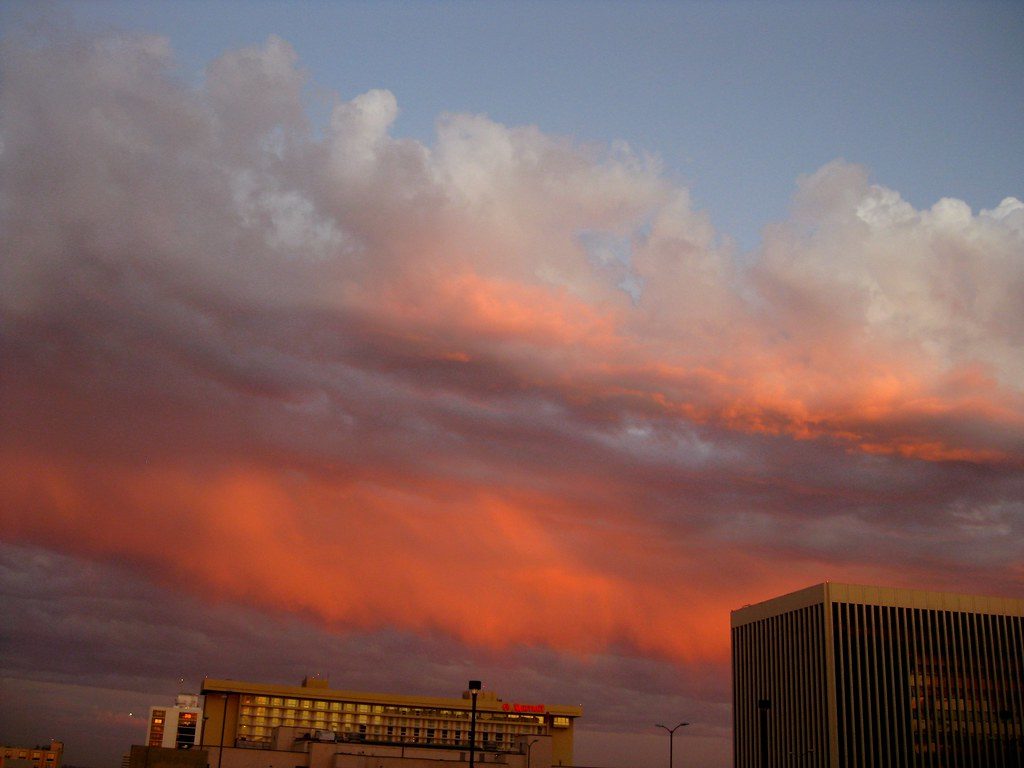
Saturday night we went out to the Redondo Beach pier just in time to watch the sun set over the Pacific Ocean. One thing that I found a bit odd was that it appeared to be setting behind a line of distant mountains. While the coast does curve westward at Santa Monica, I was pretty sure that due west of us was nothing but sea, though I figured it could have been the Channel Islands, or a very sharply-defined cloud bank.

So I did what any geek would do: looked up the angle at which the sun had set that evening.

I found two tools: The NOAA solar position calculator let me figure out, given latitude, longitude and time, the sun’s declination. Then I found another tool that let me enter the latitude, longitude, and compass bearing and see a line drawn on a map.

It turned out that the sun was setting roughly 21° north of due west, putting it roughly in line with the coast from Malibu toward Ventura…on the seaward side. The line finally connected with land out toward Point Conception, roughly 120 miles away. That’s probably too far away to be visible from near sea level, depending on how high the mountains are out there, but if the angle was off just a little bit (I did estimate the time), it could easily have be the Santa Monica mountains above Malibu (more like 20 miles).

So yes, I did watch the sun set over the ocean and over land at the same time!

  • Familiar yet alien ancient views of Earth – photorealistic simulations of the world as seen from space, millions of years ago.
  • Back in 2006, Qualcomm effectively discontinued Eudora, though they sponsored a project to extend Mozilla Thunderbird with the look, feel, and some features of Eudora. I lost track of it over the years, but it turns out they finally released Eudora OSE last September…four years later.
  • Revealed: How Area 51 Hid Secret Craft. Advanced designs by humans, of course, not alien ships.

I’ve dealt with a couple of companies that try to plug the general lack of security in email by using a “secure email” service. The way this works is:

  1. The company sends you an email with a link to a third-party or co-branded website, asking you to click on it in order to read important information about your financial/insurance/whatever account. (Or better yet, the third party site sends you the mail on the company’s behalf.)
  2. You click on the link and open the site in your web browser.
  3. You register for the site (which usually involves entering your name, choosing a password, and possibly entering other personal detail like a reminder question.)
  4. You log into the site and actually read the message.

Can you see what the problem is?

That’s right: Steps 1-3 are exactly what you see in a phishing attack. Only in a phishing attack, the third-party site is a fake that’s trying to collect account information (like your login and password) or personal information (like your SSN).

So while they may be solving the immediate problem of “someone might intercept this message,” they’re perpetuating a broader problem by training people to fall for phishing attacks.

Sadly, this is not new.

Update 2022: A decade later, they’re still doing it.

»All pages site-wide with this tag