
That’s the current headline over at the Apple website, on the announcement of iTunes for Windows.
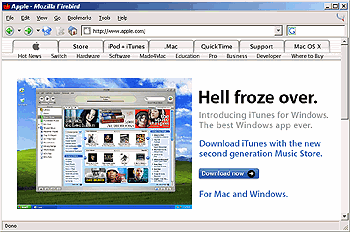
That’s the current headline over at the Apple website, on the announcement of iTunes for Windows.
OK, I’m not one of those purists who thinks all computers should be encased in beige boxes. That said, 4 of the 5 computers in our apartment are fairly plain – but two of those are because the case predates any sense of design, one was an ultra-cheap computer, and one was an ultra-cheap case.
Last week, while looking for that ultra-cheap case so I could build Red Shirt, I looked at the more expensive cases, thinking I might replace the case on my main computer, and then reuse the old one for the new machine. And while there were several really nice cases, none of them really struck me – unless you count the ones that exhibited the two trendiest offenses in case design:
In the end, I decided I didn’t want to assemble two computers, just one, so I bought the cheapest, smallest case I could find. (As it happens, it manages to make the USB situation worse by putting the ports on the side of the front panel – but I wasn’t expecting to use much in the way of USB devices on this box anyway, and it turns out the only ports this motherboard can handle are the built-in ones.)
SiteFinder was a “service” Verisign offered for a few weeks in 2003 in which DNS lookups to any non-existant domain in .com or .net responded with a pointer to an ad page. Techies revolted because it broke a lot of stuff. Verisign attempted to paint opponents of Site Finder as a minority of anti-innovation “technology purists” who still resent the presence of commerce on the Internet. A shorter version of my response ran on CNet’s News.com as a letter to the editor.
Mark McLaughlin’s opinion piece, “Innovation and the Internet,” simply proves that Verisign has completely missed the point. The reason so many people objected to SiteFinder is not the service it provided, nor a rejection of innovation, but that it caused a significant number of non-web applications to fail. Verisign, a company that should know better, had forgotten that the Internet is more than just the web.
There are many applications besides the web which make use of the DNS system, and many of them take actions that depend on whether a domain exists or not. Some of the more obvious cases occur in spam blocking. For instance, mail servers often check to see whether a the sender’s domain exists before accepting email. The DNS wildcard that powered SiteFinder broke this: suddenly, all domains would appear to be valid. A spammer could claim to be sadkjfhdsaf@asdfsadfjsdf.com, and the message would be accepted.
Another issue is DNS-propagated blacklists: at least one (ORBS, if I remember correctly) had folded and allowed its domain name to expire, but many software packages still included it in their default configurations. Since people often install software without updating, they were seeing slightly slower results at first, but the SiteFinder wildcard suddenly caused all queries to return positive, and a number of servers began rejecting all mail. (Something similar happened with Osirusoft a month earlier, but that was intentional on the part of Osirusoft’s former administrator.)
Other people are concerned about the fact that misdirected email, instead of being routed to secondary servers (in the case of a bad configuration) or bounced back by the originating ISP, is being routed through Verisign. Here, it’s a matter of trust: if you trust Verisign to do the right thing and bounce it without looking at it, then you probably have no objection. But many people saw the arbitrary creation of the wildcard in the first place as a breach of trust, casting doubt on their trustworthiness in other areas.
There are ways to resolve the issue of mistyped websites that do not break other applications. Microsoft embedded this functionality in Internet Explorer some time ago. I believe AOL has done the same in their software. While there were probably some objections, in neither case did it cause other applications to stop working.
It’s not about being technology “purists,” stifling innovation, or keeping commercialism off the Internet. It’s about recognizing the fact that the Internet is a collaborative effort, not the private domain of any one company. If Verisign had submitted its idea for review, and given others a chance to point out its flaws and to make adjustments to their own software, this could all have been avoided. As it is, it is clear that Verisign neither thought through all the consequences nor is willing to recognize that there even are consequences. And that – not a desire to “hold the Internet back” – is the reason for the backlash.
On Friday I reinstalled Red Hat 9 on my computer. On Saturday I figured out why I couldn’t build Dillo on the virtual Conectiva system (the only reason I tried to install the real thing). On Monday I made a remark on the Dillo mailing list that, after trashing the system trying to install Conectiva, “unless/until I can set up a spare system solely for trying things out, anything else… will run under User-Mode Linux.”
And that got me thinking.
A spare system wouldn’t need to be elaborate. I wouldn’t be playing games on it. I wouldn’t be doing graphics work on it. I wouldn’t even be doing web development, word processing, or checking my email. Most of the time it wouldn’t even be running – just when I wanted to try something new, or when a new release of Dillo came out and needed RPMs. And since I have a spare KVM switch, I’d only need to find space for the case, and wouldn’t need to worry about a monitor.
I’ve mentioned before that I’ve upgraded my computer piece-by-piece since 1994. Well, when you do that, you end up with a lot of spare parts left over. Sure, they’re older, slower, smaller, etc. than what you’ve got now, but if they worked when you took them out, they probably still work now. I’ve been meaning to go through all the boxes, cards, drives etc. and get rid of things I don’t need anymore, but I’d never gotten around to it. Well, on Monday I finally had motivation.
I went through looking for parts I could use to put together a spare, expendable system – one where it wouldn’t matter if the entire hard disk got wiped. I found three hard drives (two of them too small to be useful), several sticks of RAM, network and video cards, and a motherboard and a CPU that wouldn’t fit together. That left: a case, a CD-ROM, and either a CPU to go with the motherboard, or a motherboard to go with the CPU.
![[A picture of Red Shirt]](https://journal.kvibber.com/wp-content/uploads/2003/10/redshirt.jpg) It turned out my boss was getting ready to throw out some old equipment, including a huge mega-tower with a 450 MHz K6-2. The motherboard I have used to hold a K6-2. (Where it is now, I have no idea – I don’t think it’s the one I fried, especially since the motherboard seems to work.) So now I had a processor. My parents had recently replaced an extremely flaky computer, so I got a CD-ROM from that. Then I went to Fry’s and picked up a $30 case and $13 floppy drive.
It turned out my boss was getting ready to throw out some old equipment, including a huge mega-tower with a 450 MHz K6-2. The motherboard I have used to hold a K6-2. (Where it is now, I have no idea – I don’t think it’s the one I fried, especially since the motherboard seems to work.) So now I had a processor. My parents had recently replaced an extremely flaky computer, so I got a CD-ROM from that. Then I went to Fry’s and picked up a $30 case and $13 floppy drive.
That’s right: I have just built a $43 computer.
Somewhere in this whole process, Katie came up with the name “Red Shirt Linux.” And while it’s mostly going to be SuSE, Conectiva, and Mandrake, the name fits.
Preliminary tryouts look promising: All the hardware works, I was able to see old data on the hard disk before I repartitioned it, I could boot tomsrtbt off of a floppy and mess around under that. I tried Conectiva first, and it failed, but I think I’ve got a bad install CD. (The UML system I built from it has network problems, and the copy I installed on Ghostwheel is what trashed my partition table, so it doesn’t surprise me that it had problems here.) I’ll run a thorough memory test overnight just to make sure, but it looks like I’ve got a PC I can mess around with without risking any data!
For several months I’ve been providing installable RPM packages for the Dillo web browser. Since many different distributions use RPM packages, I’ve been getting requests to add various Linux distributions. I started out just installing to extra partitions, but then I started building virtual systems with User-Mode Linux.
Well, people have been requesting RPMs for Conectiva, a distribution from Brazil and partner in UnitedLinux. I built a UML virtual system, but was never able to get Dillo to compile or to get the imitation network driver working. So, tonight I decided to install an actual copy.
With most Linux installers, you can choose where to create a new partition, and set it up to add existing ones to the system. This has worked fine with every version of Red Hat, Mandrake, and SuSE I have installed. The installer will create the new partition, leave the others alone, and mark them to be visible in the system you’ve installed.
Conectiva didn’t leave the existing partitions alone. Each partition I had marked was gone: my main OS partition (currently Red Hat 9), my home directory, and all my download and media files. Fortunately I had backups of the most critical files from last Saturday, and I was able to recover my entire home directory with Tomsrtbt and Parted‘s rescue function. And I don’t mind losing my main OS, since it’s not that hard to re-install it – all I need is the configuration, and I’ve got that backed up.
That leaves my entire download and media archive. I always figured, “I can just re-download all of this, right?” And most of it I can. Much of the rest either isn’t important, or hasn’t changed since the last backup (which I’ll admit was a long time ago), or can be recovered from CD, or can be re-scanned. The few photos that hadn’t made it into last week’s backup turned out to still be in a temporary folder on my website. Still, there are things that will be hard to find again, and probably some that will be impossible.
Just in case, I’ve got a recovery tool scanning the lost partitions in hopes that it will come up with something.
I’m not touching Conectiva again – or any other distribution I’m not already familiar with – until I get a spare system set up, or maybe spring for something like VMWare. And I’m seriously considering picking up some sort of backup solution that will hold more than a CD-RW, so I’ll be more inclined to save everything instead of picking and choosing what to put on a few discs.
Update 7:45am: I got the download/media partition back. The tool I ran overnight didn’t seem to find anything, but when I ran parted again this morning (after remembering that it was on PAUD, the Parted And Utilities Disk, not Tomsrtbt) it was able to find the partition.
So now all that’s missing is the primary OS (I’m running off of one of the “extra” installations right now), and I can reinstall that easily.
Yes, it’s real! Last week Katie remarked we were running low on coffee, and I remembered an article on MozillaZine a few weeks ago about RJ Tarpley’s Mozilla Coffee. I figured, what the heck, let’s order some. It’s a way to get coffee and support Mozilla at the same time.
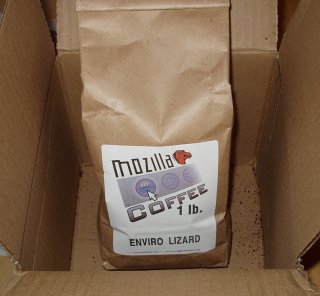
We went out for a late lunch/early dinner today, and as we came up the stairs we noticed a note tucked into the doorframe. At first I figured UPS had left a “sorry we missed you” note, but when we got up to the landing, the doormat was propped up on a six inch tall box! (That and it turned out to be FedEx, but I digress.) “Hey, no one will notice if we hide this under the doormat!”
We haven’t tried it yet, but we’ll post the results of our taste-test once we do.
Annoyances, my arse. I think the two comments linking to porn sites (which, with luck, will have been removed by the time most people see this post) qualify for a full-on pissy fit. Blog spammers should be roasted alive. Slowly.
