Following up on the PayPal anti-phishing discussion of a few weeks ago, I see that PayPal is promoting a service called Iconix. You install the program on your system, and it looks at your inbox for messages that claim to be from one of its customers. It tries to verify them “using industry-standard authentication technologies such as Sender ID and DomainKeys.” Messages that pass get a lock-and-checkbox icon attached to the sender’s name, and in some cases the name is replaced by the sender’s logo.

On the tech side, it’s similar to SpamAssassin’s whitelist_from_spf and whitelist_from_dkim features. Both allow you to specify a sender to whitelist, and it will only give a message special treatment if it can verify the sender.

On the user-interface side, it’s similar to EC certificates, in that it tries to highlight a “good” class of messages rather than flag or filter out a “bad” class.

It’s not a bad idea, actually, and now that I’m surprised I haven’t seen something similar in other email clients. It’s sort of like setting up custom rings or images for images on your cell phone address book

They seem to be focused on webmail and Outlook so far, and only on Windows, but it looks like the perfect candidate for a Thunderbird extension. They do have a sign-up form to notify you when they add support for various programs and OSes, and I was pleased to see not only Thunderbird and Mac OS listed, but Linux as well. Too often, Linux gets forgotten in the shuffle to ensure compatibility with every Windows variation.

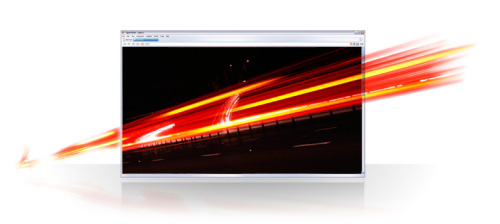
Opera Software has just released a new beta version of the desktop web browser, Opera 9.50 beta 2. The splash page makes me think of something a bit different, though:

Opera 9.5 beta
Speed, security, and performance matter.

Now, we’ve made the fastest browser in the world even faster. Opera’s new beta is quicker to start, faster at loading Web pages and better at running your favorite Web applications.

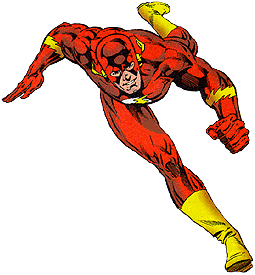
Hmm, a red and yellow blur, zooming across the view? And an emphasis on speed? That reminds me a bit of this guy:

The Flash

Opera has long promoted itself on its speed, and it has used a super-hero theme in its advertising before. The vaguely Superman-like* “Opera Man” was used heavily in advertising Opera 8, despite being ridiculed by most of the browser’s user community.

So why not a subtle reference to the Flash?

*Blue costume + red cape. Hey, if a blue shirt and red jacket work for Clark on Smallville, you know the color scheme has become iconic.

IE7On Thursday I stumbled across a campaign to Trash All IE Hacks. The idea is that people only stay on the ancient, buggy, feature-lacking, PITA web browser, Internet Explorer 6, because we web developers coddle them. We make the extra effort to work around those bugs, so they can actually use the sites without upgrading.

Well, yeah. That’s our job.

And a bunch of random websites blocking IE6 aren’t going to convince people to change. If I were to block IE6, or only allow Firefox, or only allow Opera, I’d have to have seriously compelling content to get people to switch. Mostly, people would get annoyed and move on. Who’s going to install a new browser just so they can read the history of the Flash? Or choose an ISP? Or buy a product that they can get from another site?

Slapping the User in the Face

It’s so easy for someone to walk away from your site. One of the tenets of good web design is to make the user jump through as few hoops as possible to accomplish whatever you want him/her to do. Every hoop you add is an obstacle. Too many obstacles, and they’ll just go somewhere else more convenient.

Back when I was following Spread Firefox, every once in a while someone would suggest blocking IE. Every time, people like me would shoot it down. Continue reading

Scientists have built a computer model of the Neanderthal vocal tract based on fossils, and have simulated the kinds of sounds they could have produced. Ever since I read Robert J. Sawyer’s Neanderthal Parallax novels, I’ve been fascinated by the idea that there were two distinct human species, living side by side, for perhaps thousands of years. What happened to them? Did our ancestors kill them off, or interbreed with them? Did they fail to adapt to a changing climate? (via Slashdot)

On a related note, it seems that Expelled, the anti-science propaganda film that actually invokes Godwin’s Law by claiming that “believing” evolution leads to Nazis, opens this weekend. I’m curious to see how badly they misrepresent things (it’s always best to look for yourself, instead of just taking other people at their word—that’s the whole idea behind science, after all), but I can’t bring myself to support them by actually giving them money. Meanwhile, Expelled Exposed is interesting reading.

In software, dria.org explains why the AwesomeBar is awesome. That’s the nickname given to the new address bar in Firefox 3, which lets you search your browser history as you type. It’s the reason I never went back to Firefox 2 after trying out one of the later FX3 betas, and why I’ve installed Fx3b5 on two more machines. The Opera 9.5 previews have a similar feature, but Firefox’s implementation is better visually. It’s easier to spot the page you want, and over time, it learns which pages you visit more often. It’s so much faster to type a word or two than to hunt through the bookmarks menu. (via Asa Dotzler)

IEEE has an article on how copyright law applies to websites, What Can You (Legally) Take From the Web?

Finally, ***Dave relates an incredibly cool story of going to see Avenue Q and what happened after the show. I had no idea that (at least in New York), the “Give Me Your Money” segment was actually collecting for a charity.

In conjunction with the Safari 3.1.1 security release, Apple has also released a new version of Apple Software Update for Windows. With version 2.1, they’ve taken the opportunity to fix one of the problems that caused so much criticism last month.

It now shows two lists: one for updates, and one for new software. This takes care of one of the three easy steps that I culled from discussions back in March:

  1. Separate updates from new software and label them clearly. Done.
  2. Leave the new stuff unchecked by default. Bzzzt! Try again!
  3. When run automatically, don’t pop up a notice more than once for each piece of not-installed software. [Edit:] Done.

Unfortunately the new software is still checked by default, but one hopes that the separate list would be enough to make people stop, look, and make a conscious choice as to whether or not to install it.

I don’t know yet how it handles new software when run automatically, or whether they’ve made the ignore option apply to an entire piece of software rather than a specific installer. I’ve taken iTunes off the ignore list and set it to check daily so that I can find out. [Edit:] I haven’t seen it pop up in the last 24 hours, and according to eWeek, “Apple will now only prompt the user if there are critical security updates available.”

Continue reading

»All pages site-wide with this tag