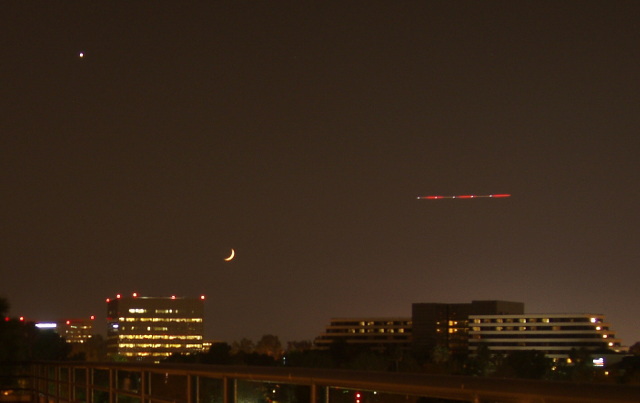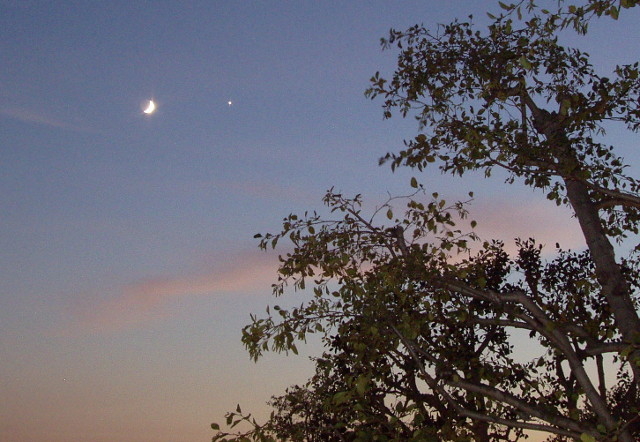
About a month ago I posted about noticing the Belt of Venus—the red band that circles the entire horizon just after sunset—and the Earth’s shadow on the sky. I snapped this picture on the drive home this evening. This is looking east, away from the setting sun.

Looking east toward Saddleback at sunset.

If you look at the right edge of the picture, behind the silhouette of the tree, you can just see the red band fading into the dark gray of the Earth’s shadow.

(And to think, I almost brought the good camera with me this morning… Update: It turns out that I did bring it, and just didn’t realize it was there. Oh, well.)

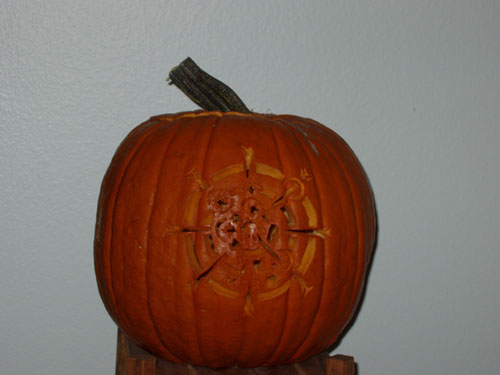
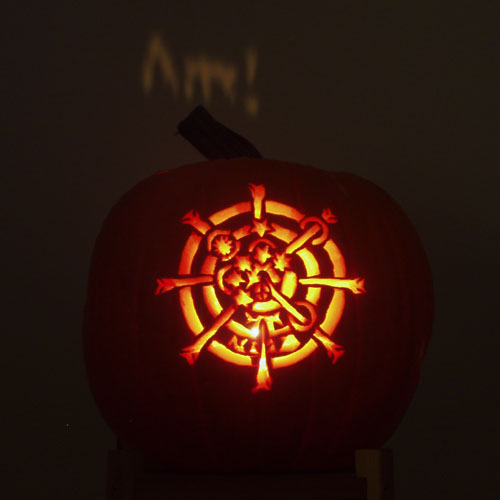
A tale of the Browser Wars on the high seas.

Harken, lads, and listen to my tale. It is the tale of the FyreFawkes, a vessel that turned the tide in the never-ending battle for the high seas.

In this day, shipping lanes criss-cross the ocean like a Web, and in years past, that web was commanded by the Fleet of the Navigators. Wherever ye wanted to go, a Navigator ship was there to take you. But the wealthy My Crows’ Loft Company controlled the ports, and knew that if they did not take command of the high seas, someone might use the Navigator Fleet to build their own harbors, outside My Crows’ Loft’s sphere of influence.

So My Crows’ Loft built their own fleet, a fleet of Explorer craft, and after a great trade war, their fleet dominated the ocean. The Navigators’ fleet shrank, nearly forgotten.

But My Crows’ Loft grew complacent in their victory, and the Explorer fleet aged. Worse, the vessels had weak spots and leaks that pirates and brigands of all sorts knew how to attack. What was once a pleasant voyage across the sea became a journey fraught with danger, with spies, phishermen, and great wyrms lying in wait for the unsuspecting voyager. Continue reading

It’s hard to believe, but it’s been three years since the first post on this blog. I still think of myself as being kind of new at this, but at this rate, we’ll be in the old guard. Or at least the new old guard. 😉

Topics have shifted around. It started out as a personal blog with Sci-Fi overtones, and slowly took on more of a focus on humor, comics and tech. Posts in the early days were divided 60/40 between me and Katie. These days it’s more 90/10, partly because we’ve both shifted a lot of the personal stuff over to LiveJournal. Strange photos started showing up very early on, making up what are now the Strange World, You Must Be Mistaken, and Signs of the Times categories.

The site started on B2 and moved to WordPress when the project forked.

Even the title is subtly different. It started out as “Ramblings,” with a “K²” icon to the left. After a while, the icon became part of the title, and it’s been known as “K-Squared Ramblings” for most of those three years.

According to the WordPress Dashboard, we now have 912 posts and 961 comments Continue reading

This is incredibly bizarre. Today I’ve started getting spam which is clearly coming from zombies and using fake return addresses and forged headers, but the content is a plaintext message encouraging hurricane relief donations and linking to the legitimate Red Cross and FEMA websites. There’s one further link, to arc.convio.net, but the ISC reports that the site is legit.

It literally looks like some spammer decided to encourage donations to the relief effort, picked an organization he figured most people would recognize, and plugged the message into his usual spam software.

I can’t decide what to do about them! On one hand, they’re spam. They’re unsolicited, they’re using spammer techniques, and they’re clearly not associated with the Red Cross. And we’ve always said the issue is “consent, not content.” But if the ISC is right, they’re not trying to pull a fast one like the scams and spyware installers that are leeching off of the catastrophe.

I keep thinking I should train the filter on them anyway, just like I would add political or religious spam, or an everyday charity that decided to start spamming for donations… but for some reason I just can’t bring myself to do it.

The SANS Internet Storm center, which has found itself dealing with the fallout on the Internet from a quite literal storm, is reporting that a vulnerability in Dameware (apparently a remote admin system for Windows) is being exploited. Ordinarily the solution would be to tell people to download the update… but the Dameware website is in New Orleans. Fortunately, the UK-based site is up.

Not everyone in New Orleans has gone offline. Netcraft reports that domain registrar DirectNIC has held on through Katrina and its aftermath. Being located 11 floors up in an area that hasn’t flooded yet probably helps. That, and having three weeks’ worth of backup power.

A quick question for people who discount the idea that global warming could be caused, in part, by human activities on the basis that we can’t possibly impact the climate as much as natural events and cycles affect it.

Do you also discount the well-documented depletion of the ozone layer by interaction with CFCs and similar chemicals? That seems to be a major environmental impact, and one that clearly has an anthropogenic component.

Nearly two decades after we cut back on CFC use, it looks like the ozone layer is finally starting to recover—or at least it’s stopped shrinking. Of course, it’ll take time. The whole reason we started using CFCs is that they didn’t seem to react with anything, so they’ll stay in the atmosphere for decades. UCI’s Sherwood Roland (who won a Nobel Prize for research on this topic) is quoted as saying, “This problem was a long time in the making, and because of the persistence of these chlorine compounds, there is no short-term fix.”

Opera BrowserOpera Software celebrates its 10th anniversary today with an online party and free registration codes for a day.

I first discovered the Opera web browser in college, probably 1998 or back in 1999. A friend who worked with me at the Artslab showed it to me, and I was impressed by how fast it was and that the installer fit on a floppy. Opera was shareware only back then, with a 30-day trial period, and I had no objection to paying the $15 or $20 $18 it cost with a student discount. (I remember scanning my student ID and emailing them a JPEG to prove I was a student.)

By the time Y2K rolled around, Netscape 4 was showing its age, and Mozilla was still early in its development cycle. IE—well, IE had won the browser war, and was arguably better than Netscape at this point, but as far as I was concerned they had cheated to do so instead of winning solely on merits. Opera was a lean, mean browsing machine.

Things changed during 2000, though. Opera 4 and 5 started getting cluttered, and Mozilla was starting to stabilize. Side projects like Galeon started branching off of Mozilla. Pretty soon I was using Mozilla all the time on Windows and Galeon on Linux.

I kept up with new releases, though, and the latest version of Opera is excellent—on both Windows and Linux. I mostly use Firefox these days, but I’m using Opera a lot more than I used to—and not just for testing!

Check out Opera, grab a free reg code while they’re still available, or just drop in on the party.

Seen in rounds at WaSP Buzz, Slashdot, and Opera Watch.

Also interesting: the Opera 10th Anniversary T-Shirt reminded me of Joi Ito’s comments on wearing Firefox (via a*dot). I wonder how people would react if I wore a Firefox shirt and an Opera hat, or vice-versa?

(Other notable tens this August: Windows 95 and Internet Explorer)

»All pages site-wide with this tag