Wow.  The Babylon 5 Scripts team keeps finding more ways to get my money.  The latest: The Chronologies of Babylon 5.  And it includes every single piece of B5 canon, down to the six short stories JMS wrote after the series ended and even the unproduced Crusade scripts.

The script books have mostly been interesting for the commentary and supplemental material. Though I was disappointed that they couldn’t get Neil Gaiman to write an intro for his Day of the Dead script in the latest volume. It just reprinted the contents of the solo script book you can get from the CBLDF, which has a brief intro by JMS and a handful of footnotes by Neil Gaiman.

So, here’s what we’ve got so far (including what’s been announced):

  • 15 volumes of Babylon 5 scripts by J. Michael Straczynski.
  • 3 volumes of “Other Voices,” the B5 scripts by other writers.
  • 1 volume of the B5 TV movie scripts (announced).
  • 1 volume of chronology (with a Q&A and presumably commentary).

In theory, that covers everything except Crusade, which is what I’m really looking forward to. Probably two or three volumes, and I’d hope they’d include the unproduced scripts. IIRC there are two by JMS and one by Fiona Avery, and the Chronology list mentions one that was assigned but not written. The two JMS scripts used to be available online through some PITA Java-based reader that theoretically prevented people from copying the text (though that can’t stop screenshots or manual transcription), but also made it really difficult to do things like scroll. The site folded years ago, probably in the dot-com crunch, and they haven’t seen the light of day since. I remember one of them contained the first indication of a link between Techno-Mages and the Shadows.

Back to the chronology: on one hand, it feels like they’re starting to milk the audience for all it’s worth now that they’ve seen the success of the script book series.  On the other hand, it’s only one additional volume.  And it looks really cool…
The latest newsletter for the Center Theatre Group includes a mention of The Fly: The Opera.  Yes, The Fly, based on the sci-fi film about a scientist who gets combined with a housefly in a teleportation accident.  And its remake. As an opera. 😯

Plácido Domingo conducts the U.S. premiere of the LA Opera-commissioned opera written by Oscar®-winning composer Howard Shore (Lord of the Rings)based on the original 1957 George Langelaan short story as well as David Cronenberg’s 1986 film, with a libretto by the Tony Award-winning playwright David Henry Hwang (M. Butterfly).

I used to figure, if someone can turn The Phantom of the Opera, Little Shop of Horrors, and Jekyll and Hyde into a musical, nothing should surprise me.  But… seriously…  The Fly? And not just a musical, but an opera? And the creative team: Placido Domingo and David Henry Hwang working with David Cronenberg?

😕

I just got an email with the reminder that J. Michael Straczynski’s Babylon 5 Script Book Series is going out of print at the end of the month. Monday, June 30 is the last day.

It’s hardly a surprise, since the series was always advertised as a limited edition.

The weird thing is that they’re also shutting down the related store, with all the quote merchandise, until August. Presumably that includes the Londo/G’Kar campaign signs as well.

Meanwhile, the companion series, Other Voices, with scripts and commentary by the other writers who worked on the show, just released the second book. (To give you an idea of just how much of B5 JMS wrote, his scripts take up 14 volumes. The others add up to just 3.) It’s been interesting to compare the different styles of commentary. Some wrote epics, some did Q&A or interview-style introductions, and David Gerrold simply wrote half a page about why he resisted writing “Believers,” and what he did when he realized exactly why they wanted him to write it.

I hate to admit it, but I’ve only just started reading the bonus volume of the original set last weekend (in between bouts of re-reading The Ringworld Throne and writing). After so many years wondering “what would have happened if Sinclair had stayed?” you’d think I’d be in a bigger hurry to find out. Okay, I was busy with the whole moving thing, and then unpacking, and then trying to catch up on a fan site, and then trying to launch a blog, and I keep getting sucked into comic forums…

I think I need to sleep more.

After reading the “Who cares what Earth this takes place on!” intro to the Justice League: New Frontier tie-in comic, I started thinking about the whole Earth-1, Earth-616, etc. thing. The confusion over Earth-1 vs. New Earth in DC (something which overshadowed discussion of the actual story in the first issue of Tangent: Superman’s Reign) highlights the question: just how important is it to label these fictional universes, anyway?

And once you’ve decided to catalog them, how do you label them?

A few multiverses that come to mind are DC’s, Marvel’s, and Michael Moorcock’s.

The multiverse of Moorcock’s Eternal Champion cycle is extremely fluid, with details changing whenever he wants to tell a different story. Just looking at the Elric stories, there are three or four origins for Stormbringer, and as many for the Melnibonéans and their pact with Arioch. There are several versions of the 20th-century Count Ulrich Von Bek (depending on whether you include Count Zodiac). Worlds are less like parallel lines and more like streams that can run together, mingle, and separate again (kind of like the briefly-used Hypertime as used by DC).

DC and Marvel, on the other hand, favor a discrete structure in which each universe can be precisely identified. This may have something to do with the focus on continuity as a key element of comic-book storytelling, and would explain why, for instance, Marvel has made an effort to number what seems to be every single alternate reality they’ve ever published.

Approaches to numbering:

  • Sequential. DC started out like this, with Earth-1, Earth-2, Earth-3, etc.
  • Random. Current DC multiverse, except for the first few we saw at the end of 52 which were based on worlds from the original DC multiverse (Earth-2, Earth-3, Earth-5 from Earth-S, Earth-10 from Earth-X). Marvel’s main continuity, Earth-616, was reportedly picked at random (though there is some disagreement on this point).
  • Referential. Things like choosing Earth-S for the worlds of Shazam or Squadron Supreme, or Earth-C for Captain Carrot. Earth-97 for Tangent (which appeared in 1997) and Earth-96 for Kingdom Come (which appeared in 1996) would also fall into this category (but see the next point).
  • Systematic. Taking referential labels a step further, using a consistent scheme. Marvel derives most of its designations from publication dates.

Personally, I prefer to just name them. “The Tangent Universe” or “New Frontier” or “Supremeverse” gets the idea across more directly than, say, Earth-9.

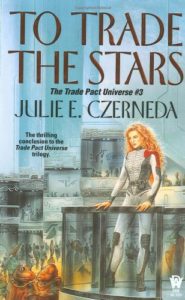
To Trade the StarsYesterday I finally had time to finish reading To Trade the Stars, the final book in Julie E. Czerneda’s “Trade Pact Universe” trilogy. Now I’m ready to pick up The Briar King again, since the final book of Greg Keyes’ fantasy quartet, Kingdoms of Thorn and Bone, comes out at the end of the month. When the second book came out, I didn’t reread the first. But when the third book came out, I found it extremely helpful to reread the first two books.

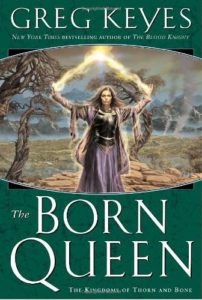
The Born QueenI was hoping to time things so that I’d be done with The Blood Knight just in time to pick up The Born Queen, but I was in the middle of the Trade Pact books and didn’t want to break up the trilogy. Then there was the trip to San Francisco, WonderCon, and New Frontier, and I’ve spent the last two weeks trying to post things while they’re still current.

On a related note, I stumbled across Ringworld’s Children in Borders the other day. I read a lot of Larry Niven in college, mostly the classics plus a few from the 1990s, but after The Burning City bored me to tears—I never finished it, which is rare for me—I stopped following his new releases. I’m going to have to return to Ringworld at some point, though.

The Beat has a couple of follow-up posts on the San Diego Comic-Con hotel issue: first, a wrap-up of the experience, then a post that puts San Diego into perspective, what makes it different from cities like New York or Los Angeles, and why just moving to Las Vegas won’t solve everything.

GTD In Space: Seven Habits of Highly Effective Spaceship Captains ranging from James T. Kirk to Malcolm Reynolds. (via ***Dave)

And, for the WTF-worthy, there’s Computer Love Day. As Mandriva puts it in their mailing:

Valentine’s Day is nearly here… February 14th, 2008. But think about it, who do you hang out with, who shares the good times and the bad ones, who drives you crazy but keeps your life together?………..Your computer, and it’s time to say it out loud: I love my computer!

»All pages site-wide with this tag