Imagine a small village near a valley, so isolated that they just call themselves “the people.” One day they find out about another village on the other side of the valley, and they start calling them “the people across the valley.” They can keep talking about “the people,” but sometimes they need to make a distinction: right now, we’re talking about the people on *this* side of the valley, not the people on both sides.

Not incidentally, the Latin prefixes for “this side of” and “the other side of” are cis- and trans-. English uses trans more frequently, as in transport, transform, transmit, transnational etc., all of which involve something crossing a divide. Sometimes it’s quite literal, like the old terms Transjordan and Cisjordan referring to the lands on the far and near sides of the Jordan river. Or more modern terms, like the cis- and trans- forms of a molecule that can have more than one structure. Or in space exploration, translunar space (beyond the moon) and cislunar (including the moon’s orbit and Lagrange points). (Who’s that contractor for the new moon missions, again?)

Come to think of it, the moon’s another good example of the same sort of thing. When we’re just talking about life here on Earth, we can say “the moon” and it’s clear which one we mean. But if we’re talking about the whole solar system, and how Earth’s moon compares to Titan or Europa, we have to specify which one we mean.

So if we’re talking about transgender people and their experience compared to non-transgender people and their experience, the clear term to use based on English grammar is cisgender, and just as transgender is often abbreviated as just “trans,” cisgender is abbreviated as “cis.”

It’s a description, just like “acoustic guitar.” They’re still guitars, but when you need to talk specifically about non-electric guitars vs. electric ones, that’s the term we use.

“Cisgender” or “cis” isn’t a slur, no matter what Twitter’s owner thinks. It’s not casting negative judgement any more than “acoustic” is casting negative judgment against the guitar, or insisting that space on one side of the moon is better than the other.
You wouldn’t think that books about astronomy and archaeology would have a lot in common, but Four Lost Cities (Annalee Newitz) and Under Alien Skies (Phil Plait) pack some odd similarities.

Both are about places we (mostly) can’t visit in person: Faraway planets in one case, the distant past in the other.

We have to piece together parts of the experience from what has come to us through time or through space: Telescopic observations, space probes, spectral analysis, and our understanding of physics — ruins, artifacts, aerial surveys and
what we know about people (both contemporary and in general).

For some sites we have very detailed and solid information: Angkor’s stone temples are still standing. Pompeii was well-preserved under volcanic ash and we still have first-hand writings about the city and its destruction. Mars and the moon have been extensively surveyed, including multiple landers and photographs from the surface. (And, in the case of the moon, a handful of people!)

Others require a lot of speculation: There’s a solid core of what we’ve figured out about Cahokia, but a lot of unknowns that we can sorta-kinda extrapolate from the histories and tales of surviving tribes in the area — but only to a point. Similarly, we know the rough structure of the TRAPPIST-1 solar system and some of its planets, but we have to speculate: if one of the planets in the habitable zone actually is habitable, what conditions would that require?

Both include major discoveries made within the last decade: Pluto and Charon were just a pair of dots until the New Horizons mission flew past it in 2015, bringing us pictures and measurements and so much data it took months just to download it from the probe back to Earth. Lidar surveys at Angkor in 2012 revealed the foundations of a vast metropolitan area around the temple complexes, upending our sense of how big the city was and identifying new sites to investigate.

It’s kind of funny how I read them so close together. Synchronicity and all that. They’re also both good (see also my review of Four Lost Cities and review of Under Alien Skies), and I’d definitely recommend them!

One of many cool facts brought up in Phil Plait’s new book, Under Alien Skies is that Martian sunsets are blue!

On Earth, nitrogen scatters light randomly, with bluer colors scattering more than redder colors, so the ambient sky is blue, but when you’re looking toward the sun at a shallow angle (like sunrise or sunset), most of the blue light is scattered into the next timezone and you see red and orange.

On Mars, tiny dust particles of iron oxides (rusty dust?) reflect yellow-orange light, making the daytime sky mostly a butterscotch color…but the particles that can stay aloft in the thin atmosphere are about the size of the wavelength of blue light, so they scatter blue light forward instead of randomly. So at the shallow angles of sunset and sunrise, the sky in the direction of the sun has more blue light than the yellows that are scattered in other directions.

Essentially the same process, but reversed because of the different content of the atmosphere!

Update: I’ve finished the book, and it’s well worth reading! Here’s a link to my review!

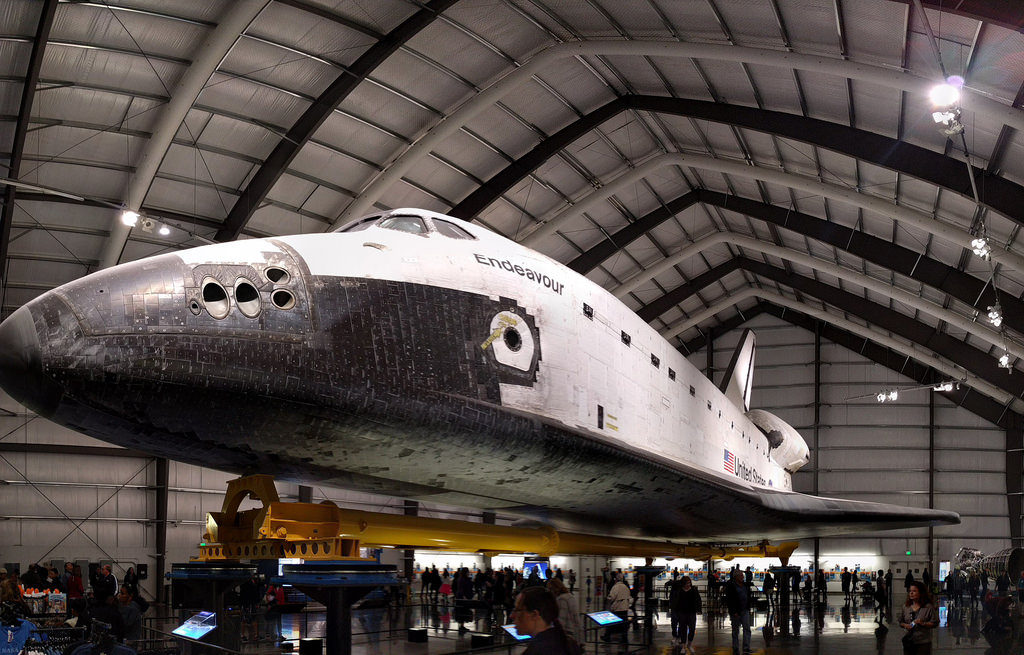
Went with the family to see Space Shuttle Endeavour and a Pixar-themed exhibit on computer animation at the California Science Center.

The 6YO loved the Pixar exhibit, which broke down all the steps to creating a computer-animated movie into separate hands-on centers where you could do things like…

  • Apply different textures and bump maps to an object.
  • Rig a character for movement.
  • Change the lighting of a scene (real or virtual).
  • Define a shape in a 3D grid and watching the computer rotate it (way too much time on this one).
  • Create your own stop-motion animation by moving an actual desk lamp.

The only way we got him out was to point out that the museum was closing, and we only had 10 minutes left to get to the touch pools he’d said he wanted to visit. As it turned out, the pools shut down about two minutes before we got there, but staff was willing to let him look at the starfish. And we did catch the last desert flash flood simulation of the day.

As for the shuttle…he wasn’t impressed. He insisted on taking the simulator ride, but the real thing? I guess it’s old news when the whole fleet’s already been shut down by the time you start hanging onto long-term memories. 🤷

Admittedly, a big aluminum hut isn’t as suitable a viewing area for Endeavour as open space in broad daylight, surrounded by an enthusiastic crowd. Though that might have been the fact that it was my first time getting up close. On the other hand, this time I could see both sides. Heck, I could walk under it!

There is a new building in the works, where they’ll be displaying it with one of the external tanks in launch position. I’m sure it will lead to plenty of cartoons and movies where someone goes to the museum, breaks into the shuttle and blasts off.

I couldn’t make the building line up with my memories of visits when I was younger, back when it was the Museum of Science and Industry. The only thing I could match up at all were the wall facing the Exposition Park rose garden, and some of the buildings by the parking lot (a sunken structure now, but I remember it being flat).

Then again, what I remember are specific exhibits more than the layout: a big math/physics exhibit, a chicken incubator, and a multi-screen cartoon about energy sources and engine types called “The Water Engine.” (Each screen has a character talking up internal combustion, flywheels, mag-lev, electric, etc. I still quote the Peter Lorre-inspired fuel-cell scientist saying “And then…we burn the hydrogen!”)

It turns out there’s a good reason nothing fit my memory: They tore down the whole building in the late 1990s, preserving only that one wall!

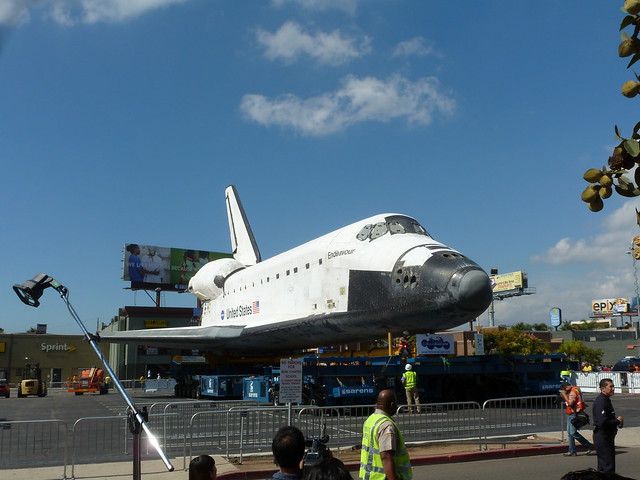
Space Shuttle Endeavour in a parking lot, seen from the front.

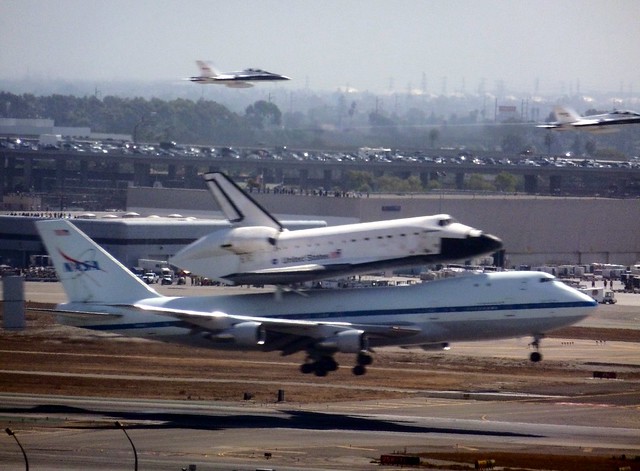
Last month I had the good fortune to watch Endeavour’s landing at LAX from the office building where I work. Today I had the opportunity to see the space shuttle up close while it stopped at a parking lot in Westchester.

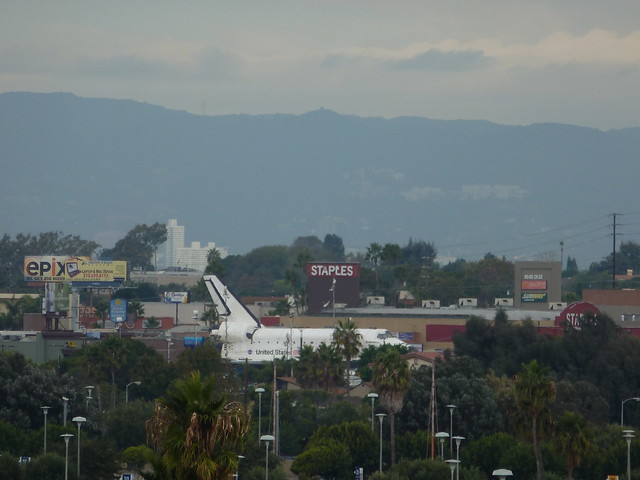
When I got to work this morning, the shuttle had already left the airport hangar where it had spent the last month, and was sitting in a parking lot a mile or so away. I didn’t have time to go look at it, but I did have time to climb up to the top of the parking structure and look for it.

Space Shuttle in a STAPLES parking lot, seen from a ways off.

The first thing I spotted was the distinctive tail, and I walked along the top floor until I could see as much of the shuttle as possible. It looked out of place surrounded by trees and a Staples sign, though I couldn’t help thinking, “Space shuttle? Yeah, we’ve got that.” I took a few zoomed pictures with my camera, then one really grainy with my phone for the “now” impact, then headed into the office. Continue reading

Update: If you’re looking for photos from Endeavour’s trip through the LA streets in October, I’ve got those too.

And that’s it. The final flight of the space shuttle has come to an end.

The last shuttle landing I saw was Discovery in 1988. My family went out to Edwards Air Force Base to watch it land. I posted a photo essay on the event last summer when the shuttle flights stopped.

The 1988 landing was a normal Shuttle landing. It landed under its own power, from orbit, and it was all business. We civilians camped out all night on a dry lake bed, kept outside a fence so far away from the landing strip we could barely see the shuttle without binoculars.

This time it was being carried by an airplane, from another airport. Safety wasn’t any more of an issue than a normal flight, so they landed at a regular airport. (Though it was escorted by military aircraft.) And since it was the last-ever shuttle flight, there was a bit of showmanship to the flight plan: Continue reading

We attended Planetfest in Pasadena yesterday. It’s still going on now, a two-day event by the Planetary Society timed to match tonight’s landing of NASA’s Curiosity space probe on Mars.

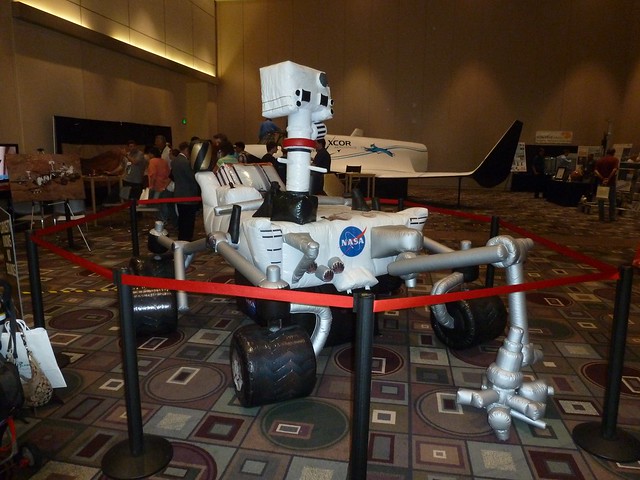
Inflatable mockup of the Curiosity Mars rover.

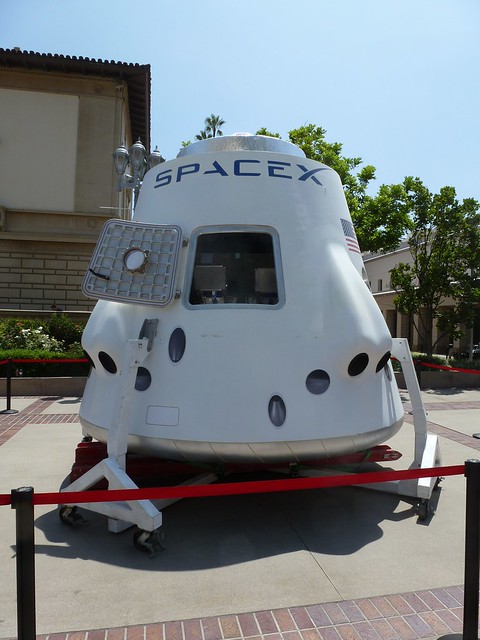
I wasn’t really sure what to expect, but it was basically a bunch of space enthusiasts and people in the industry. SpaceX has a mock-up of their crew capsule, and other sponsors had exhibits with things like space plane mock-ups or geological drills. There was a life-size inflatable model of the Curiosity rover. There was a single track of programming with speakers on topics from the actual science of Martian exploration to the question of just why we explore space in the first place. Katie caught the Sally Ride tribute while I walked J around the exhibits, and we both watched Bill Nye’s talk about “Our Place in Space,” which he finished up with a fun science demonstration featuring liquid nitrogen marshmallows, gas toruses, a candle, and Robert Picardo.

SpaceX crew capsule mock-up.

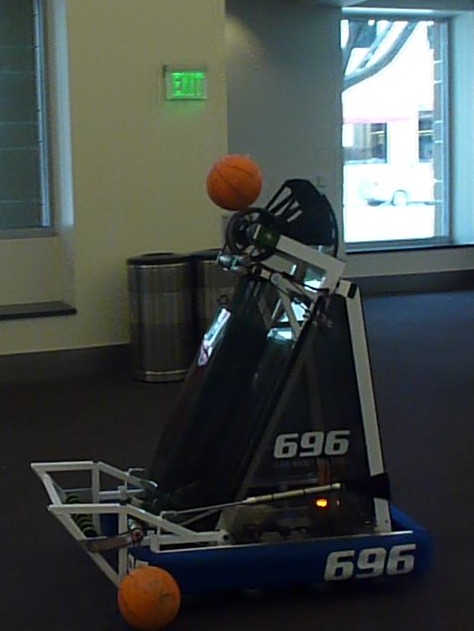
The exhibits for “kids of all ages” turned out to be for kids from 4 on up. J wasn’t really interested in the Martian soil uplift demo, or the dirty snowball CO2 comet demo, but he liked watching the Xbox Mars Lander game, and he was fascinated by the robot that picked up and tossed basketballs. He had fun hanging out with grandma and grandpa, at least, and playing with a magnetic meteorite. (The tiny fragment of verified Martian meteorite was carefully mounted on a slab with plastic wrap to protect it from skin oils, but they had a couple of non-valuable rocks that you could pick up and hold.)

A robot that plays basketball.

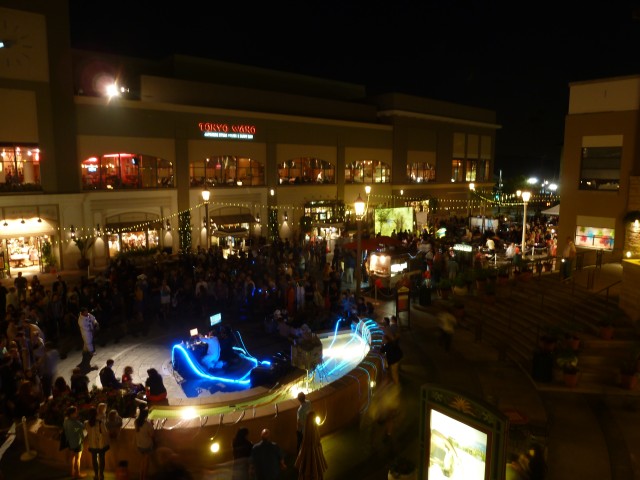
A family friend invited us to the after party at the mall across the street. It was divided into two main areas: the sci-fi-themed dance floor out on the plaza, and a set of tables on the terrace above for the sit-and-talk crowd, where the main event was a participatory art project: A group had set up one blank postcard for each day of Curiosity’s journey from Earth to Mars, and was asking attendees to draw what they imagined the probe would write home about.

Planetfest party at Paseo Colorado in Pasadena

»All pages site-wide with this tag