
Having been a teenage geek in the 1990s, the phrase “AD&D coverage” always makes me think of Advanced Dungeons & Dragons, not Accidental Death & Dismemberment. Though depending on your DM and how the dice are rolling that day, there might be some overlap.
Author Archives: Kelson

Supermoon Rising Through Clouds
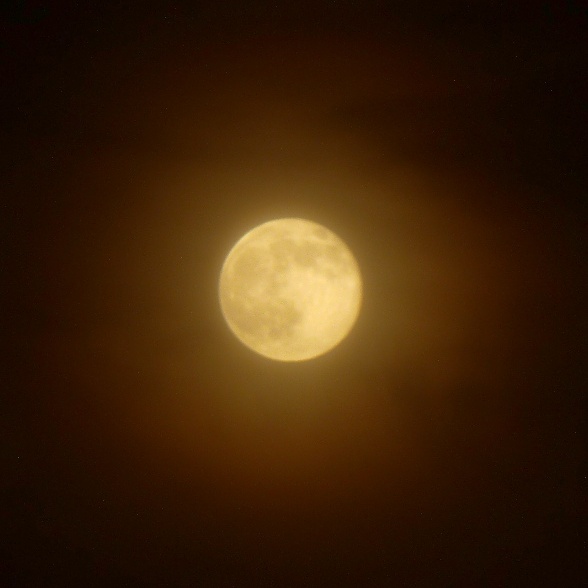
Last night’s “supermoon” rising through light clouds. Spotted, oddly enough, while walking past a Supercuts.
It wasn’t quite as cool as a week ago, when I was driving home late at night and watched the first-quarter moon setting like a giant orange slice near the horizon. But I didn’t have my camera, and wasn’t sure about stopping somewhere unfamiliar at midnight to take photos.
As it happened, last night I did have my camera in the car. I took a few shots bracketing the clouds and the moon face. I combined them with Luminance HDR, mostly to see if I could. It’s not fantastic, but it’s better than my phone would have managed (though it actually takes better photos in broad daylight than my camera does).
Times like this make me wish I had a DSLR camera, but I have to be honest: Chances are I wouldn’t have had it with me.
Speaking of HDR, my brain decided that it needed to be pronounced as a word instead of initials. Three guesses as to what vowels it decided to add!
Whatever That Means
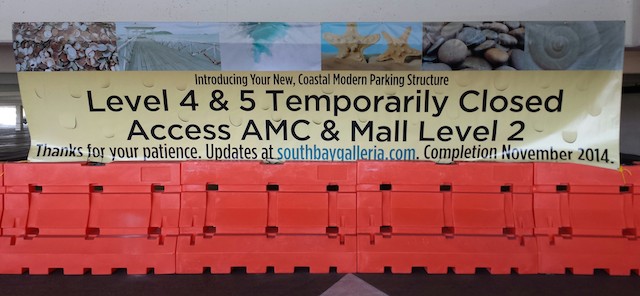
So what exactly is a “coastal modern” parking structure and why is it so great? Even this press release doesn’t shed much light on it, only saying that the renovations include “upgraded” entryways and elevators and spaces-available signs. I suppose that’s modern, but I’m really not sure where “coastal” comes in.
Autogenerate THIS!
Spam is annoying at the best of times, but over the years I’ve learned to tune it out (and in some cases find amusement in it). But a spam comment that I’ve been seeing across several blogs lately is just plain insulting.
I see a lot of interesting content on your page. You have to spend a lot of time writing, i know how to save you a lot of time, there is a tool that creates unique, SEO friendly posts in couple of minutes… [Search terms omitted because I don’t want to give them the publicity.]
Right: So I’ve got interesting content, I clearly spend a lot of time writing, but you’re telling me I should use some tool to auto-generate everything instead. Autogenerate this, jerkwad!
Though I do have to admit I’m amused at the idea of autogenerated spam clogging up the comment sections of autogenerated articles…
Wi-Fi Sprouter (The Seeds Are All Right)
You’ve probably seen the story about how a group of teenagers showed that plants won’t grow next to a WiFi router. We did our own experiment, but first some things to consider about the story making the rounds:
- They tested whether cress seeds would germinate near a wi-fi router.
- The seeds by the router DID grow, just not as well as the control group.
- The photos accompanying the news articles I saw don’t match the photos that appear in the report. They actually look like a before and after set.
- It was done a year ago, in spring 2013.
- It was a school science project. That’s not a knock, they did some good things like sending traffic through the router to make sure it was actually transmitting, and mixing seeds from multiple packets together to eliminate differences between batches.
- As with all science, the results need to be repeated in more experiments with rigorous controls to be sure they accounted for all variables.
- I couldn’t find a followup study in all the blind repostings of the original OMGWIFI claims, though I did find a discussion at JREF. If you can read past the annoyingly dismissive comments, you’ll also find some insightful remarks and links to the actual presentation (in Danish, so it’s tricky to read, but they have charts and photos)…and a few anecdotal stories by people who use the heat from their wireless routers to HELP germinate seeds!
After we read up on this, Katie decided to do a simple experiment herself. She put seeds next to our router, on top of our refrigerator, next to the TV, and for a control, outside. She found that the seeds placed next to our router did just fine — considerably better than those left outside, and slightly better than those placed elsewhere around the house.
Each bag contained one kidney bean, one black-eyed pea, and one seed from the red bell pepper I cut up for dinner. I put a section of select-a-size paper towel, folded twice, in each and set the seeds inside the second fold. Each bag got 15 mL of Brita filtered water and the air was squeezed out before sealing. Then I left them around the apartment for several days to see if they’d sprout. This is a picture of what resulted.






I wonder if the seeds in the school experiment just dried out. Katie sealed her seeds in plastic bags, which allowed radiation to pass through, but trapped moisture. As I understand it, the students watered their seeds throughout the experiment, but it’s possible the trays dried out overnight. Comparing moisture content/retention would be an interesting follow-up.
Obviously, this isn’t any more rigorous than the original experiment. But it shows that the results they found are the beginning of the process, not the last word. More importantly, it’s something you can easily test yourself if you’re so inclined. Next time you see a startling claim that’s something you can test without too much trouble, try checking it out for yourself.
Incidentally: We planted the seeds in our patio yesterday. With any luck, they’ll do as well as our tomatoes (and better than our poor carrots) this year!
Parking Lot Design: Guiding People to Make Bad Choices
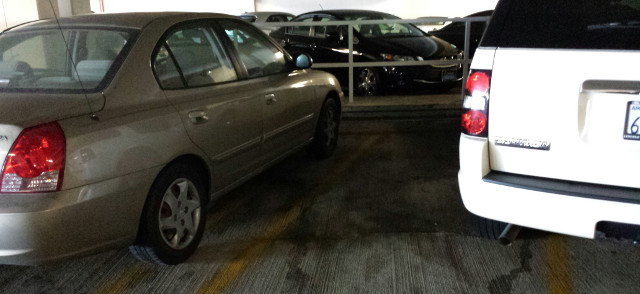
The office building where I work shares a parking garage with two other office buildings, two hotels, and an airport parking service. It can get crowded, and the spaces are so narrow and tightly packed that it’s a safe bet any given row will have two or three “open” spaces that won’t actually fit anything but a Smart car or a motorcycle, because the cars on either side are just a little bit too close to each other.
Or sometimes they’re parked at an angle into the next space, or flat-out taking up two spaces. That’s when I wish I could call them out by, I don’t know, slapping a sticker on the car that says “I’m an asshole who doesn’t know how to park.” Or starting youcantpark.tumblr.com — oh wait, someone’s done that.
It’s infuriating, especially on days like this past Friday, when I drove up and down the entire structure for half an hour looking for a spot. It took so long that my Prius shut off the electric motor due to low battery…and then turned it back on later, because all the driving on the gas motor had charged it up again.
I finally stopped at the end of a row, when two men got into a van in the last space and turned on the engine. Next to it was one of those technically-open-but-not-really spots. Behind me was another car whose driver had been following me down from the top floor, checking and discarding the same too-narrow spaces along the way. We sat there, waiting, while they sat with the engine on and the doors closed. Eventually I put my car in park, went back to talk to the guy waiting behind me, went up to talk to the guys who insisted they just needed a few more minutes before they could leave (really? they couldn’t back out, let two cars park, and find a place by the side of the aisle to let other cars by?), and just as I was about to pull over to the side so he could go around, they started backing out. I pulled into the second spot, leaving the last one clear for the car behind me.
FINALLY!
But why had it been necessary? I had passed probably 30 spaces that I could have parked in, if only the people who’d parked on either side had put in a little more effort. Obviously, people are jerks, right? They chose to park badly…but they didn’t make that choices in a vacuum.
- Narrow spaces make it tricky to begin with.
- Small errors compound as a row fills in.
- On a bad day, it gets really frustrating to find a space you can use, and when you finally do, chances are you just want to get it over with and get the hell out. On the off chance that you found two spaces next to each other, you’re not necessarily going to be thinking about whether you’ve left room for someone next to you.
Sure, people have made a lot of individual choices to park in ways that make spaces unusable…but this isn’t a problem in most parking lots. The design of the garage encourages people to park badly. I suspect that re-striping this lot to have fewer spaces per row would actually allow more cars to park here. Maybe splitting up the width of one space along the entire aisle would be enough to lessen the impact of small errors — and frustration — that often leaves them with two or three useless spaces each. That’s a net gain of one or two cars per aisle, which doesn’t sound like much, but at 2 sides × 8 lanes × 7 floors, that’s an extra hundred or so cars that could fit, with less frustration on the part of the drivers. That sounds like a win to me.
Obscure joke, ask your parents
On the way to work this morning, I noticed the car in front of me had a license plate frame that read:
LIL LADY
KT GOES KABOOM
Sometimes I wish there was a universal signal for “I recognize the joke/reference on the back of your car and it’s awesome.”