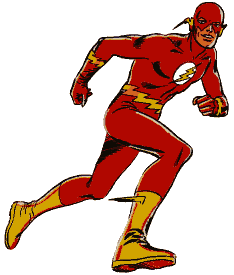
I was thinking about the timeline of DC Comics’ Earth-51 (home to the Great Disaster in Countdown to Final Crisis) and trying to wrap my head around what the past and present might mean for a world that’s been created and destroyed twice in as many years, and realized that some of the time paradoxes make much more sense if you consider that there’s more than one kind of time.

Real-world time is, as you’d expect, the time that passes between when two stories are published. For example, it’s been 45 years since Spider-Man first appeared in Amazing Fantasy #15 (Aug. 1962).

In-story time is the time that passes within a story. So even though it’s been 70 years since Superman first appeared on the newsstand, it’s only been 10–15 years since his debut within the DC Universe.

The tension between these two leads to a strange, fluid take on time, which has its own issues.

But then you get into time travel and cosmic retcons, and in-story time can’t quite explain things. Continue reading

From a food allergy alert released today:

Cracker Barrel Old Country Store, Inc., is recalling “Chocolate Covered Almonds” due to undeclared peanuts and “Chocolate Double-Dipped Peanuts” due to undeclared almonds. [emphasis added]

I have to wonder: are they just really bad about keeping their ingredients separate, or did they get the labels switched on a couple of batches?

The Born QueenWe’ve both finished reading The Born Queen, the conclusion to Greg Keyes’ The Kingdoms of Thorn and Bone. Yesterday we spent the day reading in tandem on the couch: I read book 3, Katie read book 4, and finished within an hour of each other. Determined to catch up, I read 100 pages last night and spent this morning and afternoon reading the final book.

It was well worth the wait.

The series is set two millennia after humans, led by Virginia Dare (explaining where the lost Roanoke colonists went), overthrew the demonic race that had kept them as slaves for generations. Virginia had discovered how to harness the sedos power, essentially magic. The last of humanity’s oppressors warned them that the sedos would eventually destroy their world. Of course, no one believed him.

2200 years later, this corner of the world is not unlike Europe in the early Renaissance. Except that the church is based on the sedos, in the person of saints, and its priests walk the paths to harness the sedos powers.

The world is also beginning to rot. Things of nature are dying, human alliances are crumbling, and terrible creatures thought to be myth are walking the earth. There are several factions who claim that they want to save it, but their true goals are suspect, and their methods differ greatly. The various viewpoint characters are thrust into the middle of things without any real sense of what’s going on: a holter, a princess, a novice priest, a knight, a swordsman, a composer and a queen.

One of the things I find so fascinating about this series (as I mentioned when I first read The Blood Knight) is the fact that everyone is acting on partial information. This makes them screw up, sometimes mildly, sometimes horrifically. And there’s a curveball that comes about 1/3 of the way into The Born Queen that turns everything on its head.

I don’t think it’ll give too much away to say that one of the key struggles in this book is for control of the sedos. Even 100 pages from the end, I wasn’t sure which faction would give the world a better chance of surviving.

Music also figures importantly, starting with the second book, where it’s learned that certain combinations of sound can have a profound effect on the human psyche. I found myself wondering whether Keyes had someone set any of the songs to music.

By the end of The Born Queen, most of the major questions about what’s really going on have been answered. Of course, they’re answered in pieces, by different characters with different agendas. The major characters’ arcs reach (mostly) satisfying conclusions, with some finding what they want, some finding what they need, some doing what needs to be done, and some getting what they deserve.

It’s weird to finally be done with the series, which started around the same time as this blog. The first post that I made that wasn’t “Hey, look! I have a blog!” was a review of The Waterborn and The Blackgod, Greg Keyes’ first novel and its sequel. In it, I mentioned looking forward to The Briar King when it came out.

This is cool: a fascinating tour of the world’s cities as seen in visible light from the International Space Station.

Cities at Night, an Orbital Tour Around the World

It’s interesting to see how just lighting illustrates different patterns in city development. European cities have this star topology, US cities tend to stick to the north/south grid. Different countries tend to use different colors of lighting, with the western cities more yellowish and cities in the middle east and Asia more greenish. There’s a view along the Nile, where the river runs through the middle of a channel of lights, beyond which everything is empty.

There’s also a mosaic of the Los Angeles/Orange County/San Diego area, which really points out that there’s quite a bit of emptiness still in the OC area: The Santa Ana Mountains to the northeast, and the San Joaquin Hills to the sourthwest, make large dark areas. The northwest plain melds seamlessly into the Los Angeles area, while a narrow (but very bright) channel winds its way through the middle before opening up into south county.

The downside, as pointed out in the comments, is that this is all wasted energy. With lamps that direct all of their light downward instead of out into space, we could light our cities with less energy and keep the skies dark for stargazing.

The Blood KnightAfter working my way through The Briar King in bits here and there, I made time for The Charnel Prince.  I finished the second book Tuesday evening, and I’m currently 100 pages into The Blood Knight.

Meanwhile, I’ve been talking about the books (Greg Keyes’ The Kingdoms of Thorn and Bone) a lot, trying not to drop spoilers in case Katie might read them at some point in the future.  The night I finished book two, I had come home to find her on the couch, reading the first book.  Since she not only reads faster than I do, but has more time on her hands these days, she’s caught up.

It’s nice to really be able to talk about the books, especially since I remember so little of the one we’re both currently reading.

The funny thing is, at this rate, she’ll probably finish the series before I do!