
 In honor of the release of Safari 3, here’s a little something we found at Trader Joe’s.
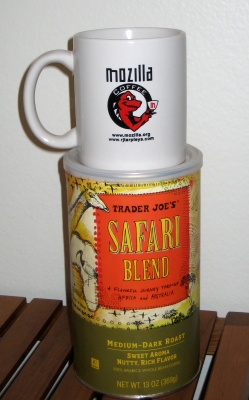
The mug is from the short-lived Mozilla Coffee. It seemed appropriate. Now if I can just track down some Opera Coffee, or Explorer Coffee…

In honor of the release of Safari 3, here’s a little something we found at Trader Joe’s.
The mug is from the short-lived Mozilla Coffee. It seemed appropriate. Now if I can just track down some Opera Coffee, or Explorer Coffee…
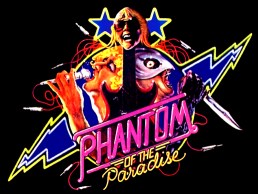 Watched Phantom of the Paradise this weekend. It’s a bizarre 1974 mash-up between The Phantom of the Opera and Faust set in a satire of the 1970s music industry.
The movie casts Paul Williams (who wrote all the music for the film) as a reclusive recording mogul, Swan, who steals a struggling songwriter’s pop cantata based on Faust to open his new music palace, the Paradise. The songwriter tries to correct the “misunderstanding,” ends up beaten, jailed, and ultimately scarred when he gets caught in a record press trying to destroy it. He sneaks into the newly-opened club, dons a mask, and alternately pursues revenge on the man who stole his music, and his obsession with launching the career of a young singer he befriended earlier in the film (bringing in the Phantom/Christine dynamic).
Believe me, it’s stranger than it sounds.
Anyway, afterward, I went looking on IMDB (as I often do) to see what else the various actors had been in. Somehow I ended up on a horror movie review site, 1000 Misspent Hours, which gave the movie 3½ stars and basically considered the music to be the main failing (though, since it’s a satire, that’s largely intentional. There’s a reason I only have about 3 of the film’s songs on my iPod).
 Something interesting I learned was that the Phantom’s origin is actually derived from the 1943 Phantom of the Opera movie with Claude Raines, which, judging by its review, has about as much to do with the original novel as, well, Phantom of the Paradise does. I’m mainly familiar with the original silent version and the Andrew Lloyd Webber musical, both of which track the Gaston Leroux novel fairly well. (Edit: Now that I think about it, the 1943 origin also explains the “Acid: Do not throw in face!” gag from Gremlins 2.)
 I do have to take issue with some of his criticisms of Rocky Horror. Not that they aren’t valid, but that several things he finds inexplicable—the thin plot, nonsensical showstoppers, and how the cult following could possibly have started—are easily explained by the fact that it’s based on a stage play, The Rocky Horror Show (also explaining why the movie is The Rocky Horror Picture Show), which sets up a completely different dynamic and expectations. Interesting that the main venue for the film seems to be the midnight showings, which seek to recapture the experience of live theater.
I found the site’s rating system interesting: not only does he have a 1–5 star scale, but he also assigns negative stars for movies that are “so bad, they’re good.” So of course I had to see which films he gave -5 stars, meaning “So bad, it’s genius.” I ended up reading around 10 or so reviews on Sunday night, some of them for movies I will probably never, ever see.
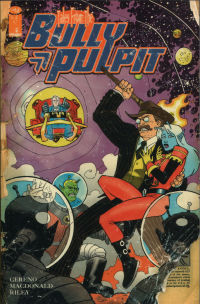 At long last, I’ve located a copy of Tales from the Bully Pulpit!
It’s a sci-fi comedy graphic novel featuring a time-traveling Teddy Roosevelt and the ghost of Thomas Edison, battling a descendant of Adolf Hitler. On Mars. Wearing mecha armor. (No, really, I am not making this up!)
Seriously, how can you co wrong with that?

 Fedora 8 has just been released, code-named “Werewolf.” As is tradition for this particular Linux distribution, the official release announcement is accompanied by an alternative, humorous announcement playing off the code name.
This time, the joke announcement is a song parody of Michael Jackson’s “Thriller.” And unlike a lot of really bad filk I’ve seen (online and otherwise), it’s surprisingly not bad (for all the subject matter is a bit odd. At least, from what I remember of the original song, it scans.
This just showed up in my email from Babylon 5 Scripts:

From JMS’s Cafe Press store (the same site through which he’s selling his script books with commentary):
With the coming 2008 elections, there aren’t a lot of candidates we can agree upon. So as a public service, we are now providing a slate of candidates that will bring the country together in common cause and preserve many of this nations’ finest electoral traditions.
Slates available include Londo/G’Kar, G’Kar/Londo, and Zathras/Zathras (trained in crisis management!)
I remember having an unofficial Sheridan/Ivanova ’96 (or possibly Sheridan/Delenn) bumper sticker, but I’m fairly certain it was a homemade “Elect The Brain” (as in Pinky and the…) sticker that I actually put on my car that year.
Now if only they’d used the correct punctuation on the ’08 instead of trusting smart quotes. (That should be an apostrophe, not a left single quote.)
Five years ago, Mozilla was forced to rename the Phoenix web browser because Phoenix Technologies was working on an in-BIOS browser that would let you get on the internet and troubleshoot/download drivers/etc. even if your operating system was trashed. It became Firebird, and then Firefox. The Phoenix product has finally been released. Ironically, it’s evolved into an embedded Linux distro that runs…Firefox.