 Continuing the tale of our late-February vacation (starting with Cambria and Hearst Castle and moving on to Monterey and Carmel, we catch up to San Francisco itself and two days at WonderCon.
Note: If you want to skip straight to the photos, head over to my Wondercon 2009 Photo Set on Flickr.
We’d been to WonderCon once in 2008 and had a great time, and while we weren’t planning to make it an annual trip, the timing worked out such that we’d be in San Francisco the right weekend anyway.
Staying in San Francisco: The Mosser
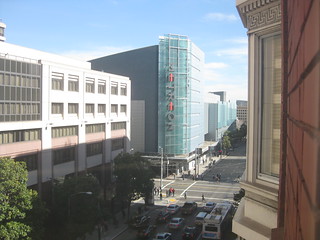 Last year we stayed at the Mark Twain, which was okay, but this year on my brother’s recommendation we stayed at the Mosser Hotel. It was quite nice, although the rooms were still extremely small by modern standards — small enough that instead of an actual desk, there’s a fold-out desk on the armchair. There’s also a flatscreen TV with both pay-per-view and video game rentals, and an AT&T wireless hotspot accessible from the room. The staff was nice, and the location was perfect. We were in a decent area of town, near restaurants, 5 minutes from the Moscone Convention Center one way, 5 minutes from a BART, MUNI & cable car station the other way, and right across the street from the official convention hotel.
Day 4: Friday (Feb 27) at WonderCon
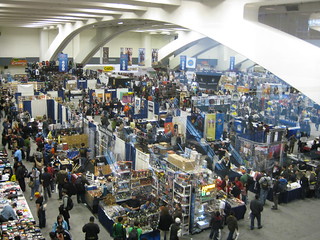 After Thursday’s long drive, we slept in Friday morning and made our way to the convention center around 11:00. The “line” to get to the registration area moved quickly enough that it might as well not have been a line, and there were only a few people in front of us at the badge pick-up windows, so we made it through the whole process in only a few minutes. Then we stood in line for 45 minutes waiting for the hall to open at noon. Oh, well!
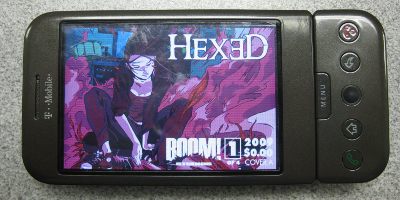
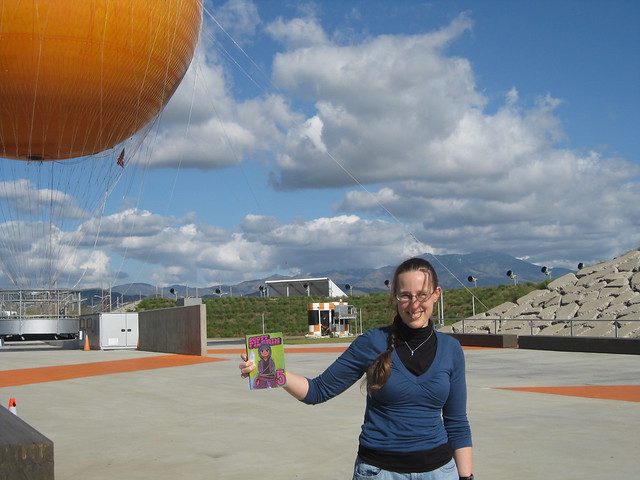
We started by making a beeline to the BOOM! Studios booth to pick up several copies of the Farscape #1 WonderCon exclusive variant — one for us, and several more for people at the Terra Firma message board. Series writer Keith R.A. DeCandido was there signing them, and we chatted a bit with him and with another Farscape fan. After that I got in line for the DC booth, and Katie went off to explore. I picked up a bunch of random swag from DC, some of which I want to keep and some of which I’ll probably offer to people on Speed Force.
 Next I headed over to Artist’s Alley to track down some of the artists connected with Comic Book Tattoo for signatures. I’d gotten a few of them (including Tori Amos herself!) at last year’s San Diego Comic-Con, but took the massively heavy
 lead weight book back to my hotel room at the first opportunity, not thinking that I could catch up with more of the creators. So now I’m trying to fix that.
I found David Mack first, and he had a whole spread of Kabuki material. As we talked, I admitted that I’d never read any of it, and he not only offered me a few issues of the latest series for free, he signed them!
I wandered the floor a lot, picked up some cheap trades, scarfed down a small pizza and eventually went up to a panel on “The Real Archeology Behind Indiana Jones.” It was run by an archeology professor from some college out near Lake Tahoe, and he had this talk about the major artifacts in the four films — what is known about the Ark of the Covenant, where people are looking for it, (or in some cases, claim they’ve found it but won’t let anyone see) — the actual stories behind the Sankara stones and the Thugee cult — legends around the history of the Holy Grail, and where people think it might be — the history and legends of the various crystal skulls, none of which can be verifiably traced to an actual excavation.
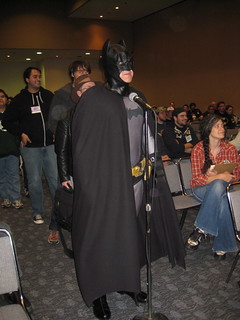 Then I hit DC Nation, Katie hit panels on 2D visual effects and the shift from a cowboy metaphor to a super-hero metaphor in US Politics (all those Obama-as-Superman images), we met up at the BOOM! panel, and finally went to the Wonder Woman screening.
Friday was, overall, really laid-back. The crowds were light, people in line were patient, and there weren’t even too many people in costumes. Even DC Nation was relaxed, though that’s probably in large part because Dan Didio was at Megacon and Ian Sattler was running the panel.
Wonder Woman
We had no trouble getting into the Wonder Woman screening, and managed to get seats maybe 10 rows back. I noticed a woman I recognized in a WW outfit (someone I’d seen as WW at other cons). Oddly, they kept calling it the movie’s premiere, even though it had premiered at New York Comic-Con a few weeks earlier, so at best this was the west coast premiere. Still, the movie was very good and amazingly epic for a 90-minute animated film. (Reviews are all over the place now that the DVD is out, so I’ll skip the details.)
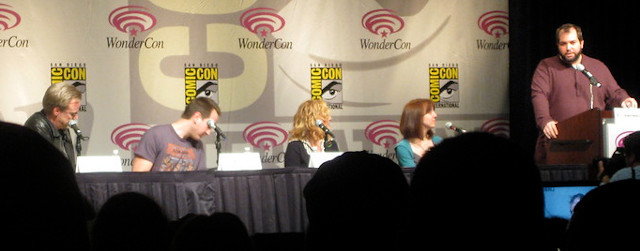
After the screening there was a discussion panel with producer Bruce Timm, screenwriter Michael Jelenic, actress Virginia Madsen (Hippolyta), director Lauren Montgomery, and executive producer Gregory Noveck. They talked about making the film for quite a while, then took audience questions until their time was almost up.
Then they ran the trailer for the next DC animated project: Green Lantern: First Flight. I’m not a huge Green Lantern fan, but this looks suitably cosmic in scope and sci-fi in tone, and frankly, that’s the way I prefer the character, so it looks promising!
Evening
 After the discussion, we cleared out. Neither of us wanted to watch a bunch of Star Wars fan films at this point (I would have 10 years ago, but these days? Not a priority.), and we were hungry. So we headed back to the hotel to change and went out to look for someplace to eat dinner. We ended up at a very good steak restaurant in the Marriott, then went back to the hotel where stayed up way too late uploading photos and dashed off a first impressions post of the con.
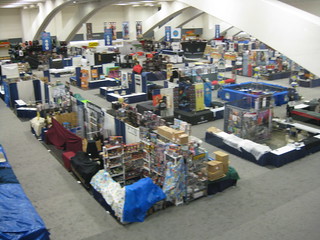
Update: On the way out, though, we stopped at the mezzanine walkway, which has a long glass-enclosed view into the main floor. It was eerie to see all the booths set up, fully lit, but with covers thrown over tables, and the aisles empty except for (as far as I could see) one person.
Continued in Saturday at WonderCon.
 DC Comics recently
  I own a jacket labeled Claiborne, which is of course made by the Liz Claiborne company.