This past week has mostly been taken up by unpacking, at least to the point that we can use things. We got most of the bedroom set up the first night — we needed somewhere to sleep — but the rest has been slow going. We finally got the TV and DVD player hooked up today, and tested it by re-watching Raiders of the Lost Ark.*

One thing I’ve noticed is all the extra expenses that pile up after the move.

You have to replace things lost during the move. I misplaced the screws that held together the bed frame when I dismantled it, so after we moved the last boxes in and got cleaned up, I drove out to Lowe’s looking for replacement hardware. Similarly, we forgot to remove the under-the-cupboard paper towel holder, and had to get a new one.

There are also things you can’t take with you. Stick-on wall hooks in the closet, for instance.

Or things that are included in one place, but not in another. Our old apartment had a built-in lock on its garage storage. At this place, we had to get a padlock. (Well, actually, we didn’t. A day after buying it, I found one in my toolbox that I’d forgotten.) We also had to get a shower curtain rod. Fortunately we have plenty of lamps, but that’s one I’ve run into when moving before.

All this on top of the stuff you expect to pay: rent, deposits, boxes, movers or a rental truck, pizza for friends who are helping, etc.

*Regarding Indy, I had originally planned to re-watch the entire Indiana Jones trilogy before going out this weekend to see Kingdom of the Crystal Skull. But it took a while to empty enough boxes to get the TV set up. We did manage to watch Last Crusade on one of the computers, which was a bit awkward. We went out with friends on Saturday to catch the new film. It was a lot of fun, but not phenomenal. Better than Temple of Doom (which is still better than a lot of films) but not as good as Raiders or Last Crusade.
Central City is big. You just won’t believe how vastly, hugely, mind-bogglingly big it is. I mean, you may think it’s a long way down the road to the chemist’s, but that’s just peanuts to Central City. (With apologies to Douglas Adams.)

It’s an old post, but I just found the Absorbascon’s take on Central City, looking at the wide expanses depicted in Carmine Infantino’s Silver-Age drawings of the Flash’s hometown.

What is this vast complex? The National Science Center? NIH? STARLabs HQ? No. It’s Barry Allen’s back room. In his APARTMENT. In your house, this sort of room is barely big enough to hold the Cybex machine you don’t use. In a Central City apartment, it’s about the size of a bowling alley.

On a related, but more serious note, letterer Todd Klein has posted a 4-part study of the Flash Logo from 1940 through the present day: Part 1 · Part 2 · Part 3 · Part 4. With his insider knowledge, it’s far more thorough than the study I did a few years ago. (via Wallyoeste)

Mark Pilgrim, in The Day the Music Died, points out what happens when DRM meets market failure.

On August 31, Microsoft will turn off the servers that validate their “PlaysForSure” DRM system (this predates the system they use for the Zune). This means that anyone who has bought music that uses PlaysForSure will not be able to transfer it when they upgrade or replace their computer, or get a new music player.

It won’t be an instantaneous death like DIVX was, or like a subscription system, because it doesn’t phone home whenever you try to play a track. But it’ll be a lot faster than simple technological obsolescence. I can still play my old VHS tapes until my VCR breaks down (and then I could probably still get it fixed if I really wanted to), even though I don’t think I’ve seen a pre-recorded tape in a store in years.

This is also why I prefer to check Amazon’s MP3 store first, before going onto the iTunes Music Store, and then prefer DRM-free iTunes Plus to standard iTunes tracks. Given their current position, Apple isn’t likely to get rid of iTunes anytime soon, but if they ever did, I’d be in the same boat as people who purchased PlaysForSure tracks. (Though I’m hoping they’ll move the entire catalog away from DRM long before that happens.) Whereas since Amazon’s tracks are plain, ordinary MP3s, they could abandon the business tomorrow and I’d still be able to play the tracks for as long as I can find software that plays MP3s.

(via ma.tt)

Reusable Cover Art in Historical Novels: A Gallery. A lot of them are clearly using classical paintings, but some of them are photographs or even modern-style art. What’s especially interesting are the covers which used the same source material, but altered it subtly: adding a headband or a pendant, replacing a bedframe, etc.

The Rap Sheet has even more examples.

(via Colleen Doran)

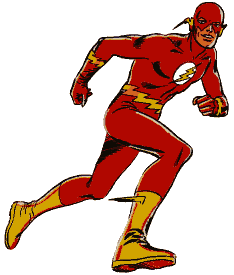
Drawing of the Flash, a man running wearing a red suit with yellow lightning-themed trim.Yesterday’s article about the Flash (warning: major spoilers for this week’s DC Universe: Zero) in the New York Daily News brings up the hero’s key role in launching the Silver Age of Comics. Superheroes had fallen out of favor in the early 1950s, and comics were exploring genres like westerns, horror, romance, etc. When DC successfully relaunched the Flash in 1956, there was an explosion of new super-hero titles.

The Daily News quotes former Flash scribe Geoff Johns as saying, “Without Barry Allen, we’d still be reading comic books about cowboys.”

I don’t think that’s precisely true. Not to discount Barry’s contribution—it’s entirely possible, even likely, that super-heroes would have remained a background genre. But for one thing, we’re looking at half a century of ephemeral pop culture. For another thing, let’s consider: why were comics going after the western, crime and horror genres when super-heroes failed? Because that’s what was popular in movies and television at the time.

I’d guess that, without the Flash revitalizing super-heroes, we would have seen more science-fiction comics in the 1960s, more police comics in the 1970s, sitcom comics in the 1980s, and so on. Comics genres would probably have followed along with trends in pop culture instead of becoming heavily focused on a single genre.

We wouldn’t be reading cowboy comics today; we’d be reading reality comics.

Perhaps the presence of multiple genres would have eventually gotten rid of the “but, you know, comics are just for kids” mentality. (Not that it’s worked for cartoons or video games yet, but video games are still relatively new, and cartoons have similarly been dominated by the musical fairy tale and slapstick comedy short.)

Eh, who knows? Maybe they’d be all about pirates.

Edit: The comment thread at The Beat also has some interesting speculation on comics without the Silver Age Flash.

»All pages site-wide with this tag