When I was around 15, I had a close encounter with a rattlesnake. In my tent. No one was bitten, but getting that snake out was an interesting experience. It happened during a week-long summer camp at Lost Valley Scout Reservation in the mountains northeast of San Diego. It was at least my fourth summer camp with my Boy Scout troop, placing it around 1991 or 1992, and at least my second at Lost Valley.
Lost Valley
There are two kinds of campsites at Lost Valley (or at least there were in the early 1990s): One type had simple wooden cabins, which held two bunk beds apiece*. This was the other type, with canvas tents. The canvas made up the roof and walls, and was tied to a metal frame with a plywood floor. (Note: this arrangement is not sealed.) Two cots lay on the floor. Scouts would typically lay out their sleeping bags on top of the cots, and stow their gear underneath.
The site was in a wooded area of the camp — mostly evergreen trees — below a hill, in the Camp Irvine section. Looking in from the road, there was a large rock formation to the right, which I remember a lot of us scouts would climb onto. (It’s the 13th point of the Scout Law: A Scout Climbs Rocks) To the left, the land stayed flat at least as far as the next section of road. Straight back was a fairly steep hill which led up to more campsites and eventually the dining hall, if you were willing to go off-trail and cut through another site. Judging by the map, it looks like it was probably Indian Wells campsite. Edit: My dad points out that the stones had been grinding sites for the local Native American tribes, which may have been the source of the name.
Finding the Snake
My tent was toward the back. One night** as I was getting ready for bed, I set my canteen down before closing it and accidentally knocked it over. I quickly set it upright, then got down with a flashlight to look at the puddle of water spreading back under my cot, and see if I needed to move anything out of the way.
Looking back at me was a rattlesnake. It had apparently set up its own camp under my bed. I said, surprisingly calmly, “Oh, there’s a snake under my cot.”
“That’s nice,” my roommate, Geoff, who was already half-asleep, mumbled. Followed a few seconds later by, “WHAT!?!?”
I think he went to get an adult while I kept my distance and watched the snake. Or possibly the other way around. Or maybe we both went for help. I definitely recall one of those audio relays of boys saying, “There’s a snake in Kelson’s tent!” Someone went to contact camp staff, and the snake crew showed up. (Chances are pretty good that Phil Brigandi*** was among them.)
Keep in mind that it was dark. It was several hours into night, and the only light came from flashlights and propane lanterns.
Removing the Snake
My dad, who was there as a troop leader, adds a little more info:
They used the opportunity to make a point that little rattlesnakes are more dangerous than adults, because they’re less skilled at releasing their venom in small doses. (Otherwise, the snake has no venom for a second strike, in case it needs to fight another enemy.) So little rattlesnakes inject you with everything they’ve got.
Our biggest concern of course was that we didn’t want the rattlesnake to get away while we went and got the snake control guys. (Otherwise, you’ve got the trouble of wondering where it’s GONE!) Of course, nobody was going to try to catch it or anything, so the basic idea was to leave it alone but keep the lights on so we could keep an eye on it. We all counted ourselves lucky when we got back and found that the snake was still where we’d found it!
They don’t kill rattlesnakes when they find them, just relocate them. (Rattlesnakes play a part in the local ecosystem, after all.) Their equipment consisted mainly of a stick with, IIRC, a loop of rope on one end, and a large wooden box. Normal practice involved trying to pick up the snake with the stick, depositing it in the box, closing it in the box, then taking it out somewhere farther away from any people.
There was a problem, though: The snake was too small to pick up. It just kept sliding through the loop. Finally someone (possibly my dad, now that I think about it) picked it up with a shovel and put it in the box. They closed it up, may have loaded it on a truck, and that was the last I ever saw of the snake.
Notes
*It was in one of those cabins that I once rolled off the top bunk in my sleep and woke up on the way down, before I hit the floor. I don’t remember it hurting at all. I just climbed out of my sleeping bag, climbed back up, and went back to sleep.
**I think it was the same night that I took my camera and a tripod out to one of the large meadows and experimented with taking pictures of the night sky. I got some fairly decent (for a first-timer) shots of Sagittarius, Scorpio, and the Milky Way, which I’ll have to see if I can find sometime.
***I was prompted to write this when I read Orange County Historian Phil Brigandi‘s account of the first time he ever saw a rattlesnake bite in his many years at Lost Valley Scout Reservation.


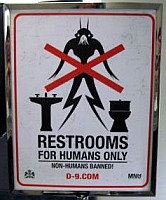
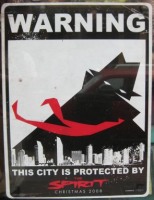 With the massive convention floor and unbelievable crowds, they’re doing everything they can to stand out. So we get the viral marketing, like the ads for TruBlood, the Humans-Only Restrooms signs, the army of people in Quarantine outfits, the Neighborhood Watch–style sign for The Spirit. We get the swag. We get the celebrity appearances. We get displays of terra-cotta warriors to advertise The Mummy and replicas of the Owlship from Watchmen.