Stopped Freeway

Here’s something funny that happened last weekend.

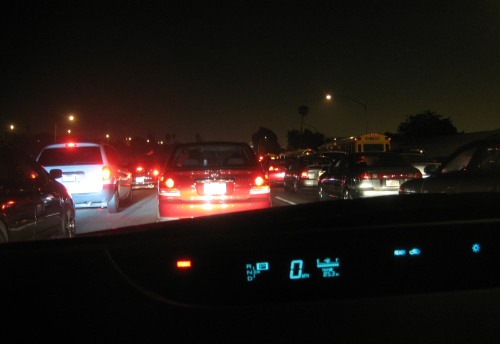
We were driving back from Los Angeles Saturday night around 11:30pm. You might think at that hour traffic would be relatively light. Not so: it was Saturday night, after all, and the route we were taking (101 south to 5 and onward) went straight through Downtown LA. By the time we merged onto the 5 we’d already been delayed by several slowdowns from accidents. It was a bit past midnight when traffic just…stopped.

We waited, figuring it was another round of stop-and-go traffic. And waited. A fire truck quietly worked its way along the right shoulder. After a few minutes, I put the parking brake on.

But the funny part was the driver of the car next to us.

He looked like he was probably around 20, and was driving an SUV with a sunroof. After a few minutes of dead stop, he opened the sun roof — this was midnight, remember — and climbed up on top of his car to see what was going on.

Then he got back down, opened the door, and walked around to the back of his truck so he could get his camera…and his guitar.

Next step: He handed the camera to his friend in the passenger seat, then walked out in the middle of the lane to pose by the car in front of him, giving a double thumbs-up sign and a goofy grin. As far as we could see, he didn’t actually end up playing the guitar.

I expect the photo is probably on Facebook or Myspace by now…somewhere.

All I’ve got are some blurry photos of the dashboard and the cars ahead.

Oh, and the traffic break? Not surprisingly, it turned out to be an accident. Once we started moving again, we passed an area where several lanes were blocked off…and a car was propped up on its side.
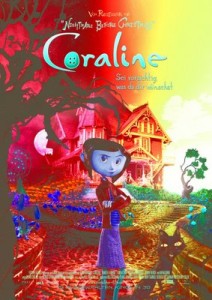
Neil Gaiman remarked on his blog that images his agent emails from Germany end up with the colors inverted, and posts an example of a Coraline poster:

Coraline (German, inverted colors)

“…ah yes, I thought. That’s the sequel, all right. CORALINE APOCALYPSE”

I used to run into this with TIFF images when building websites. (No big surprise, given that there are a million variations on the TIFF format.) I think it was around 2000 or so that I was working on a website for a law firm, and they sent me their logo. The logo, as I received it, was yellow on light blue, so I built a site with black text on a white background for the main areas, and yellow on light blue (matching their logo) for the title, navigation, and borders.

I sent them a link to the test site. They looked at it, and said it was very nice, but could I try to match the color scheme on their logo instead?

It turned out that red and blue had gotten switched around (and possibly more, because I can’t remember how the yellow ended up in there), but anyway it was supposed to be white on light brown. I switched the channels, redid all the graphics and styles for the site, and they stuck with it for several years.

Back on the subject of Coraline, Gaiman adds in his post that the film has become “the second highest grossing stop-motion film ever” after Chicken Run. So why does it seem to be forgotten already? Just two months ago, commentators were falling all over themselves to say Coraline was the turning point for 3-D animation being part of the storytelling and not just a gimmick. Now everyone’s talking about how Monsters vs. Aliens is the turning point for 3-D animation being part of the storytelling and not just a gimmick.

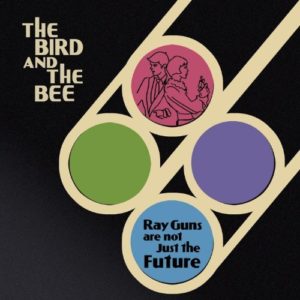
On my way to a doctor’s appointment before lunch, I heard a song on the radio that I liked and wanted to find out more about. I never assume that the DJ will actually identify the song, but I remembered I had Shazam on my G1, and for once it actually managed to identify the song! (Usually I’m trying to ID background music in a restaurant or shopping mall or someplace where half the time I can’t even recognize the song if I do know it). Thankfully for my dignity, it wasn’t Paris Hilton, but rather “What’s In The Middle” by The Bird and the Bee, from their new album Ray Guns Are Not Just The Future. (As it turns out, since it was Morning Becomes Eclectic, the DJ did name the song afterward. But still.)

Now, Shazam is very smart in that it offers a link directly to the song on the Amazon MP3 Store. So I could easily have just bought the song for 99¢ when I parked the car, except…

With unfamiliar artists, I like to at least check out the rest of the album and see whether I want just the one song, or more. And whether it’s a failing in Shazam’s app or the Amazon MP3 app, I could not find a way to go from the song to the album. So I shelved it until later.

Afterward, I opened the Amazon MP3 app by itself, searched for the group, and opened up the album. Another smart thing: If you preview a song on an album, it will go down the whole list playing a clip from each song. I turned up the volume, started the car, and listened to a summary of the whole album on my way to lunch. I decided I liked enough of it to hand over $9 for the lot and see if the remaining songs grew on me, so after I parked the car, I tried to buy the album.

Then I was told that MP3 purchases had to be downloaded over WiFi. WTF? I had a strong 3G signal, and I’ve downloaded large apps (iVerse’s comics and some games are on the order of 5 MB, comparable to a song in MP3 format) over 3G before. Sure, it takes a while, but it’s on the order of minutes, not hours. Naturally the place I’d gone to didn’t have WiFi, and I’m not at the point where I trust it to hold the downloads until the next time I connect to a wifi network. Which will probably be when I get home.

The end result was that I had an entire afternoon to second-guess my decision to purchase the album.

In summary:

  • Good: Shazam makes it easy to buy the song you’re hearing right now from Amazon.
  • Bad: Shazam doesn’t make it easy to buy the album on which that song appears.
  • Good: Amazon makes it easy to listen to samples of an entire album.
  • Bad: Amazon won’t let you download an album unless you’re at a WiFi hotspot.

We watched Star Wars last night, the DVD version. It’s been about four years since I last saw it. When Revenge of the Sith came out, we came home and immediately re-watched A New Hope, then caught the next two films over the following week or so.

It’s been long enough that memories have blurred, and some (but not all) of the revisions to the film don’t seem jarring anymore. (I had the same experience last month with the extended versions of the Lord of the Rings trilogy, especially with the first two films.) Most of the scenes where they just wanted to do more dynamic shots, like the Millennium Falcon blasting its way out of Mos Eisley, not only blend in just fine, but really are improvements. As for Mos Eisley itself, I’m of two minds: On one hand, I liked the stark barrenness of the tiny frontier town presented in the original version. But at the same time, it does make more sense for a spaceport to be a bustling metropolis.

All the scenes with Obi-Wan, Luke, and the droids on Tattooine take on added significance after having seen just how Ben, Anakin, and Padme were connected to each other and to the droids a generation earlier.

As for additional scenes: I still think the Jabba the Hutt scene adds absolutely nothing to the film, and that if they really wanted to add it, they should have rewritten Jabba’s dialogue (an easy task) and/or edited it into something that wouldn’t simply re-hash the conversation with Greedo. The brief moment with Luke meeting Biggs, however, adds quite a bit.

At one point early in the film, I turned to Katie and said something to the effect of, “The next time they re-release this in theaters, I am absolutely going.” But the more I think about it, I’m not sure I’d want to, at least not immediately. The 1997 re-releases were great, and I saw each movie several times, but the audiences — especially the opening night audiences — were full of the hardcore fans who cheered whenever a character first appeared on screen. They were reacting to things outside the movie itself, actually distracting from it rather than enhancing the shared experience. Maybe waiting a week would cut down on that sort of thing.

The Top 10 Reasons I Will Not Follow You in Return on Twitter is making its way around…well…Twitter today. Just reading the tile makes me wonder: why would someone expect to be followed in return? I guess it comes down to this question: What does it mean to follow someone? Is it different from friending them? And just what does “friend” mean in this context, anyway?

The way social networking sites use the term “Friend” has always bugged me. The actual software for Facebook, MySpace, or LiveJournal seems to use it to mean two distinct things:

  • An actual friend, someone with whom you interact on a personal basis.
  • An entity whose posts you’re following because you’re interested in the content, rather than invested in the person.

Wishful thinking aside, reading Neil Gaiman’s blog regularly doesn’t make me his friend.

Okay, so “Friend” is shorthand, but it brings in a load of connotations, blending the two meanings. People will freak out when a stranger “friends” them, will feel insulted if someone that they’ve friended doesn’t friend them back, or will feel rejected if someone de-friends them. I’ve heard it suggested that one reason people move from one social network to another is to start over with a clean slate of friends, and not have to worry about the drama of removing anyone from their current friends’ list.

Twitter, with the simple and direct term, “Follower,”, doesn’t seem like it would bring in the same level of baggage. To me, clicking “Follow” doesn’t feel like it has the same emotional weight as marking someone as a friend. I follow accounts that I find interesting, and that I actually have a chance of keeping up with. If someone follows me, I don’t feel obligated to follow them, and if I follow someone else, I don’t expect them to follow me.

So I was perplexed when I started seeing new followers showing up on my personal Twitter account who clearly had only done a keyword search on my latest tweet, or looked at who I was following. What were they expecting? That I would look at the “XYZ is following you!” email and trace it to their website? That I would follow them back?

It didn’t make any sense to me.

Of course, now I’m sure they were expecting me to follow them back. As this article suggests, a lot of people do see “Follow” as a synonym for “Friend”, and they were most likely trying to game that system.

In other words, despite the terminology, Twitter’s stuck with the same old baggage that clogs up other social networks.

»All pages site-wide with this tag