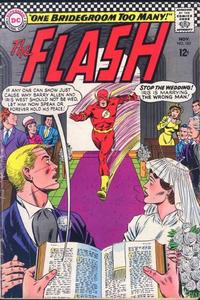
Cover: Flash #165Over the past few weeks I’ve been going through the Silver Age Flash series, cataloging character appearances. I’m almost done – only 25 issues left – but it reminded me of something:

Why is it that super-hero weddings are almost always interrupted by super-villains – even when the hero’s identity is secret?

Is it just that readers expect a story with some sort of fight in it, and if it’s just a wedding they’ll be disappointed?

Consider these examples:

  • Flash II (Barry Allen) and Iris West: the wedding is interrupted when Professor Zoom disguises himself as the groom, and the Flash has to get rid of him and then make it to the wedding himself.
  • Flash II (Barry Allen) and Fiona Webb (after Iris’ death): Zoom returns, Flash spends the whole day chasing him around the globe, and eventually Fiona gives up and runs out of the chapel, just in time for Zoom to try to kill her. (Flash stops him with a last-second choke-hold which breaks his neck, leading to a manslaughter trial, the disappearance of Barry Allen, and finally the cancellation of the series.)
  • Flash III (Wally West) and Linda Park: at the moment the rings are exchanged, Abra Kadabra kidnaps Linda, sends everyone home, and casts a massive forget spell, erasing all memory and records of her back to the point she met Wally. Eventually she escapes, Kadabra is tricked into reversing the spell, and they hold a new wedding – 18 issues later.

And it’s not just the main characters who get this treatment: Continue reading

I’m beginning to understand why someone would jump out of a bathtub and go streaking through the streets with a fantastic new idea. Recently, in the shower, my brain decided it wanted to write a graphic novel. The day after, it worked out a genetic explanation of channeling in the Wheel of Time universe. If you haven’t read any Robert Jordan, or if you don’t know basic genetics, this won’t make a huge lot of sense. If you’ve read some but not all, be warned that this explanation contains information you may not have reached. None of it is serious, but if you’re a fanatic about not being spoiled, watch out. I’ll break the article before I get into speculation that people might not have heard or want to hear.

Here’s my model. There are three factors controlling channeling ability: whether you can do it, whether you have the spark or can learn, and how strong you are. Strength and sparkiness don’t seem to be related, and neither seems to be related to sex. What I propose is that basic channeling ability is a recessive, sex-linked trait. There are variations of a gene on both the X and Y chromosomes, X’ and Y’ to borrow from Katherine Kurtz, that enable awareness of, respectively, saidar and saidin. In order to channel, someone has to have this variation on both their sex chromosomes. So an X’Y male can’t channel, but an X’Y’ can. X’X women and X’Y or XY’ men can’t even sense the Source. The elegant part of this is that it explains why men who can channel or learn can sense when a woman is channeling: they have the X’. It also explains why channeling-capable men can only tell other men can channel when they do it, while women have an easy time telling when other women can channel (sensing other Aes Sedai, seeing the glow, knowing who’s sparky), since they have double sensitivity to saidar.

Sparkiness is easy compared to that. It seems to be a simple dominant-recessive or absent-present allele situation. For simplicity’s sake, let’s say there are two possible places on non-X-or-Y chromosomes that the allele (call it “spontaneity,” S for absent and s for present) can appear. If someone has one, and all other genetic markers are in order, he/she is a learner; two means he/she has the spark. This makes for a very easy Punnett square giving about twice as many sul’dam as damane.

I won’t address strength, since it’s not a black-and-white issue and probably involves a lot of genes that most people just don’t use, not having the right matchups in spontaneity or sensitivity. However, I do want to look at what happens when you examine a few special families…. Continue reading

A few weeks ago, the floodlight in our entryway went out. This was the first built-in fixture to burn out, so we checked with the apartment office to see whether we should replace it ourselves or ask maintenance do it. They said they’d take care of it.

A few days later, the light was still out, but we got a service report with one line written on it:
Replaced Blub
Upon reading “replaced blub,” the manager joked, “There’s your problem!”

Shortly afterward, the bulb was replaced.

Despite what you might believe, tumbleweeds are actually quite common in suburban Southern California. They often grow by the side of the freeway, occasionally getting picked up by the wind and bouncing across cars.

Never is this more noticeable than during the Santa Ana winds, which seasonally sweep out from the desert to the coast, blowing over trees, knocking out power lines, and sending the smog out to sea. (Unfortunately, by the second or third day, all the dust from the desert has taken its place.) The two of us got some great shots from the most recent Santa Anas which hit during the week leading up to Thanksgiving.

Tumbleweed by the side of the road.
A tumbleweed seeks relief at a fire hydrant.

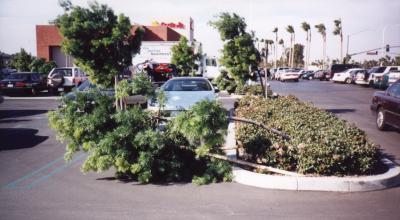
Downed tree in parking lot.
Even a support stake couldn’t keep this tree up.

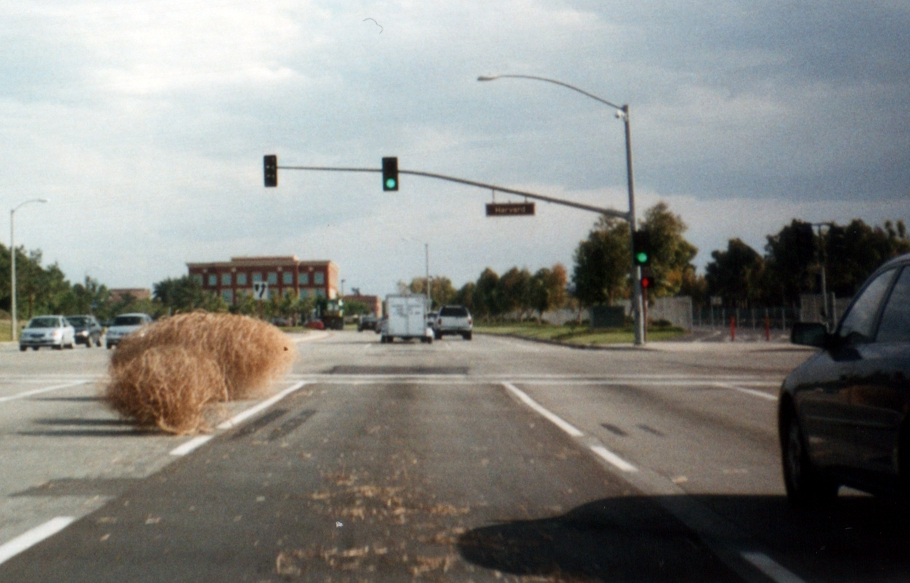
Tumbleweeds in the *middle* of the road.
Hey! Get off the road! (Yes, tumbleweeds can get that big.)

I remember back in college we had interesting naming schemes for computers. The ICS labs had the Guilder and Florin Macintosh networks with servers Westley and Buttercup. There was also a Solaris network where each machine was named after a Roman emperor, with names like Aurelian, Caligula, Gothicus, Hadrian, Pacatian, Saloninus, Trajan, etc.

The lab I worked at over in the School of the Arts started naming their Windows NT servers after renaissance artists: Leonardo, Raphael, Michelangelo, Donatello… well, that’s what we told them the origin was, anyway! The first SGI box (for 3D modeling) we got we named Trippy, and then when we got several in we started naming them Happy, Sleepy, etc.

Then we got in a whole mess of computers, expanding our NT network from 3 machines to 14. We were trying to come up with a theme to name them, and started in with names like Pepsi, Mountain Dew, etc. I had to leave after we set up the first 3 or 4 of them, and the next morning I received a mass e-mail stating, “The Artslab liquor cabinet is stocked.” The message went on to list the new computers’ names: Absolut, Alize, Bacardi, Baileys, Bombay_Sapphire, Captain_morgan, CuervoGold, Glennfiddich, Jagermeister, Jimbeam, Midori, Remmy_Martin, Seagrams, and Wildturkey. Soon after, we got a pair of Mac G3s and named them BlackLabel and BlueLabel.

The names stayed at least as long as I did, and may be there still. It was funny, though, to get reactions from people – students who had actually used the machines, or faculty and staff opening up Network Neighborhood – as they realized they were all alcoholic drinks!

J. Gregory Keyes has fast become one of those authors whose work I will pick up knowing nothing more than who wrote it. I enjoyed his work in the Babylon 5 and Star Wars universes, but after reading the four novels of The Age of Unreason and these two, I can say I’ll definitely be picking up The Briar King when it comes out in January.

Now, The Age of Unreason is probably Keyes’ most well-known work to date. (If the title doesn’t sound familiar, chances are you’ve heard of the first novel, Newton’s Cannon). It takes place in an alternate Eighteenth Century in which Isaac Newton discovered the key to alchemy, transforming the world with new technology… and setting off an arms race of sorts. What begins as an alternate history becomes an epic battle for the future of the world, and ultimately of humanity itself.

While I’d recommend someone curious about Keyes’ writing start with Newton’s Cannon, I’d like to call attention to his earliest published novels, The Waterborn and The Blackgod, collectively known as The Chosen of the Changeling.
Continue reading

ยปAll pages site-wide with this tag