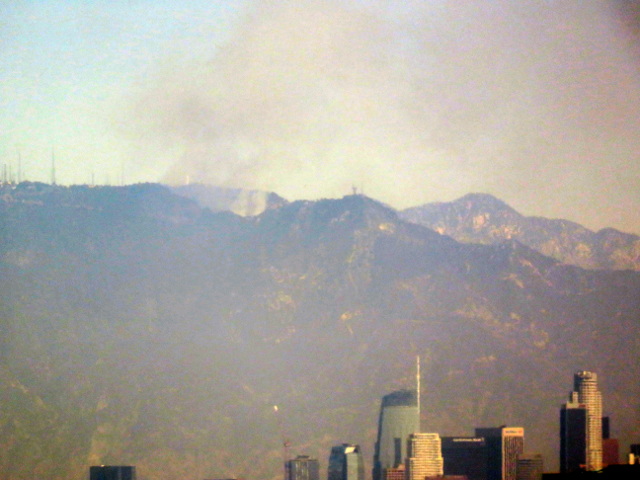
A fire is raging in the hills and canyons of Orange County. It’s nothing compared to the devastation in Northern California, where 160,000 acres have burned, killing 21 people and wiping out whole neighborhoods in Napa and Santa Rosa — but a dozen homes have been lost and about as many damaged in the 8,000-acre blaze near Anaheim.

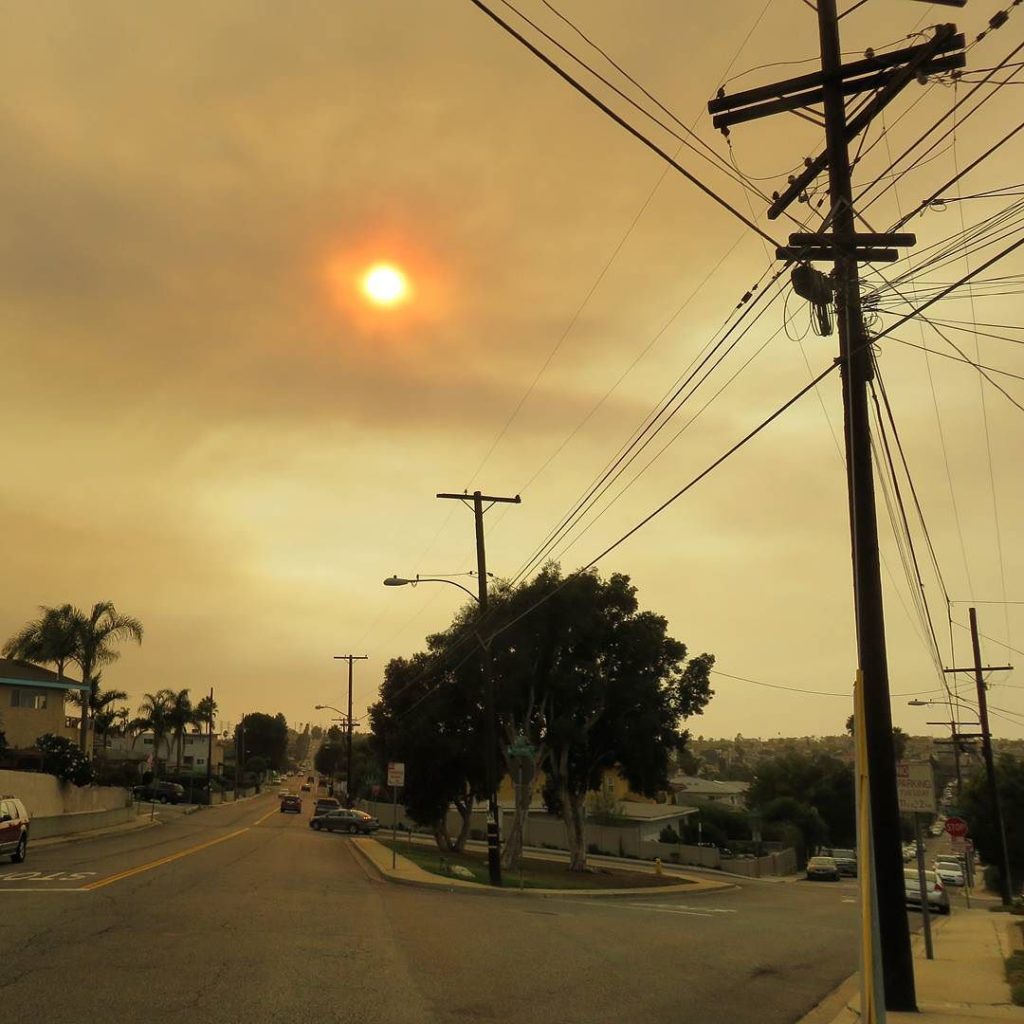
Even though I live farther away now, the smoke still reached the coast on Monday, the first day of Canyon Fire 2 (so-named because it picked up where the Canyon Fire left off last month). It turned the sun orange and the sunlight yellow, like sunset but at too high an angle. The smoke is a lot more diffuse now, looking more like typical smog, and firefighters are getting the fire under control as the weather changes.

The evacuation maps and the photos of Peters Canyon remind me of the Santiago Fire ten years ago this month. That fire burned for nearly three weeks and scorched 28,000 acres. I wondered whether they ever caught the arsonist who set it. As far as I can tell from a quick search, they never did. The most recent article I found was on the five year anniversary of the fire. At that time, they had “narrowed the search to three suspects…but no arrests [had] been made.”

October is always a bad month for wildfires in California. Plants have been drying out all summer, the winter rains haven’t started yet, and the hot, dry seasonal winds of fall — Santa Anas in the south and Diablos in the north — whip up the flames and drive them long distances. But in the last decade, more and more fires have burned large areas in summer, spring, and even winter, to the point where “fire season” may as well be year-round.

One more time, religious freedom means you get to practice your religion, not force other people to follow yours. This isn’t complicated.

Imagine for a moment that [insert religion you don’t like] lobbies the government to force you to follow their rules on behavior, dress, etc. You see where this is going, right? Because you have imagined it. Now think for a minute, because it’s the same thing.

Religious freedom has to apply to everyone — including minority religions and those without religion — or it isn’t freedom, it’s favoritism.

You don’t like birth control? Don’t take it. But don’t block other people from taking it when you’re in a position of power over them.

That’s not you following your religion. That’s you forcing other people to follow your religion. And that infringes on their freedom.

This blog has been around 15 years. Social media has mostly moved on, to silos like Facebook and Twitter. People don’t follow random personal blogs. Topic-focused sites are what people actually read, and even that mainly following links from silos.

Meanwhile there are so many major things going on that make the things I post about here — comics, fandom, photos of things I found interesting, random tech thoughts — seem trivial.

So why keep a blog going? And why write about trivialities, and not big things like the battles over civil rights, healthcare, environmental protections, war?

As for the first: Some of it is stubbornness. And some of it is wanting to keep part of my writing/photo presence somewhere “permanent” (to the extent that anything online is).

As for the second: I’ve never really liked talking news and politics online. I rarely feel like I can add anything that hasn’t already been said (probably better) by someone else. Also, online conversation has gotten way too toxic. On the other hand, while the little things may be trivial, they add up. They add up to your life. It feels like I might actually have something to say that’s not already been said a thousand times by people more familiar with the issue than I am.

Plus it’s a way to assert some normality in a world that feels decidedly abnormal.

I’m not likely to come up with anything super-profound on the most important topics, but I can make short statements, and I can amplify other voices. And I’m trying to come to grips with the fact that that’s important. I’ve been reading a lot more and posting a lot less over the past year or so, but even if I can’t say anything profound, I shouldn’t stay silent.

So I’ve been microblogging, and linking, and reposting — all things that are better suited for a service that’s built around those use cases. When I have something longer to say, I do try to pull it in here, because a blog post is better than a Twitter thread… But I think more people probably see my retweets than my blog posts, anyway.

The practice of recycling old news articles still throws me off at times. For instance: here are two recent LA Times articles using big disasters as springboards to talk about possible giant earthquake scenarios in California. They start out talking about the Houston flooding from Harvey and yesterday’s quake in Mexico, then segue into Los Angeles disaster planning. By the end, they’ve segued into the same text. I was reading today’s and thinking, “I just read this, recently.” A ten-second search turned up the older article.

It’s not plagiarism. It’s the same reporter at the same newspaper. It’s basically the equivalent of stock footage, and it’s hardly the only example. It’s probably not even a new practice, just a lot easier to find now that everything’s online and searchable.

Adding a splash of color to Brutalist design, in the final stages of converting an office building near LAX to a hotel. Believe it or not, the bolted-on cross pieces are new. I can’t imagine they’re aesthetic, which makes me wonder if it’s some sort of earthquake retrofitting and they’re making the best of it.

It’s an interesting approach, but it still looks way more institutional than inviting, IMO.

Update: It turns out the scaffolding is being used to hang a full-height geometric design. I’m still not convinced it didn’t start as some sort of seismic retrofit, but it will at least look a little more inviting once they’re done.

These are all on three different days, incidentally, which is why you can’t see the first square on the left side in the middle photo.

Update: This LA Times article on what to do in an earthquake may be relevant. In most cases, you want to drop, cover, and hold — don’t run outside, since you’re more likely to be hit by something falling off a building than crushed in a collapse. But “brittle concrete buildings” are more likely to collapse than other types.

The city of Los Angeles in 2015 passed a law requiring those buildings to be retrofitted, but gave owners a 25-year deadline to do it once they are given an order to seismically evaluate the building. The city is still working on preparing its list.

Hmmm….

I’ve always wanted to see a total solar eclipse, but until now I never had the opportunity. I’ve caught a number of partial solar eclipses over the years, and quite a few lunar eclipses. This year’s “Great American Eclipse” was perfect: it passed close to Portland, where we have family, and we could visit friends on the way up.

By the time I reserved our hotel there was nothing left inside the path of totality, but we could still get an expensive room in Portland. I reserved that immediately for the nights before and after, then a motel for a few nights before so we would have time to visit, then we planned out the trip up and back.

Driving Into the Path

The morning of August 21, we got up at 5:30 to drive south into the path of the eclipse. We didn’t actually make it out the door until at least 6:30, and the parking attendant had lost our key (fortunately we had two, and they did eventually find it that afternoon), and then we got lost trying to find an ATM in case we had to pay a ton to park in someone’s field (one way streets and bridges and driving into the early morning sun), but we got on the road toward Salem by around 7:15/7:30, with our eclipse glasses, water, snacks/emergency food, and a very sleepy 6½ year old.

The threatened traffic jam carpocalypse didn’t materialize. There were slowdowns, sure, but nothing we hadn’t experienced on the way out of LA. Our nav system (which J. calls the “map lady”) sent us onto a side road at one point, and we drove through the countryside a while before getting back onto the interstate.

Continue reading

»All pages site-wide with this tag