Neither of us spent more than an hour or so on the floor on Saturday, in part out of self-defense. Comic-Con is usually the most crowded on Saturdays, though we didn’t see much difference from Friday this year.
After the Flash panel, I went back to my back issue hunt. Found quite a few in the $150-500 range. Unfortunately I’m looking in the $50-100 range. Dealers just haven’t brought their low-grade Golden Age books, so it looks like it’ll be back to eBay.
Quick Draw was, as promised, lots of fun. I missed the first 20 minutes or so (I’d been planning to go to the One Year Later panel, but changed my mind at the last minute—no regrets there!), but Katie caught the whole thing. Sergio Aragonés, Scott Shaw!, and Kyle Baker were directed by Mark Evanier to draw ever crazier things, sometimes competing to convey a “secret word” in a Pictionary-style game.
The Narnia/Pirates panel, expected to be the highlight of the day, turned out to be a big disappointment. Last year, the Narnia presentation was fascinating, despite the delay from the satellite link-up, because things were completely new, and because the people involved knew what fans were interested in seeing. This time they basically sent the marketing guy out to talk about the special edition DVD.
As for Pirates of the Caribbean… the talk by John Knoll was a fascinating insight into the technology that they used to animate Davy Jones, but the first half was out of place at a Comic-Con. It would have done much better with a highly technical audience—maybe at a Cal Tech Seminar Day or something. Once he started showing the before-and-after shots, and the test footage, the audience warmed up to him. And some of the joke footage, like the giant Krispy Kreme donut rolling out into the surf, or Elizabeth Swann cutting a swath through the Dutchman’s crew with a pair of lightsabers, was great.
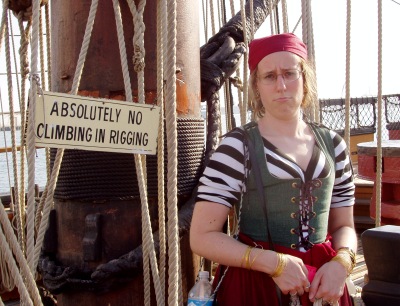
After that fiasco, we decided to clear out instead of staying for the Spider-Man panel. Neither of us had anything we were looking at for the rest of the afternoon, so we decided to go out to see the Star of India (the ship, not the restaurant) and the other ships out by the bay. Among other things, Katie wanted to get some pictures while still in her pirate costume. Unfortunately it took us so long to get around the insanely long line for Spider-Man—which was a big surprise, since we’d just walked into the hall earlier—that we missed our trolley. Literally, we were up to the gate on the opposite side of the tracks when it pulled away. We ended up postponing our dinner reservations to make sure we had enough time.
As it turned out, the Star of India itself was closed, but the HMS Surprise (used for filming Master and Commander) was open, along with the HMS Berkeley, a ferry, and a pleasure boat called the Medea. The Berkeley had mostly been turned into the Maritime Museum, but the engine rooms were open for view. We skipped the Soviet submarine. Bulky costumes and full backpacks don’t go well in confined spaces.
We had enough time to drop stuff off at our hotel room and lie down for a few minutes, then went back to the Gaslamp district and dinner at Dussini, a Mediterranean place that replaced the old Spaghetti Factory. Once again, a great restaurant. We also saw a great demonstration of why you should make reservations: The walk-in couple in front of us had a 45-minute wait. We were shown to our table immediately.

![[Outhouse on a crane]](https://journal.kvibber.com/wp-content/uploads/2006/07/floating-outhouse.jpg) We stayed at the Radisson Harbor View. The end of the hallway had a view of the harbor, but our room had a view of the construction across the street. When we first stepped onto the balcony, we saw a crane lifting an outhouse up to the topmost floor of the site. There’s something inherently absurd about a port-a-potty flying through the air.
We stayed at the Radisson Harbor View. The end of the hallway had a view of the harbor, but our room had a view of the construction across the street. When we first stepped onto the balcony, we saw a crane lifting an outhouse up to the topmost floor of the site. There’s something inherently absurd about a port-a-potty flying through the air.
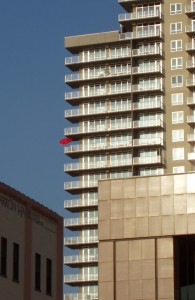 There were quite a few high-rise buildings that looked very much like this one. Sort of the skyscraper equivalent of clone homes, I suppose. This one had one difference: One of the tenants had set up a large, red umbrella on their balcony.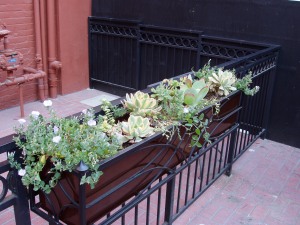



![[Picture of the Flash (Barry Allen) from Showcase #4]](https://journal.kvibber.com/wp-content/uploads/2006/07/barry1.png "The Flash (Barry Allen) from his first appearance in Showcase #4, 1956")