The Station Fire burning through the Angeles National Forest north of Los Angeles is expected to reach the summit of Mt. Wilson sometime tonight. In all likelihood it will damage or destroy the communications towers and the observatory complex. The Mount Wilson Observatory is an active observatory, and is also of historical importance because of discoveries made there over its 105-year history. In particular: Edwin Hubble’s* observations with the 100-inch Hooker telescope (shown at right) indicated that universe is much larger than was previously thought, and that it was expanding — observations that revolutionized astronomy and led to the current Big Bang theory.

People listening to a talk, lots of pictures of the sun printed out on the wall.I’ve been to the observatory once, on a tour my family took on August 8, 1992. We’d just come back from a trip to Florida where we visited Disney World and Cape Canaveral during the summer I was 16. I really wish I could remember more about the trip…but I took pictures and labeled them (though not in much detail). With the observatory threatened, I thought I’d dig them out and scan them**. You can see all eight on my Mt. Wilson Observatory Tour 1992 photoset on Flickr.

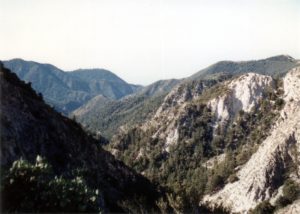
Forested mountain valley with a hazy white sky.The Observatory’s website is apparently hosted on the grounds, so the fact that its fire status page is still responding indicates it’s still there and has power. The latest update says that they’re setting up a backup info page, but it’s showing a 404 error right now.

*As in the Hubble Space Telescope.

**Scanning them was not a problem. Digging them out? That was a problem. I knew exactly which photo album they were in, and thought I knew where the album was. As it turned out, it wasn’t there. It was in an unopened box shoved at the very back of the long,narrow hall closet, such that I had to move 3 other boxes, several bags, and an unused CD rack just to see that it was labeled “photo albums” on top. Edit: And, oh yeah, the trail of ants along the wall, going after the long-forgotten bag of Halloween candy. The wall I kept brushing up against. How did I forget that part?

That’s the missing piece that makes the classic phrase more than a simple tautology. It’s not just that it’s in the last place you look. It’s that it’s in the last place you want to look.

Panda Express as it stands today. (Literally, today, 20 minutes before posting this.)

When I lived in Lake Forest during the year 2000, I used to frequent a place called Panda Panda. It was your basic steam table Chinese restaurant, but it was good. I remember the occasional evening on which I’d think, “Do I go to the store, buy ingredients, come home, then spend time cooking just for one person, or do I go out and grab some fast-ish food?” Panda Panda was a frequent winner of these decisions.

It was located at the corner of El Toro and Raymond, near the library. Panda Panda shared a building with a Quizno’s sandwich place and was one driveway away from a Wendy’s.

I don’t know if they were a small chain or a solo restaurant, but they were eventually bought out or otherwise assimilated by Panda Express, which I’ve never particularly liked. (Though Panda Inn, a table-service restaurant owned by the same company, has been consistently good.) Naturally they homogenized the menu as well.

That was the end of that.

A few years later, as part of the big project to renovate the area, both buildings were bulldozed to make way for a new strip mall segment. Panda Express got the prime spot in the new building, but all traces of Panda Panda are lost.

For the record: I’m currently sitting in a Wahoo’s taco place roughly where the driveway used to be.

  • Last night I learned that the Satellite Market near Disneyland is still there, but the Sputnik-style sign has been replaced. Old & new photos.
  • Side salad vs. fries study: Adding a healthier option caused people to choose the unhealthy option more often. It’s made me a lot more aware of what I order for lunch.
  • Spam apparently advertising speed bumps: “Women won’t hide their excitement when they see your bulge in the street”
  • Funny webcomic: Ada Lovelace: The Origin! (via @johannadc)

When I was around 15, I had a close encounter with a rattlesnake. In my tent. No one was bitten, but getting that snake out was an interesting experience. It happened during a week-long summer camp at Lost Valley Scout Reservation in the mountains northeast of San Diego. It was at least my fourth summer camp with my Boy Scout troop, placing it around 1991 or 1992, and at least my second at Lost Valley.

Lost Valley

There are two kinds of campsites at Lost Valley (or at least there were in the early 1990s): One type had simple wooden cabins, which held two bunk beds apiece*. This was the other type, with canvas tents. The canvas made up the roof and walls, and was tied to a metal frame with a plywood floor. (Note: this arrangement is not sealed.) Two cots lay on the floor. Scouts would typically lay out their sleeping bags on top of the cots, and stow their gear underneath.

The site was in a wooded area of the camp — mostly evergreen trees — below a hill, in the Camp Irvine section. Looking in from the road, there was a large rock formation to the right, which I remember a lot of us scouts would climb onto. (It’s the 13th point of the Scout Law: A Scout Climbs Rocks) To the left, the land stayed flat at least as far as the next section of road. Straight back was a fairly steep hill which led up to more campsites and eventually the dining hall, if you were willing to go off-trail and cut through another site. Judging by the map, it looks like it was probably Indian Wells campsite. Edit: My dad points out that the stones had been grinding sites for the local Native American tribes, which may have been the source of the name.

Finding the Snake

My tent was toward the back. One night** as I was getting ready for bed, I set my canteen down before closing it and accidentally knocked it over. I quickly set it upright, then got down with a flashlight to look at the puddle of water spreading back under my cot, and see if I needed to move anything out of the way.

Looking back at me was a rattlesnake. It had apparently set up its own camp under my bed. I said, surprisingly calmly, “Oh, there’s a snake under my cot.”

“That’s nice,” my roommate, Geoff, who was already half-asleep, mumbled. Followed a few seconds later by, “WHAT!?!?”

I think he went to get an adult while I kept my distance and watched the snake. Or possibly the other way around. Or maybe we both went for help. I definitely recall one of those audio relays of boys saying, “There’s a snake in Kelson’s tent!” Someone went to contact camp staff, and the snake crew showed up. (Chances are pretty good that Phil Brigandi*** was among them.)

Keep in mind that it was dark. It was several hours into night, and the only light came from flashlights and propane lanterns.

Removing the Snake

My dad, who was there as a troop leader, adds a little more info:

They used the opportunity to make a point that little rattlesnakes are more dangerous than adults, because they’re less skilled at releasing their venom in small doses. (Otherwise, the snake has no venom for a second strike, in case it needs to fight another enemy.) So little rattlesnakes inject you with everything they’ve got.

Our biggest concern of course was that we didn’t want the rattlesnake to get away while we went and got the snake control guys. (Otherwise, you’ve got the trouble of wondering where it’s GONE!) Of course, nobody was going to try to catch it or anything, so the basic idea was to leave it alone but keep the lights on so we could keep an eye on it. We all counted ourselves lucky when we got back and found that the snake was still where we’d found it!

They don’t kill rattlesnakes when they find them, just relocate them. (Rattlesnakes play a part in the local ecosystem, after all.) Their equipment consisted mainly of a stick with, IIRC, a loop of rope on one end, and a large wooden box. Normal practice involved trying to pick up the snake with the stick, depositing it in the box, closing it in the box, then taking it out somewhere farther away from any people.

There was a problem, though: The snake was too small to pick up. It just kept sliding through the loop. Finally someone (possibly my dad, now that I think about it) picked it up with a shovel and put it in the box. They closed it up, may have loaded it on a truck, and that was the last I ever saw of the snake.

Notes

*It was in one of those cabins that I once rolled off the top bunk in my sleep and woke up on the way down, before I hit the floor. I don’t remember it hurting at all. I just climbed out of my sleeping bag, climbed back up, and went back to sleep.

**I think it was the same night that I took my camera and a tripod out to one of the large meadows and experimented with taking pictures of the night sky. I got some fairly decent (for a first-timer) shots of Sagittarius, Scorpio, and the Milky Way, which I’ll have to see if I can find sometime.

***I was prompted to write this when I read Orange County Historian Phil Brigandi‘s account of the first time he ever saw a rattlesnake bite in his many years at Lost Valley Scout Reservation.


I haven’t seen 300 yet. But not because I’m not interested in the story.

I hadn’t heard of the Battle of Thermopylae until a few years ago, when I picked up a book called Atlantis Gate, by Greg Donegan. It was a sci-fi/fantasy thriller involving a war across time for the fate of the world. One front was ancient Greece, with one side aligning with the Spartans, and the other with the Persians. IIRC, the Spartans had to protect a gate in the pass until either someone could get a message through, or someone could close it. I actually found that the most interesting part of the book. The rest felt too much like it wanted to be an action movie. (About 2/3 of the way through I discovered it was actually the final book in a series of four. It didn’t grab me enough to pick up the earlier ones.)

Not long afterward, I started reading Harry Turtledove’s Videssos Cycle, in which a Roman legion gets transplanted to a sword-and-sorcery world. Among their number is a Greek doctor, who remarks at one point about the very same battle. At this point I realized that Donegan wasn’t making everything up, and started reading up on the actual battle.

So when I heard about the Frank Miller/Lynne Varley graphic novel, I put it on my wish list. Eventually I picked it up, read it, and enjoyed it. Then I heard they were making a movie, which sounded really promising.

Then the first previews aired, and it looked… well… overblown and hammy. Even the good reviews make it sound like two hours of hack-n-slash.

I think I’ll wait for the DVD.

(Sort of vaguely a response to Warren Ellis’ recent remarks on “Bad Signal” that he hasn’t seen 300 because he read the book—and didn’t like it.)

Irish and Mexican FlagsI caught a story on The World (PRI) today about Los Angeles band Ollin’s song tribute to Saint Patrick’s Battalion (in Spanish, El Batallón de Los San Patricios)—a group of several hundred primarily Irish Americans who, during the Mexican-American War (1846–1848), left the US Army to fight alongside the Mexicans. They fought fiercely for a year, but came to a bad end: most were captured by the US and executed as traitors.

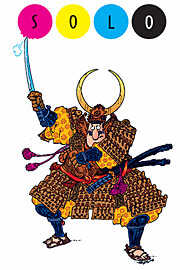
Cover of Solo #11It reminded me of a story Sergio Aragonés told last year in his issue of Solo (#11). In “Heroes,” he talks about growing up in Mexico, where the San Patricios are national heroes. They have statues, memorials, and a commemorative ceremony every year on the spot where they were executed. After telling the story of how he learned about the battalion, he jumps forward a few decades. Living in the US, with his daughter going to American schools, he wanted to see how she would learn about the heroes of his youth. So he looked through her textbook to the section on the Mexican-American war, and found only a fleeting remark about how a bunch of drunk Irishmen deserted the US Army, surrendered, and were executed.

It was a surprisingly serious story from an artist known for his comedy (some of the other stories in the issue are drop-dead funny), and an interesting commentary on how nationalism shapes our views of history, with one side elevating the battallion, and the other trivializing them.

»All pages site-wide with this tag