Back in December 2024, Niantic posted about a large geospacial model they were building using data from Pokémon Go.

That led to a lot of online talk, with takes ranging from:

  • Well yeah, that’s what we figured they were doing with the “Scan a Pokéstop to build better AR models” feature.
    to
  • Watch out! Niantic is building a global AR model using every image that passes in front of your phone’s camera!

I was in the “of course that’s what it’s for” camp. When the game rolled out the Pokéstop scanning feature a few years earlier, it seemed obvious that it was training 3D machine vision, like how all the “pick the squares with bicycles” CAPTCHAs are obviously training for self-driving cars. I figured there was a good chance someone would use it for some harmful purpose or another, probably surveillance, so I skipped those tasks.

Anyway, after a week or so, Niantic updated the article to clarify* that it was using the deliberate Pokéstop scans in public places for Pokémon Playground, not any of the other AR features like taking a photo of your buddy in the kitchen.

This made sense, because if they were using that data, it would have eventually gotten better at placing a Pokémon in my kitchen. (The floor’s a grid. You’d think that would help, but noooo….)

Drones (And not just Beedrils or Combees)

Those scans are back in the news, because as DroneXL reports, that geospatial model is being used for camera-based drone navigation.

Including military drones.

Because of course everything has to be weaponized. Allegedly even Pixar’s RenderMan.

Admittedly, GPS itself started as a military technology long before it became civilian infrastructure. Military and civilian tech really do just have a revolving door between them, don’t they?

Training Data

Among other sources, DroneXL cites a Dutch-language article at Trouw, who asked the defense contractor (Vantor) directly whether it uses Pokémon Go data: Vantor initially said no, but later walked back any guarantee. Niantic Spatial, however, has stated that the Pokéstop scans were used to train an “early version” of their model. That means the data (or weights produced from it) is still in there, just blended so much by training process that it can’t be identified anymore.

Kind of like you probably couldn’t confirm my old blog posts are in the training data for an LLM by looking at the LLM weights, but you can find pages from hyperborea.org in Common Crawl data, and assume any model trained on Common Crawl still has it in there somewhere.

Maybe scans made since Scopely (US-based, Saudi owned) bought Niantic’s gaming division last year haven’t gone into the map built by Niantic Spatial (still independent), so Vantor technically isn’t using current player data. Or maybe Niantic Games continued passing scans along to Niantic Spatial for a while, under the separate TOS, and Vantor’s spokesperson just hadn’t made the connection.

Quietly Dropped

Curiously, the Pokéstop scanning task I’d left in my list for years just disappeared a few days ago.

At first I deleted the tasks as I got them, but every time I scanned an eligible stop it would add a new one if I didn’t have one in my list. So after a while I just left one there and ignored it like an ad banner.

It turns out Pokémon Go discontinued the features on June 2, just three days before the Trouw article was published. (New tasks stopped appearing that day, and it took a few days for old tasks to disappear.)

Coincidence? Maybe. But the timing’s certainly suspicious.

Notes

* Before Niantic published their update, I e-mailed them asking for clarification. It took them over a month, but they did eventually reply:

Hi Trainer, we appreciate your patience. Thanks for your questions about AR Mode and our Privacy Policy. I’ve shared some additional information below:

For Pokémon GO, only AR scans from the PokéStop Scanning feature will contribute to the development of the Large Geospatial Model. As noted in the PokéStop Scanning Help Article (https://niantic.helpshift.com/hc/en/6-pokemon-go/faq/2519-scanning-a-pokestop/): information gathered during PokéStop Scanning allows Niantic to generate accurate, dynamic 3-D maps of real-world objects and their relative locations, and help devices understand the surroundings in AR real-time. As noted in the Editor’s note to the blog post, merely playing the game does not train an AI model.

When using AR or AR+ mode, we do not store your photos on our servers. For PokéStop Scanning, once a PokéStop scan is voluntarily uploaded, the video recording and associated camera data is retained on our servers in accordance with our data retention policies. For more information please see our Privacy Policy (https://nianticlabs.com/privacy).

It’s been 18 years since drug companies replaced pseudoephedrine with phenylephrine to keep their cold medications available over the counter when the people waging War On Drugs(tm) decided to restrict the main ingredient in Sudafed (and what it was named after) because it could be used to make meth.

Though I remember some other decongestant plugging the idea that “unlike those medications, we chose not to change our formulation…” Yeah, because you weren’t using an ingredient that got semi-banned!

From the start, the new formulation clearly wasn’t as effective. When I found out that I could still buy the real medication as long as I asked at the pharmacy counter (and showed ID so that the DEA or whoever knows I’m not trying to get around limits by hitting every pharmacy in town), I stopped bothering with the OTC versions entirely.

I wasn’t surprised when studies showed that phenylephrine doesn’t work.

Back in 2015.

(Restricting sales of the real stuff didn’t seem to make much of a dent in the meth problem, either.)

“Only” eight years later, the FDA reached the same conclusion.

And yet the industry is complaining that “if oral phenylephrine were not available over the counter, it would be a significant burden to consumers.”

HOW?????

It doesn’t work. People who buy it are wasting their time and money on snake oil instead of buying a different medication that might actually do something for them. (Not that this is a problem for the supplement industry, where “not evaluated by the FDA” might as well be a selling point.)

We all ended up worse off: cold meds that don’t work, submitting to surveillance to get the meds that do work, and it didn’t even slow down the meth epidemic.

Update: It took another year for the FDA to recommend pulling it.

Cnet has a report on how police departments are being inundated with false alarms from Amazon Ring alerts because people have freaked out over the camera footage of innocent activities. In one case someone called to report footage of themselves walking into the door!

I’m reminded of a case that happened nearby just a month ago. In Manhattan Beach (near Los Angeles), police from five cities — and an LA Sheriff’s helicopter — descended on a neighborhood because someone panicked over Ring footage of a food delivery sent to the wrong address. It took them an hour and a half to confirm that there was no crime in progress.

The story basically filled a bingo card:

  • IoT doorbell camera (and of course it was Ring)
  • Gig/app delivery service
  • Upscale neighborhood
  • Paranoid reaction to, you know, people
  • NextDoor posts quoted in article (because of course they are)
  • Massive police over-response
  • SMS alerts sent to neighboring cities

It was absurd. Fortunately no one was hurt or arrested, so it remains an absurdity, but between the waste of resources, the increase in fear, and the risk that something could have gone wrong, it fits right in with these other cautionary tales. As Fight for the Future puts it:

Ubiquitous, privately owned surveillance camera networks are NOT going to make our neighborhoods safer. They just make us all paranoid. Soon we’ll be snitching on our neighbors Red Scare style. Enough

I always find it weird when someone insists that 1984 is warning about socialism because of the party name. The horrors committed by IngSoc are authoritarian, and have nothing to do with whether the economy is socialist, capitalist or communist, or the state is a republic, monarchy, etc.

You could easily imagine a libertarian state where a big enough corporation has the powers of ubiquitous surveillance, controls communication and information, has violent agents asserting control over people, etc. Same abuses, no socialism.

I mean, Cyberpunk corporate dystopia is an entire genre.

And we don’t even need to imagine giant corporations with microphones in homes, tracking people’s every move, mediating their communications and their access to knowledge, driving them toward the daily outrage.

Here’s a fascinating look back at the spam wars by former Gmail spamfighter Mike Hearn.

I was involved for most of the previous decade as (among other things) the email admin for a small ISP. We used a mix of public blacklists, a private blacklist, virus filtering, SpamAssassin with both shared rules and local custom rules, and various other tools all tied together, some at the Sendmail level and the rest through MIMEDefang. It worked tolerably well, though of course it wasn’t perfect. I find it amusing that Gmail declared victory on spam in 2010, the same year that I changed jobs to a position that was more software developer and less sysadmin.

Privacy is a growing concern these days, so he also talks about the impact that widespread end-to-end email encryption would have on spam fighting. If you’re the mail handler, you can’t filter on, say, links found in the message, or characteristics of the writing or formatting, or anything else in the content. You can’t even run statistical analysis on all known spam and non-spam to see which the new message fits better. All you can do is look at where it came from and where it’s going.

Moving the spam filter to the client lets you do content filtering on your own mail, but you can’t take advantage of the larger volume of data that an ISP can, which means your filtering isn’t going to be as effective. And if your main email client is your phone, that’s really going to slow it down — and chew up battery.

Encrypting more of our communication is probably the way to go, but we’ll have to come up with new approaches to some previously-solved problems like this.

It got me thinking: Most of us not only accept that our email providers will look inside our mail to filter spam and viruses, we expect it. That’s weird. The idea of the post office looking inside our letters is so abhorrent that even tracking programs raise concerns. The idea of an actual person reading our email in transit creeps us out. Many people have problems with the idea of automated systems (like Gmail) reading our email for purposes of targeted advertising. But spam filtering? We get upset if it’s not happening!

That says something interesting about our priorities, and about how big an impact unfiltered spam has on our email.

Via ma.tt.

Every time I listen to Vienna Teng’s song, “The Hymn of Acxiom,” it gets creepier. It’s beautiful, it’s haunting…and it’s all about how big data is keeping track of every trace we leave, piecing together a more and more detailed picture of each of us in order to feed us back the perfect, tailored life, and isn’t that what we wanted?

Tracking. Privacy. Social media. Filter bubbles.

And I always think, “I need to post something about this on Facebook…”

And that just creeps me out more.

Seriously, doesn’t this chair look like it was made of the material they were trying to find a use for in the first episode of Better Off Ted…and turned into a chair so irritating that it increased worker productivity because people couldn’t get comfortable? (You can see it in the middle of this 10-minute preview.)

office-chair

It was the chair in our hotel room (the converted bank office with the impressive lobby). Fortunately it wasn’t nearly as scratchy as Viridian Dynamics’ “Focus Master.” (Incidentally: more Better off Ted episodes are starting up in a couple of weeks for the summer!)

Some graffiti on plywood in the Gaslamp District area:

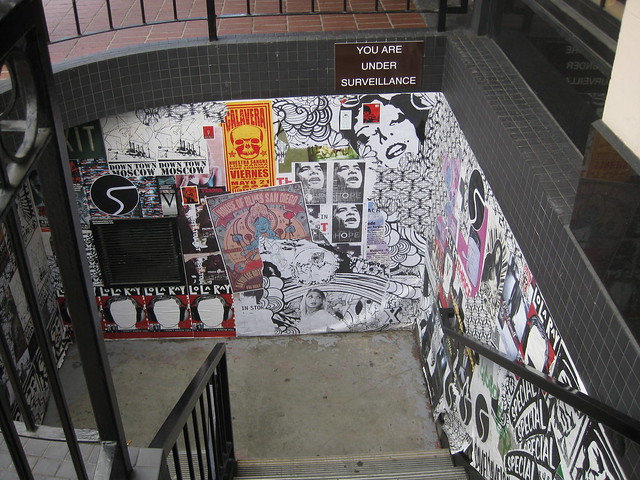
And then there was this “You Are Under Surveillance” sign. Something about the combination of the sign, the stairway, and all the posters on the walls just looked interesting.

»All pages site-wide with this tag